
When discussing innovation in American agriculture, John Deere is typically the first name that comes to mind. What began as a small workshop has grown into one of the most important firms in the agricultural industry.
This article will guide you through the John Deere company history – key leaders, and significant milestones that contributed to the development of modern agriculture.
A Few Words About John Deere Founder (1937-1886)
John Deere is the founder of Deere & Company. He was born in Rutland, Vermont, in 1804. Deere established a strong reputation as a skillful and talented blacksmith from an early age.
When the New England economy began to decline, he moved to Grand Detour, Illinois, to start again.
He soon recognized that local farmers were struggling with cast-iron plows that easily clogged in the thick, sticky soil of that place.
To solve this problem, he invented a polished steel plow that could “self-scour” from a broken saw blade in 1837.
Crowds gathered to see his innovation in action, and demand for those steel plows grew very quickly after that. This innovation marked the birth of his company. It also signaled the beginning of a new era in American agriculture.
Deere relocated its operations to Moline, Illinois, by 1848, using the Mississippi River as a source of electricity and transportation. Even though Deere died in 1886, his legacy lives on in every machine that bears his name.
Key Leaders of the John Deere Company

Many strong and talented leaders have helped shape John Deere’s history. Each provided new ideas and helped to grow the business.
Let’s start with the first leader after John Deere – his son, Charles Deere!
Charles Deere: 1886 – 1907
In 1886, the 2nd son of John Deere, Charles Deere, took over as the president of the company.
Using his sales experience, he opened the company’s first location in Kansas City. Feedback from these branches helped a lot with the development of new agricultural equipment.
By the time Charles passed away in 1907, John Deere had become one of the leading producers of farming equipment in the US thanks to his leadership.
William Butterworth: 1907 – 1928
In 1907, Charles Deere’s son-in-law, William Butterworth, became president. One big change he made was combining 25 sales offices and 11 factories. That’s what we know as Deere & Company today.
The company expanded its product line and entered the combine industry in 1912. After acquiring the Waterloo Engine Gas Company in 1918, they started producing tractors.
He joined and served as head of the U.S. Chamber of Commerce after retiring in 1928, and he died in 1936.
Charles Deere Wiman: 1928 – 1955
The next president was John Deere’s great-grandson, Charles Deere Wiman. He started out at the company as a line worker until becoming president in 1928.
He introduced the recognizable Model “A” and Model “B” tractors in 1934 and 1935. Although it was during the Great Depression at that time, his guidance enabled the company to stay strong during difficult times and achieve lasting success.
William Hewitt: 1955 – 1982
In 1955, Wiman’s son-in-law, William Hewitt, was elected president. He quickly made John Deere a global company. Under his direction, the business launched strong new tractor models and expanded the business to Europe and Mexico.
And in 1960, the “New Generation of Power” tractors were invented, making a significant step forward. This contributed to the leading role of Deere in modern farming.
Robert Hanson: 1982 – 1990
Though not a Deere family member, Robert Hanson had a significant influence. He was appointed chairman and CEO during a difficult economic time in 1982. Hanson contributed to the company’s expansion despite the economic downturn of the 1980s.
He founded John Deere Health Care, Inc. in 1985, guiding John Deere into the healthcare industry. This was a wise move to demonstrate the brand’s ability to innovate and diversify.
Hans Becherer: 1990 – 2000
Under Hans Becherer’s direction, the company embraced innovation and diversity. A separate lawn and grounds-care division was established as a result of his emphasis on diversifying into new market niches.
The company also entered key partnerships, including a long-term sponsorship with the PGA Tour and the opening of the John Deere Pavilion in 1997. All of these helped to contribute global image and reputation of Deere & Company.
Robert W. Lane: 2000 – 2009
Robert W. Lane understood what it would take to assist Deere & Company in achieving maximum global expansion. In terms of asset efficiency and return on investment, the company achieved world-class status by developing the SVA (Shareholder Value Added) model.
Not stopping there, he also updated dealer organizations and modernized historic plants across the globe to meet the market demands even better.
Samuel Allen: 2009 – 2019
Samuel Allen joined John Deere and became CEO in 1975. He led the company to global growth and strong financial success. He concentrated on precision and innovations to position Deere as a leader in global modern agriculture.
John May: 2019 – present
John May joined John Deere in 1997. He led growth in China and managed the Dubuque factory. Now, as CEO and Chairman, he drives the Smart Industrial strategy.
He focuses on using cutting-edge technology, enhancing the customer experience, and optimizing operations to serve better global industries.
John Deere: Eras of Innovation
Deere & Company has undergone significant periods of innovation and vision over nearly 2 centuries. Let’s explore 4 of the most transformative eras in John Deere company history.
1837-1852: Invention of The Steel Plow
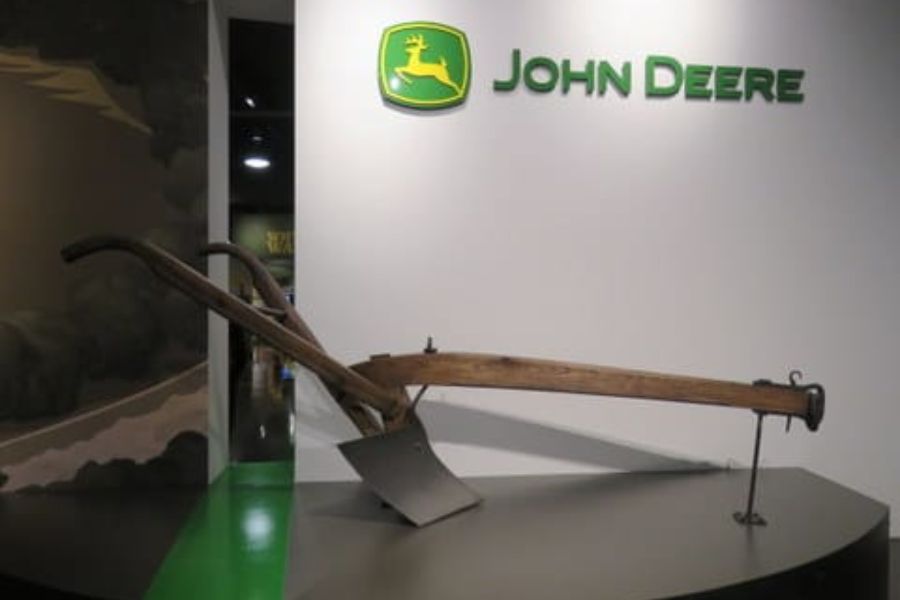
This period marks the humble yet legendary beginnings of John Deere. It all started with a steel plow. Farmers met difficulties when using traditional plows (often made of wood or cast iron) on hard, sticky soils of the Midwest.
And John Deere, a talented blacksmith, solved the problem by inventing a steel plow with a polished surface and curved shape. This allowed the soil to slide away easily instead of sticking to the moldboards as before.
The invention of the steel plow helped to solve a big problem at that time. And very quickly, the business of Deere was booming.
Significant milestones:
- 1937: John Deere used a broken saw blade to invent his first steel plow.
- 1843: Started full-time plow production after partnering with Leonard Andrus.
- 1848: Partnered with Tate and Gould and relocated the company location to Moline, Illinois.
- 1849: Opened a factory; output rapidly doubled in the first year.
- 1852: The partnership ended, and Deere became the sole owner of the business.
1910-1918: Full Product Line Launch
This period is a remarkable moment in John Deere company history. Deere & Company began producing a wide range of farming equipment rather than only plows.
Their purpose is to supply nearly everything a farmer needs, from harvesters to tractors. It meant that their ambition was to become a “full-line” equipment producer.
To accomplish that, John Deere acquired many other enterprises. Then, it merged its factories and sales branches into a more unified and powerful system. As a result, Deere expanded rapidly.
They had more than 8,500 workers by 1918, more than three times as many as in 1910. What’s even more amazing was that by 1928, half of all John Deere’s sales came from equipment they hadn’t even manufactured before 1910.
Significant milestones:
- 1910: Deere had a major transformation. They bought other businesses, merged operations to create a full product lineup.
- 1912: Preferred stock of Deere was listed on the New York Stock Exchange. By the end of the year, Deere had 24 sales offices, 15 factories, and a Moline-based export division.
- 1918: John Deere purchased The Waterloo Gasoline Engine Company for $2.25 million. This event marked their official entry into the tractor and engine industry.
1956-1964: Become a Global Brand

John Deere’s two-cylinder tractors were beginning to fall behind by the middle of the 1950s. Farmers required more advanced and powerful machines. So, the company took a bold step.
They invented a brand-new line of tractors. That was the biggest product launch at that time in their history. Consequently, by 1963, John Deere had become the market leader for agricultural and industrial equipment worldwide.
In this period, the company focused on expanding its business globally and promoting product innovation and quality.
Significant milestones:
- 1956: John Deere built a small factory in Mexico. Besides, it also bought most of Heinrich Lanz, a German company. This was one of Deere’s initial moves toward global expansion.
- 1958: In this year, Deere created a new Industrial Equipment division. It had its own dealers and made a full range of construction machines. 440 Crawler, the first bright yellow equipment, was made for this purpose.
- 1960: A big event took place – “Deere Day in Dallas”. Deere introduced to the market 4 new robust tractor models. They were designed with four- and six-cylinder engines.
- 1963: Don’t stop there, Deere continued to launch a new line – consumer products (such as mowers, snow blowers, and lawn tractors).
- 1964: Deere launched its new global headquarters in Moline, Illinois this year. The building was designed by the famous architect Eero Saarinen and became a symbol of Deere’s innovation and growth.
1987-1997: 10 Years of Transformation
John Deere celebrated its 150th anniversary in 1987. However, the company was facing a difficult time during that period.
A year earlier, during a nationwide farming recession, Deere reported a $229.3 million deficit. Employee morale was low, sales were declining, and Deere needed to do something to change all of this.
That’s why Deere started rebuilding in the same year. They implemented a new method for employee rewards that was known as “Genuine Value”.
With all the effort and improvement, little by little each year, Deere made a strong comeback. The business completely recovered by 1997, when it reported a record profit of $960.1 million.
Significant milestones:
- 1987: Deere celebrated 150 years in business after reporting a significant loss in 1986.
- 1989: Hans Becherer became the 8th CEO of Deere, taking over from Robert Hanson.
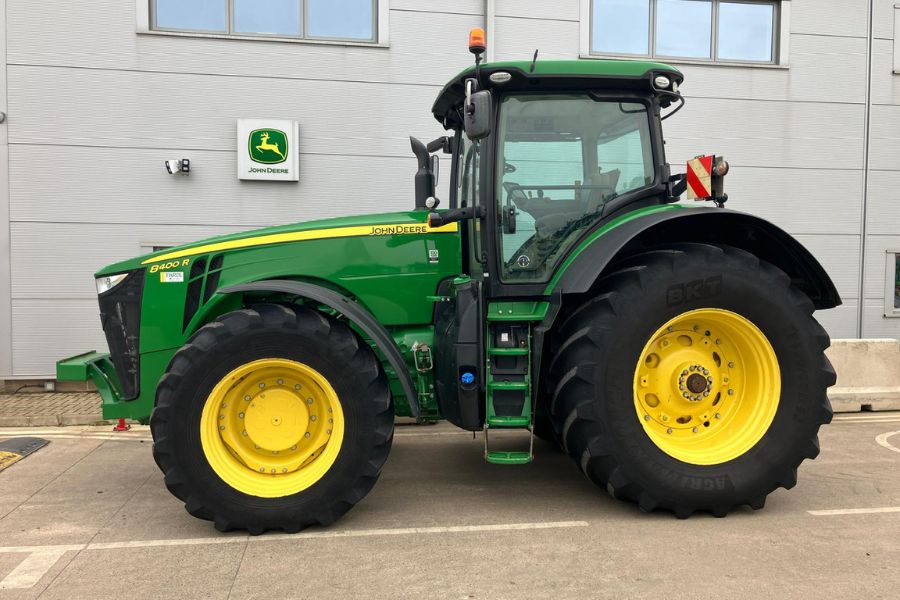
- 1994: Deere introduced the powerful 8000 Series tractors.
- 1997: With record profits of $960.1 million, Deere outperformed the previous year by 14%. The John Deere Pavilion opens in Moline.
The company also became the title sponsor of the Quad City Classic golf tournament and the official supplier of equipment for the PGA Tour.
2022 – Introduce Autonomous Tractors
John Deere introduced its first completely autonomous tractor. It is equipped with advanced technology (AI, GPS, and advanced sensors), allowing it to operate without a driver.
Farmers to monitor and control the tractor from a remote location via a smartphone app. This milestone demonstrates John Deere’s continuous dedication to smart farming and sustainable development.
Where Is The John Deere Factory Located?
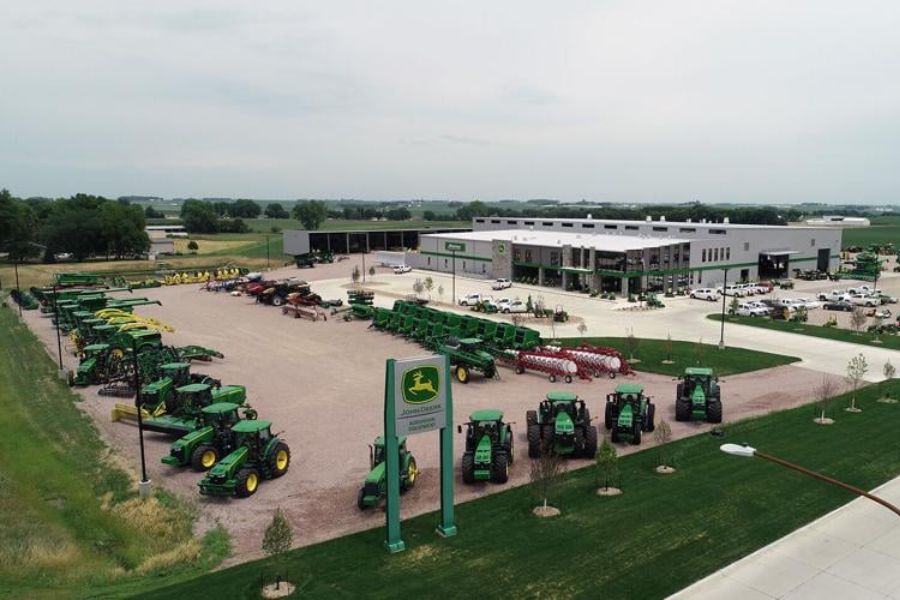
With over 100 factories across over 30 countries, John Deere has become a global brand. These factories are designed to meet consumer demands – whether it’s farming, construction, lawn care, or forestry.
Let’s take a look at some of the most important factory sites in John Deere company history:
1848 – The company relocated from Grand Detour to Moline in Illinois. Better transportation and water power were available in this new location. It was essential for future expansion.
1887 – The Deere & Mansur division moved to a larger plant in Moline due to an increasing demand for planters.
1913 – A brand-new harvesting equipment factory opened. Later on, this evolved into the John Deere Harvester Works. It continues to operate today and produces S-Series combines.
1918 – John Deere purchased the Waterloo Gas Engine Company this year and entered the tractor industry. In its first year of operation, this factory produced almost 5,000 tractors, making it a huge success.
1947 – After opening, the Dubuque Works facility emerged as a major location for the production of forestry and construction equipment.
1948 – After World War II, Deere purchased a part of an old ammunition factory and converted it into the Des Moines Works. This is now renowned for producing cotton-harvesting, spraying, and planting equipment.
Bottom Line
Through the John Deere company history, we see that it has truly stood the test of time. It grew from a little blacksmith shop in Illinois to more than 100 facilities worldwide today.
From a single plow, the company has expanded to become a favorite name brand in forestry, construction, and agriculture. John Deere will likely stay at the forefront as long as there is land to cultivate and food to grow.



Leave a Reply