
News
Dimensions of Bale of Hay: Small vs. Large Bales Compared
Nov
Whether you have a small farm or a large livestock operation, it’s important to understand the different dimensions of bale of hay. Its size will impact how it is stored, fed, or handled.
It will help to save you time, effort, and space when choosing the right sizes of hay bales. We will break down the different types and sizes of hay bales to see which will be most suitable for your requirements.
The Importance of the Dimensions of Bale of Hay
The size of the hay bale has a significant impact on how farmers use, store, and transport their hay. Smaller bales are perfect for backyard cattle, ponies, and small farms. This is because they are simple to handle and move by hand.
On the other hand, larger bales are ideal for large operations that use machines to handle those heavy loads.
The dimensions of bale of hay also impact the feeding management. Your animals will have fresh hay longer, and minimize waste.
Different Types of Hay Bales
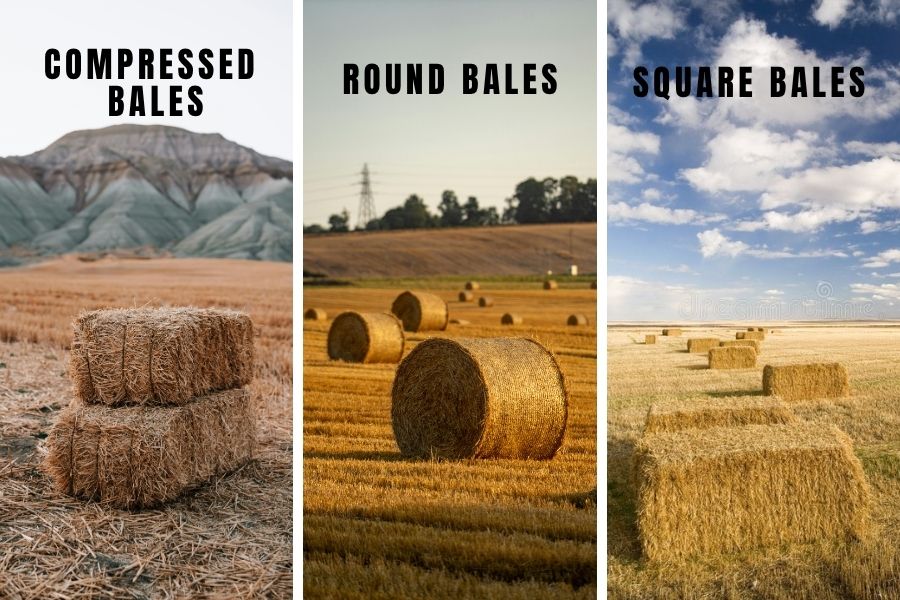
Hay bales come in a variety of forms. Square, round, and compressed bales are the most 3 popular types.
Square Bales
This is the traditional option for small farms and stables. They are lightweight, stackable, and easy to feed out by hand. These bales usually come in small two-string or three-string sizes.
Round Bales
Round bales can weigh hundreds of pounds and are ideal for large-scale operations. They are bigger and heavier than square types. You need to use loaders or tractors to move and store those round bales.
Compressed Bales
These bales are suitable for farms with small storage space or for export. They are tightly packed to save space and make transportation easier.
Dimensions of Small Hay Bales
Small hay bales are a perfect choice for farmers or livestock owners who just need to feed a few animals. They are lightweight and can be moved around by hand.
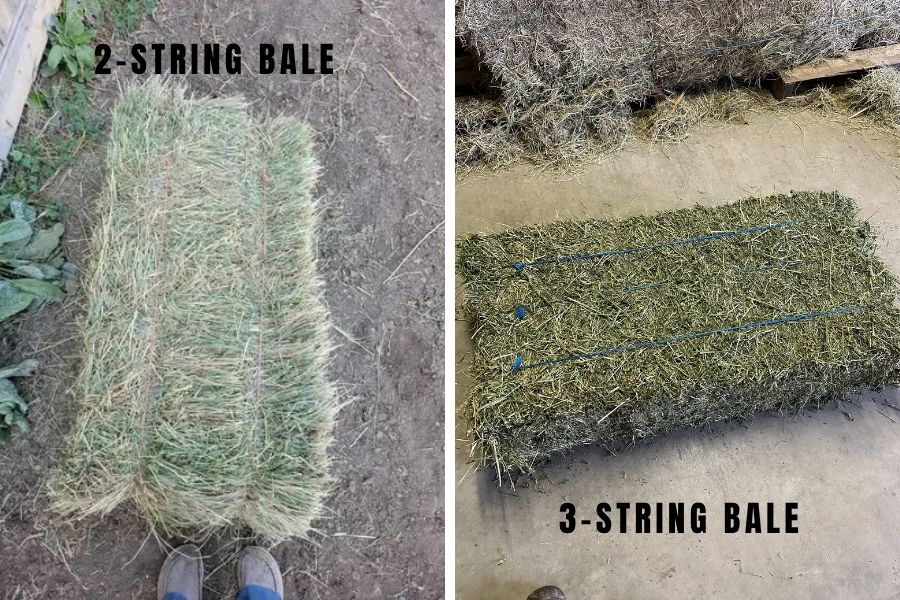
The dimension of small bales depends on the number of strings used to tie them. Two or three-string hay bales are the most common.
Two-string Hay Bales
Two-string hay bales are the most common type you can find on small farms. They usually weigh between 50 and 60 pounds. They have dimensions of approximately 14 inches high x 18 inches wide x 35 inches long.
These bales are perfect for daily feeding. 10 to 12 two-string bales are equal to one large round bale. This makes them a practical option for reducing waste.
Three-string Hay Bales
Three-string bales are perfect for those who need to store more hay but still want manageable sizes. They typically weigh 100 pounds and have dimensions of around 16 inches high x 22 inches broad x 44 inches long.
Farmers can modify the baler’s settings to get the perfect size for stacking or storage requirements.
Dimensions of Large Hay Bales
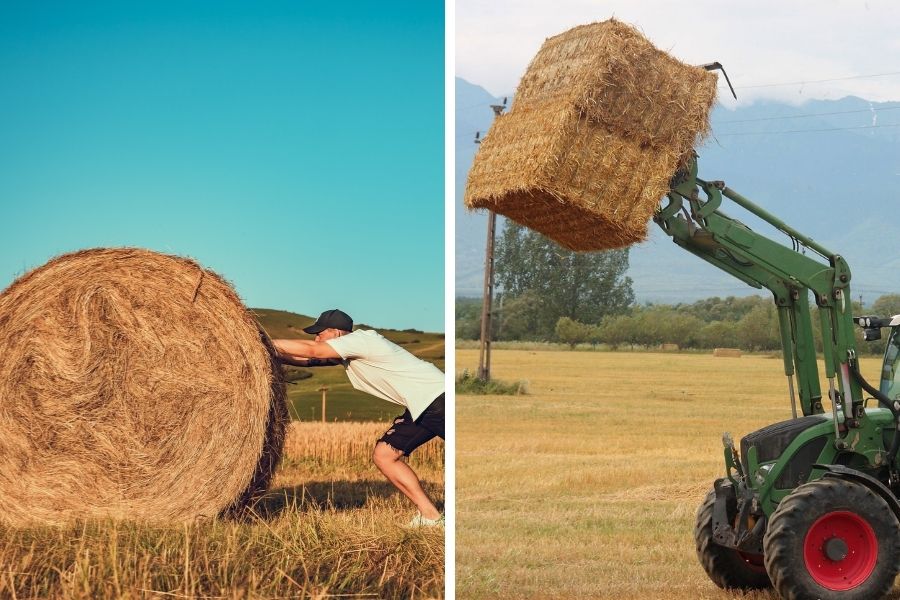
Large bales of hay are often the most common choice for those who run larger farms or feed a large number of animals. They minimize effort, reduce handling time, and are perfect for mechanical storage and transportation.
Square and round shapes are the 2 main shapes of these bales. Each has special advantages based on the feeding setup and equipment.
Large Round Hay Bales
Most large farms with open feeding grounds prefer to use large round hay bales. A typical round bale weighs about 1,500 pounds and measures 5 ft x 6 ft.
If each cow eats roughly 32.5 pounds a day, five 5×6 bales may feed about 30 cows per week. It means that these bales can feed many animals at once.
Because of their design, they are easy to roll, feed, and store outside with less chance of spoiling.
Large Square Hay Bales
These hay bales are square in shape, making them perfect for stacking, storage, transportation, or large-scale feeding. That’s why they are common among commercial farmers.
Depending on the baler, typical sizes are 3 x 3 x 8 ft, 3 x 4 x 8 ft, or 4 x 4 x 8 ft. They can weigh anywhere between 800 and 1,400 pounds. This depends on moisture content and density.
Conclusion
You’ve learned about different dimensions of bale of hay. Farmers or livestock owners can make smarter feeding and storage decisions when choosing the right hay sizes.
You will get the most value from each bale just by choosing the right one.