
News
John Deere Combine Harvester History: What Made Each Era Unique
Aug
John Deere combine harvester history is a great story of constant innovation. This company has been helping farmers worldwide in increasing productivity since inventing the first steel plow in 1837.
Their state-of-the-art cotton pickers, headers, and combines guarantee that every crop is collected precisely during harvest season, from planting to harvesting.
Iconic Milestones of John Deere Combine Harvester History
In this part, we’ll go through the memorable milestones in the history of John Deere combine harvesters. It is a wonderful and proud journey that is worth learning and understanding.
Early Beginnings (1909–1914)
John Deere entered the combine and harvester market by starting to produce binders in Canada in 1909. They made 500 binders for the 1911 harvest season by 1910. That site is now the Harvester Works facility, located in East Moline, Illinois.
They formally started construction on this site in 1912. More than 33,000 horse-drawn machines, including corn binders, grain binders, and mowers, were manufactured during World War I to assist farmers during challenging times.
Rise of the Combine (1927–1939)
In 1927, the John Deere company released the No. 2, its first combine harvester. This model combined threshing and harvesting in a single step.
By 1934, Harvester Works had expanded to more than 1.16 million square feet, even with underground tunnels.
In 1935, John Deere purchased the No. 36 hillside combine. This increased the ability for farmers to operate on slopes up to 50%.
The Model 11A and 12A were introduced in 1939. The 12A model went on to become a best-seller, with over 116,000 units sold in the next ten years.
Self-Propelled Innovation (1947–1957)
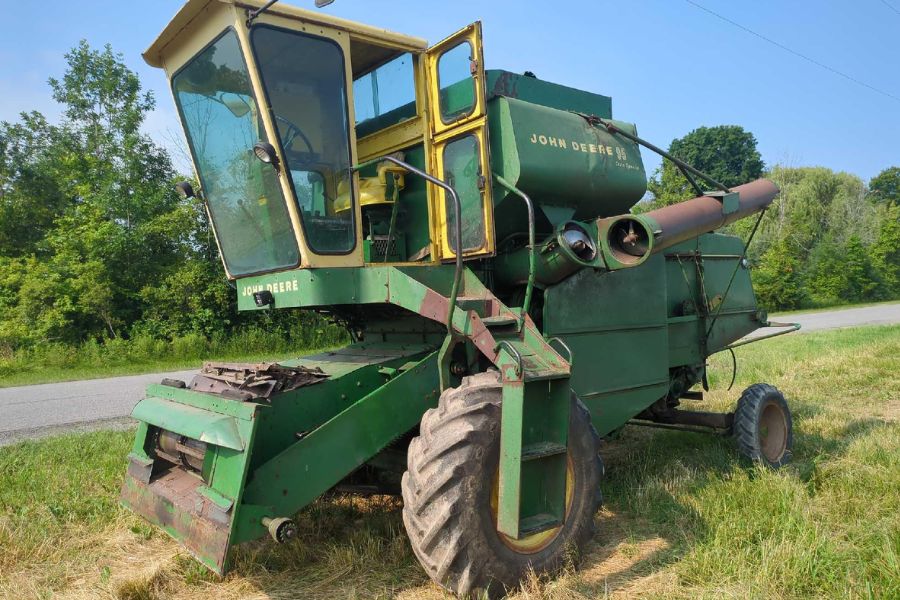
In 1947, John Deere debuted its first self-propelled type, the No. 55 Combine. And in 1954, the groundbreaking No. 10 model was introduced to the market.
Farmers could harvest, shell, and clean all at once up to 20 acres of corn a day thanks to No. 10. Later on, it earned a Historic Landmark Award.
And then in 1957, model 95 was first launched to the market. It was quickly the biggest self-propelled combine in the world, with more than 39,000 units produced through 1969.
Efficiency & Versatility (1970–1979)
Significant improvements came in the 1970s. The Quick-Tatch header system was a feature of the New Generation combines, which were first introduced in 1970.
This allowed farmers to switch quickly between headers for various crops. In 1979, the company introduced the first four-row cotton picker, increasing cotton field output by up to 85%.
Leadership & Legacy (1989–2012)
By 1989, John Deere became the top combine brand in North America with its Maximizer line.
One year later, in 1999, the company released the STS combine. This one featured cutting-edge rotor technology for improved grain handling and smoother operation.
In 2007, the 70s Series Combines made their debut, producing 265–440 horsepower. The company celebrated a significant milestone in 2010 – 500,000 self-propelled combines were produced in this year.
Harvester Works celebrated its 100th anniversary in 2012, two years later.
Modern John Deere Combines & Harvest Machines
For over 100 years, John Deere has been creating harvest equipment that evolves with the needs of modern farming.
Modern combines and attachments enable farmers to save time, minimize crop waste, and make quick data-driven decisions.
Let’s explore some of the remarkable machines invented throughout John Deere combine harvester history.
S-Series Combines
The S-Series Combines of John Deere are designed to perform well in a variety of crops and environmental conditions. They can handle any crop, such as canola, soybeans, corn, and wheat.
They can gently separate grain while retaining maximum efficiency thanks to sophisticated rotary threshing technologies. Apps like MyOperations, Connect Mobile, and GoHarvest can integrate seamlessly with the equipment.
This gives farmers access to real-time updates and insightful information through their devices. Large grain tanks to reduce unloading stops, strong harvest automation, and user-friendly controls are other features of these combines.
John Deere T670 Combine
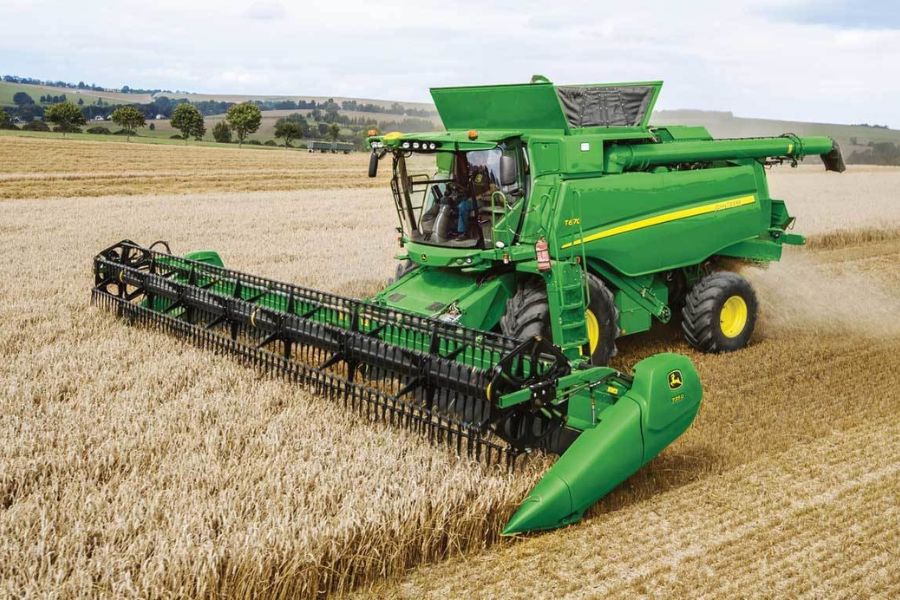
The T670 Combine is designed for high performance, particularly while harvesting tiny grains. It helps you get more clean grain faster than ever because it has one of the biggest active separation areas available.
The single-point feederhouse latch makes easy and rapid attachment switching. With features like the mass-flow sensor and in-cab reel resume, operators can adjust quickly as field conditions change.
Strong capacity, dependable separation, and tools to enhance harvesting quality are all included with the T670.
A Selection of Corn Heads
The purpose of John Deere corn heads is to simplify and improve the efficiency of corn harvesting. Knife stalk rollers are included for improved stalk cutting and cleaner fields.
Even under challenging conditions, the AutoTrac RowSense feature automatically steers you to stay precisely in line with the rows. Harvesting will be more effective and less taxing as a result.
John Deere offers many models, such as 706C, 712C, 716C, and 718C, to serve different farm sizes and requirements. There is a John Deere corn head to suit your operation, whether you like folding frames or more rows.
700 Series Draper Platforms

John Deere draper platforms help farmers cut crops fast and clean. The machines are designed with a timed dual knife drive, which remains smooth cutting even at high rates.
The low-profile cutterbar hugs the ground, giving the lowest possible cut height. This is perfect for short or fallen crops as well as lowers crop loss and enhances feeding.
Models like the 725D, 730FD, 735D, 735FD, 740D, 740FD, or 745FD are suitable options for hardy crops like canola. These drapers work in perfect harmony with John Deere combines to increase harvest production.
600 Series Platforms
John Deere’s Model HydraFlexTM Platforms 600 Series are designed to integrate smoothly with S-Series Combines. The 620F, 625F, 630F, 622F, and 635F are among the models.
The HydraFlexTM system increases overall harvest efficiency by enhancing feeding and minimizing grain loss. These platforms are designed for speed and accuracy, regardless of whether you’re working with small grains or soybeans.
Farmers who wish to reduce field downtime and improve cutting performance would opt for them.
John Deere 615P Belt Pickup Platform
The 615P Belt Pickup Platform is designed to feed windrowed crops neatly and evenly. It can move material easily with a dual-belt draper. A suspension system called FieldGlideTM for improved ground following.
In uneven fields, these features help to increase efficiency and decrease crop loss. It’s a reliable option for more accurate and easier harvesting of small grains.
Cotton Series for Harvesting
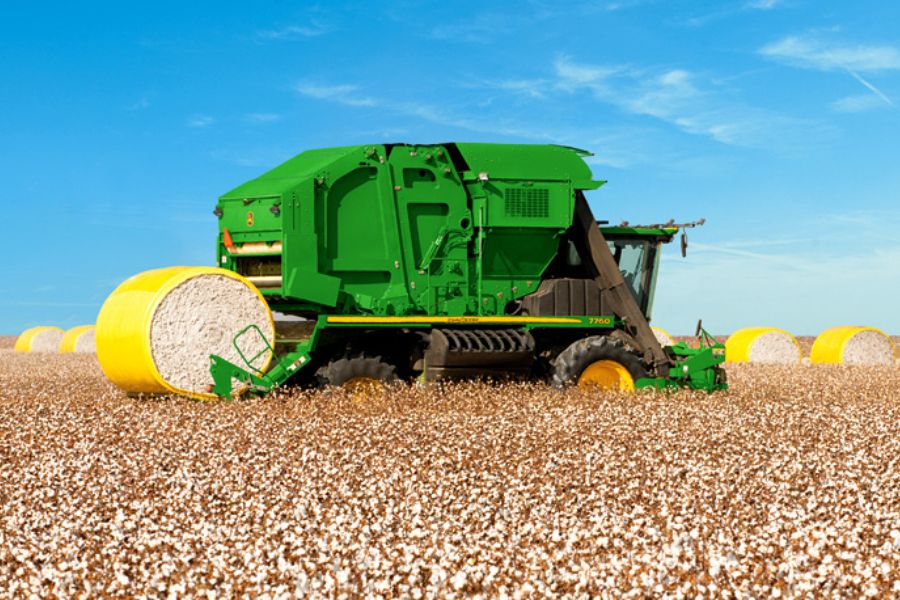
John Deere offers several machines for a smooth and efficient cotton harvest. The CS690 Cotton Stripper and CP690 Cotton Picker increase productivity while preserving good fiber quality.
Cotton can be transported more quickly and easily using the CM11 Cotton Module Handler. When combined, these tools provide farmers with intelligent, reliable performance from field to module.
CH570 Sugar Cane Harvester
Less waste and cleaner harvesting are the goals of the CH570 sugar cane harvester. By providing a consistent and even feed, its front end lowers soil input and cane loss.
It also includes smart tech tools to help sugarcane growers monitor performance and make better decisions. This harvester is perfect for increasing productivity and reducing manual work.
Bottom Line
John Deere combine harvester history – as you can see – never stops being innovative to meet the needs of farmers. Operators can harvest more quickly, cut waste, and preserve crop quality with smart features for almost any crop.
John Deere has a harvesting solution designed for your farm, regardless of whether you grow corn, cotton, sugarcane, or grain.