Description
-
Model List:
- 848G Skidder
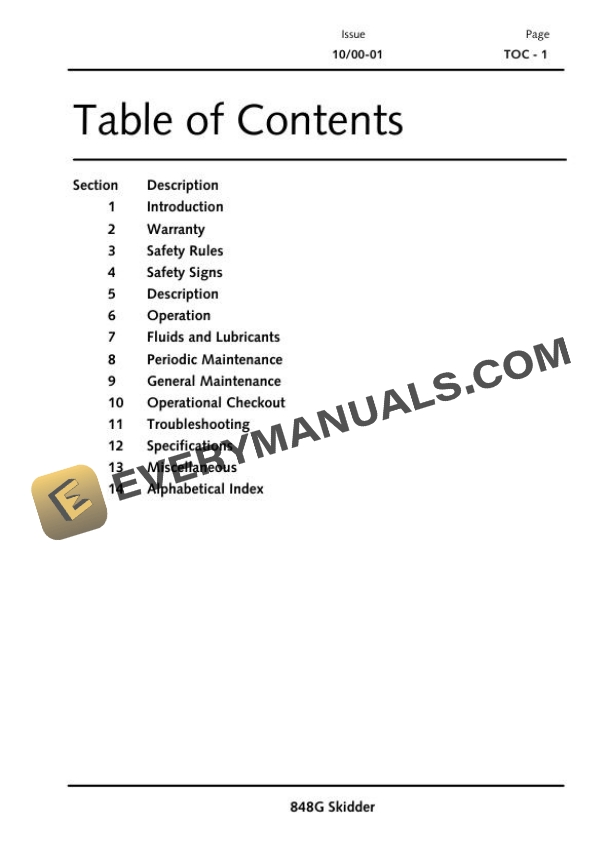
- 1. Table of Contents
- 2. Introduction
- 2.1. Foreword
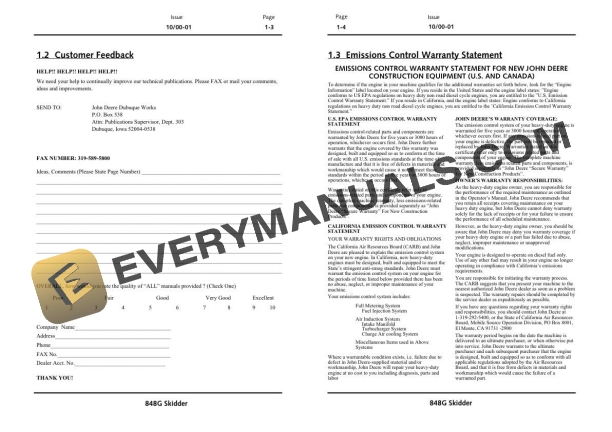
- 2.2. Customer Feedback
- 2.3. Emissions Control Warranty Statement
- 2.4. Model and Serial Number Record
- 2.5. Modifications or Repairs to Rollover Protective Structures (ROPS)
- 2.6. Nonapproved Field Product Changes
- 3. Warranty
- 3.1. Warranty
- 4. Safety Rules
- 4.1. Skidder Safety Features
- 4.2. General
- 4.3. Safety Symbol
- 4.4. Understanding Signal Words
- 4.5. General Safety Precautions
- 4.6. Operating Safety Precautions
- 4.7. Servicing Safety Precautions
- 4.8. Transporting on Public Roads
- 4.9. Fire Prevention
- 4.10. What to Do if the Machine Catches Fire
- 5. Safety Signs
- 5.1. Safety Signs
- 5.1.1. Skidder Safety Decals
- 6. Description
- 6.1. Introduction
- 6.2. Equipment Nomenclature
- 6.2.1. Dual Arch Grapple Skidder Major Components
- 6.2.2. Dual Arch Grapple Skidder Major Components
- 6.3. Controls and Instrumentation
- 6.3.1. Operator Controls and Instruments
- 6.3.2. Monitor Instrument Panel
- 6.3.3. Switches and Indicators
- 6.3.4. Driving/Operating Controls
- 6.3.5. Safety Items
- 6.3.6. Miscellaneous Items
- 7. Operation
- 7.1. Driving the Skidder
- 7.1.1. Prestart checks
- 7.1.2. Before Starting The Engine
- 7.1.3. Starting the Engine
- 7.1.4. Stopping the Engine
- 7.1.5. Reducing Engine Load
- 7.1.6. Engine Breakin Procedure
- 7.1.7. Operating the Transmission
- 7.1.8. Operating the Driving Controls
- 7.2. Using the Implements
- 7.2.1. Operating the Decking Blade
- 7.2.2. Operating the Winch
- 7.2.3. Fairlead Position
- 7.2.4. Operating the Dual Arch Grapple
- 7.3. Skidding Technique
- 7.3.1. Cable Skidding
- 7.3.2. Grapple Skidding
- 7.4. Roading the Skidder
- 7.5. Transporting the Skidder
- 7.6. Towing the Skidder
- 7.6.1. Towing Very Short Distances
- 7.6.2. Manual Parking Brake Release
- 7.6.3. Towing Procedure General
- 7.7. Tilting the Cab
- 7.7.1. Raising the Cab
- 7.7.2. Lowering the Cab
- 7.8. Using Booster Batteries
- 7.9. Storage
- 8. Fluids and Lubricants
- 8.1. Fluids and Lubricants Specifications
- 8.2. Recommended Fluids and Lubricants
- 8.2.1. Breakin Oil
- 8.2.2. Diesel Engine Oil
- 8.2.3. Transmission/Winch Oil
- 8.2.4. Axle Oil
- 8.2.5. Hydraulic System Oil
- 8.2.6. Diesel Fuel
- 8.2.7. Grease
- 8.2.8. Engine Coolant
- 8.2.9. Sampling Programs
- 8.2.10. Supllemental Coolant Additives
- 8.2.11. Testing Engine Coolant
- 8.2.12. Replenishing Supplemental Coolant Additives (SCAs) Between Coolant Changes
- 8.2.13. Disposing of Coolant
- 8.2.14. Water Tank
- 8.2.15. Lubricants General
- 9. Periodic Maintenance
- 9.1. Maintenance Preparation
- 9.2. Engine Break in Period
- 9.3. Periodic Maintenance Schedule
- 9.4. Periodic Maintenance Procedures
- 9.4.1. Maintenance 8 Hours
- 9.4.2. Maintenance 50 Hours
- 9.4.3. Maintenance 250 Hours
- 9.4.4. Maintenance 500 Hours
- 9.4.5. Maintenance 1000 Hours
- 9.4.6. Maintenance 2000 Hours
- 9.4.7. Maintenance 3000 Hours
- 9.4.8. Unscheduled Maintenance
- 9.5. Periodic Maintenance Checklist
- 10. General Maintenace
- 10.1. Maintenance Preparation
- 10.2. General Maintenance Procedures
- 10.2.1. Checking and replacing the Engine Torsional Damper
- 10.2.2. Cleaning the Crankcase Vent Tube
- 10.2.3. Bleed Fuel System
- 10.2.4. Servicing the Batteries
- 10.2.5. Welding on Machine
- 10.2.6. Replacing Fuses
- 10.2.7. Inspecting the Air Conditioning System
- 10.2.8. Winch BRAKE OFF Adjustment
- 10.2.9. Accelerator Pedal Adjustment
- 10.2.10. Service Brake Pedal Adjustment
- 10.2.11. Checking/Cleaning Windows
- 10.2.12. Fastener Torque Recommendations
- 10.2.13. Hydraulic Fittings Torque Recommendations
- 11. Operational Checkout
- 11.1. Operational Checkout
- 11.1.1. Controls and Instrumentation
- 11.1.2. Brakes
- 11.1.3. Driving
- 11.1.4. Hydraulic Functions
- 11.1.5. Winch
- 11.1.6. Accessories
- 11.1.7. ROPS and Compartment
- 11.1.8. Miscellaneous Checks
- 12. Troubleshooting
- 12.1. General Troubleshooting
- 12.2. Engine Troubleshooting
- 12.3. Electrical System Troubleshooting
- 12.4. Transmission Troubleshooting
- 12.4.1. Transmission
- 12.4.2. Transmission Controller
- 12.4.3. Brake System Troubleshooting
- 12.4.3.1. Service Brake
- 12.4.3.2. Parking Brake
- 12.4.4. Drivetrain Troubleshooting
- 12.4.5. Hydraulic System Troubleshooting
- 12.4.5.1. Hydraulic Pump
- 12.4.5.2. Hydraulic Cylinders
- 12.4.5.3. Steering
- 12.4.5.4. Implements (Decking Blade, Arch, Grapple)
- 12.4.6. Winch Troubleshooting
- 12.4.7. Miscellaneous Troubleshooting
- 12.4.7.1. Cab Heater
- 12.4.7.2. Air Conditioning System
- 13. Specifications
- 13.1. Dimensions 848G Dual Arch Grapple Skidder
- 13.2. Grapple head Dimensions
- 13.3. Equipment Specifications
- 13.3.1. Power Train
- 13.3.2. Cooling System
- 13.3.3. Engine Air Intake and Exhaust
- 13.3.4. Fuel System
- 13.3.5. Electrical System
- 13.3.6. Brake System
- 13.3.7. Hydraulic System
- 13.3.8. Winch
- 13.3.9. Miscellaneous
- 14. Miscellaneous
- 14.1. Measurement Conversions
- 14.1.1. Miscellaneous Conversions
- 14.1.2. Metric and Imperial Unit Expressions
- 14.2. Wood Measurement Equivalents
- 14.3. Weights of Commercially Important Woods
- 14.4. General Bolt Torque Values
- 14.5. Crime Prevention Tips
- 14.6. Periodic Maintenance Checklist
- 14.7. John Deere Service Literature Available
- 14.8. John Deere Service Keeps You on the Job