Description
-
Model List:
- Timberjack 1270C Harvester
- 1. Introduction
- 1.1. General
- 1.2. Location of rating plates and serial numbers
- 1.3. Timberjack authorized dealers and service centers
- 1.4. Timberjack Continental Distribution Centers
- 2. Warranty
- 2.1. Warranty service
- 3. Safety instructions
- 3.1. Safety symbol
- 3.1.1. Significance of warnings
- 3.2. General safety rules
- 3.2.1. Boarding the machine
- 3.3. Operating safety precautions
- 3.3.1. Alarms
- 3.3.2. Emergency exits
- 3.3.3. Driving on frozen waters
- 3.3.4. Power cables
- 3.3.5. Driving on public roads and other transport driving
- 3.4. Servicing safety precautions
- 3.5. Fire prevention
- 3.5.1. What to do if the machine catches fire
- 4. Cabin and controls
- 4.1. Main switch
- 4.2. Control lights
- 4.2.1. Warning lamps and beeper on the roof
- 4.3. Dashboard
- 4.3.1. Ignition switch
- 4.3.2. Window wipers and washers
- 4.4. Control panels
- 4.4.1. Crane control levers
- 4.5. Timberjack 3000, functions
- 4.6. Air conditioner
- 4.6.1. Operation instructions
- 4.7. Pedals
- 4.8. Adjusting the operators seat
- 5. Operating instructions
- 5.1. Operation
- 5.1.1. Safety switches
- 5.1.2. Emergency stop
- 5.1.3. Crane
- 5.1.4. Brakes
- 5.1.5. Steering
- 5.1.6. High/low gear and front wheel drive
- 5.1.7. Differential locks
- 5.1.8. Frame brake
- 5.2. Driving
- 5.2.1. Before starting the engine for the first time in a working day
- 5.2.2. Operating the engine
- 5.2.3. Offroad driving
- 5.2.4. Onroad driving
- 5.3. Transporting the machine
- 5.4. Towing the machine
- 6. Maintenance
- 6.1. Servicing safety precautions
- 6.2. General maintenance instructions
- 6.2.1. Assembly instructions
- 6.2.2. Tightening torque for bolted joints
- 6.2.3. Welding instructions
- 6.2.4. Instructions for cleaning of Lexan/Marguard windows
- 6.3. Wheels
- 6.3.1. Changing wheels
- 6.3.2. Antislip fitting
- 6.3.3. Bogie tracks, fitting
- 6.4. Recommended lubricants and fluids
- 6.4.1. Capacities
- 6.4.2. Diesel fuel
- 6.4.3. Engine oil
- 6.4.4. Coolant
- 6.4.5. Grease
- 6.4.6. Hydraulic oil
- 6.4.7. Brake fluid
- 6.4.8. Gear oil
- 6.5. Maintenance intervals
- 6.6. Detailed maintenance
- 6.6.1. Daily maintenance or every 10 hours
- 6.6.2. Weekly maintenance or every 50 hours
- 6.6.3. Maintenance after every 250 hours
- 6.6.4. Maintenance after every 500 hours
- 6.6.5. Maintenance after every 1000 hours
- 6.6.6. Maintenance after every 2000 hours
- 6.6.7. Maintenance after every six months
- 6.6.8. Annual maintenance
- 6.7. Maintenance of the crane
- 6.7.1. Daily maintenance or every 10 hours
- 6.7.2. Weekly maintenance or every 50 hours
- 6.7.3. Maintenance after every 250 hours
- 6.7.4. Maintenance after every 1000 hours
- 6.7.5. Maintenance after every 2000 hours
- 6.8. When necessary, service and adjust the following
- 6.8.1. How to eliminate air from the fuel system
- 7. Hydraulic system
- 7.1. Working hydraulic system
- 7.2. Hydrostatic system
- 7.3. Hydraulic tank
- 7.3.1. Filling with hydraulic fluid
- 7.3.2. Draining the hydraulic fluid
- 7.4. Vacuum pump
- 7.5. How to bleed air from the hydraulic system 29 30
- 7.5.1. How to bleed air from the hydrostatic system
- 7.5.2. How to bleed air from the working hydraulic system
- 7.5.3. Bleeding the brakes
- 7.6. Check and adjust the hydrostatic system
- 7.6.1. Supply pressure on the drive pump
- 7.6.2. Drive pressure
- 7.6.3. Drive motor
- 7.7. Working hydraulics how to check and adjust the pressures
- 7.7.1. Adjustment of the stairs valve
- 7.7.2. Pilot pressure, working hydraulics
- 7.7.3. LS pressure, working hydraulics
- 7.7.4. The backpressure valve of the crane tank line
- 7.7.5. Maximum pressure of the working hydraulic pump
- 7.7.6. Pressure difference p
- 7.7.7. Constant pressure valve
- 7.7.8. Main pressure relief valve
- 7.8. How to check and adjust the brake system
- 7.8.1. Checking the brakes
- 7.8.2. Mechanical adjustment of brakes
- 7.8.3. Checking the drive brake
- 7.8.4. Checking the service brake
- 7.8.5. Checking the load and release range
- 7.8.6. Checking the relief valve of the brake charging pressure
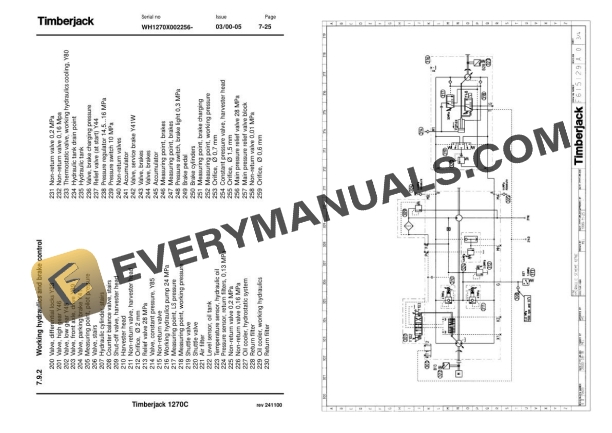
- 7.9. Hydraulic scheme
- 8. Electrical system
- 8.1. Batteries
- 8.1.1. Using booster batteries
- 8.2. Main switch andfuses
- 8.2.1. Fuse box F1
- 8.2.2. Fuse box F2
- 8.3. Sensors of the machine
- 8.4. Repair welding
- 8.5. Electrical scheme
- 9. Transmission
- 9.1. Hydrostatic system
- 9.2. Control of transmission
- 9.3. Brakes
- 10. Crane
- 10.1. General description of the crane
- 10.2. Operating safety precautions
- 10.3. General operating instructions
- 10.4. Technical data
- 10.4.1. Tj 210 H 97
- 10.4.2. Tj 210 H 83
- 10.4.3. Rotator
- 11. Equipment
- 11.1. Air conditioner
- 11.1.1. Danger and precautions
- 11.1.2. Configuration and location of the air conditioner
- 11.1.3. Maintenance of the air conditioner
- 11.1.4. Troubleshooting the air conditioner
- 11.2. Engine and cabin preheater
- 11.2.1. General
- 11.2.2. Maintenance of the engine preheater
- 11.2.3. Timer for engine and cabin preheater
- 11.3. Fire extinguisher system
- 11.3.1. Control unit
- 11.4. Handheld fire extinguishers
- 11.5. Stump treatment system
- 12. Technical data