
Description
-
Model List:
- H215E Harvester Head
- 1. Table of Contents
- 2. Foreword
- 2.1. Copyright
- 2.2. Foreword
- 2.3. Declaration of Incorporation
- 2.4. General assembly instructions
- 2.5. Product identification
- 2.5.1. Identification plates
- 2.6. Base machine requirements
- 2.7. General hydraulic system requirements
- 2.8. Standard warranty
- 3. Safety
- 3.1. Follow Laws and Regulations
- 3.1.1. Recognize Safety Information
- 3.1.2. Understand Signal Words
- 3.1.3. Prepare for Emergencies
- 3.1.4. Wear Protective Clothing
- 3.1.5. Handle Chemical Products Safely
- 3.1.6. Cabin protective structures
- 3.2. Operating the harvester head
- 3.2.1. Attach Do not Operate Tag
- 3.2.2. Pay Attention to Bystanders
- 3.2.3. Operate the Boom Safely
- 3.2.4. Keep Danger Zone Clear
- 3.2.5. Avoid saw chain shots
- 3.2.6. Avoid Crush Points
- 3.2.7. Avoid Power Lines
- 3.2.8. What To Do If the Machine Catches Fire
- 3.2.9. After a fire
- 3.3. Maintenance
- 3.3.1. Keep Machine in Good Condition
- 3.3.2. Use Proper Clothing
- 3.3.3. Use Proper Tools
- 3.3.4. Support Machine Properly
- 3.3.5. Avoid High Pressure Fluids
- 3.3.6. Avoid Heating near Pressurized Fluid Lines
- 3.3.7. Make Welding Repairs Safely
- 3.3.8. Dispose of Waste Properly
- 3.4. Safety Decal Locations
- 4. Specifications
- 4.1. Harvester head brochure
- 4.2. Harvester head components (H215E)
- 5. Transportation and storage
- 5.1. Preparing for storage
- 5.2. Transport by road
- 5.3. Transport by trailer
- 6. Harvesting instructions
- 6.1. Planning the work
- 6.1.1. Example of map sketch
- 6.2. Thinning
- 6.2.1. Thinning with harvester alone
- 6.2.2. Thinning with harvester and chain saw
- 6.2.3. Thinning between logging roads
- 6.3. Regeneration harvesting
- 6.3.1. Felling into trees
- 6.3.2. Felling outwards from the stand
- 6.3.3. Felling in both directions
- 6.4. Felling
- 6.4.1. Felling stage
- 6.4.2. Felling on slope
- 6.4.3. Felling trees with large roots
- 6.4.4. Root sets
- 6.5. Delimbing and crosscutting
- 7. Systems and Components
- 7.1. Frame
- 7.1.1. Bushing protection
- 7.2. Delimbing and debarking knives
- 7.2.1. Debarking quality
- 7.2.2. Knives cylinders
- 7.3. Debarking feed rollers
- 7.3.1. Feed roller arms
- 7.4. Diameter measuring device, cylinderintegrated
- 7.5. Saw unit
- 7.5.1. Saw feeding mechanism
- 7.5.2. Saw chains and saw bars (SuperCut 100S)
- 7.5.3. Chain lubrication system
- 7.5.4. Chain oil tank
- 7.5.5. Saw sensor
- 7.5.6. Chain shot guard
- 7.6. Length measuring device (H215E)
- 7.6.1. Length measuring sensor
- 7.7. Hydraulic system
- 7.7.1. EVO3 (H215E) harvester head valve
- 7.7.1.1. Hydraulic functions
- 7.7.1.2. EVO3 connectors
- 7.7.1.3. HHC (L22) connectors (H215E)
- 7.7.2. Hydraulic hoses
- 7.7.2.1. Knife cylinder hoses
- 7.7.2.2. Feeding hoses
- 7.8. Stump treatment
- 7.9. Tutorial videos for main harvester head components
- 8. Maintenance
- 8.1. General
- 8.1.1. Preparations
- 8.1.2. Welding instructions
- 8.1.3. Special tools
- 8.1.3.1. Extractor tool for Deutsch connectors
- 8.1.3.2. Saw motor puller tool
- 8.1.3.3. Assembly tool for feed cylinder piston gasket
- 8.1.3.4. Chain tensioning check valve installation tool
- 8.1.3.5. Check valve installation tool
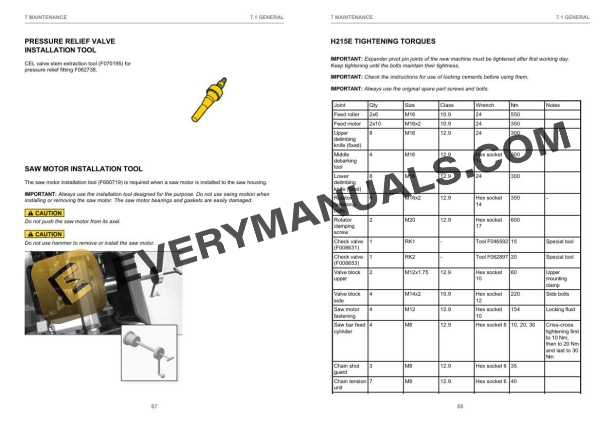
- 8.1.3.6. Pressure relief valve installation tool
- 8.1.3.7. Saw motor installation tool
- 8.1.4. H215E tightening torques
- 8.1.5. Conical sleeve pin tightening
- 8.1.6. Fluids and lubricants
- 8.1.7. Tutorial video for harvester head daily maintenance
- 8.2. Service intervals
- 8.3. Every 25 hours
- 8.3.1. Check diameter measuring device
- 8.3.2. Check chain lubrication system
- 8.3.3. Grease right side of head
- 8.3.3.1. Upper delimbing knife
- 8.3.3.2. Feed roller arm
- 8.3.3.3. Lower delimbing knife
- 8.3.3.4. Tilt
- 8.3.4. Grease left side of head
- 8.3.4.1. Upper delimbing knife
- 8.3.4.2. Feed roller arm
- 8.3.4.3. Lower delimbing knife
- 8.3.4.4. Tilt
- 8.3.5. Grease length measuring device
- 8.3.6. Grease saw unit
- 8.3.7. Fill chain oil tank
- 8.4. Every 50 hours
- 8.4.1. Grease rotator and link
- 8.4.2. Check rotator screws
- 8.4.3. Grease the bar holder (SuperCut 100S)
- 8.5. Every 250 hours
- 8.5.1. Check cylinders, protection covers and hoses.
- 8.5.2. Check bolt fastenings
- 8.5.3. Check bushing protections
- 8.6. Every 1000 hours
- 8.6.1. Wash the head
- 8.6.2. Check visually the frame
- 8.6.3. Check lock nuts of knives and roller arms
- 8.6.4. Clean saw chain oil strainer
- 8.6.5. Measure hydraulic pressures
- 8.6.5.1. General information
- 8.6.5.2. Main pressure (MP)
- 8.6.5.3. Low pressure (LP)
- 8.6.5.4. Pilot pressure (PP)
- 8.6.5.5. Chain tensioning pressure
- 8.6.6. Maintain knives and debarking tools
- 8.6.6.1. Sharpen delimbing knives
- 8.6.6.1.1. Back bevel
- 8.6.7. Inspect chain shot guard
- 8.6.7.1. Identification of excessive wear and damage
- 8.6.8. Clean rotator magnetic plug (if rotator is equipped with one)
- 8.6.9. Tighten rotator screws
- 8.7. As required
- 8.7.1. Replace length sensor
- 8.7.2. Replace diameter sensor
- 8.7.3. Adjusting the link brake
- 8.7.4. Saw unit maintenance
- 8.7.4.1. Saw chain components
- 8.7.4.1.1. Changing the Saw Chain (SuperCut 100S)
- 8.7.4.1.2. Changing the Saw Chain
- 8.7.4.1.3. Sharpening the saw chain
- 8.7.4.1.4. Repairing the saw chain
- 8.7.4.2. Chain tensioning
- 8.7.4.2.1. Bleed chain tensioning system (SC100)
- 8.7.4.2.2. Bleed chain tensioning system (SuperCut 100S)
- 8.7.4.2.3. Remove saw tensioning device (SC100)
- 8.7.4.3. Saw bar
- 8.7.4.3.1. Basic inspection
- 8.7.4.3.2. Changing the saw bar (SuperCut 100S)
- 8.7.4.3.3. Changing the saw bar (SC100)
- 8.7.4.3.4. Changing the Bar Holder (SuperCut 100S)
- 8.7.4.3.5. Changing the Bar Holder (SC100)
- 8.7.4.3.6. Straightening the saw bar
- 8.7.4.4. Replacing saw sensor
- 8.7.4.5. Adjusting saw sensor wheel
- 8.7.4.6. Replacing drive sprocket
- 8.7.4.7. Replacing tip sprocket
- 8.7.4.8. Removing saw motor
- 8.7.4.9. Replacing chain shot guard
- 9. Attachments
- 9.1. Declaration of Incorporation template_harvester_head_en
- 9.2. JD_Harvesterheads_200_400series_EN