
Description
-
Model List:
- JD18 OEM Diesel Engine
- 1. Contents
- 1.1. Record Keeping
- 1.1.1. Record Engine Serial and Model Number
- 1.1.2. Engine Option Codes
- 1.1.3. Record ECU Serial Number
- 1.1.4. Recognize Safety Information
- 1.1.5. Understand Signal Words
- 1.1.6. Follow Safety Instructions
- 1.1.7. Replace Safety Signs
- 1.1.8. Illuminate Work Area Safely
- 1.1.9. Work in Clean Area
- 1.1.10. Use Proper Tools
- 1.1.11. Live With Safety
- 1.1.12. Prevent Machine Runaway
- 1.1.13. Handle Fuel SafelyAvoid Fires
- 1.1.14. Prepare for Emergencies
- 1.1.15. Handle Starting Fluid Safely
- 1.1.16. In Case of Fire
- 1.1.17. Handle Fluids SafelyAvoid Fires
- 1.1.18. Avoid Static Electricity Risk When Refueling
- 1.1.19. Service Machines Safely
- 1.1.20. Wear Protective Clothing
- 1.1.21. Protect Against Noise
- 1.1.22. Handling Batteries Safely
- 1.1.23. Prevent Acid Burns
- 1.1.24. Stay Clear of Rotating Drivelines
- 1.1.25. Install All Guards
- 1.1.26. Practice Safe Maintenance
- 1.1.27. Remove Paint Before Welding or Heating
- 1.1.28. Avoid Heating Near Pressurized Fluid Lines
- 1.1.29. Avoid HighPressure Fluids
- 1.1.30. Do Not Open HighPressure Fuel System
- 1.1.31. Protect Against High Pressure Spray
- 1.1.32. Prevent Battery Explosions
- 1.1.33. Avoid Hot Exhaust
- 1.1.34. Work In Ventilated Area
- 1.1.35. Service Cooling System Safely
- 1.1.36. Decommissioning Proper Recycling and Disposal of Fluids and Components
- 1.2. Fuels, Lubricants, and Coolant
- 1.2.1. Diesel Fuel
- 1.2.2. Supplemental Diesel Fuel Additives
- 1.2.3. Lubricity of Diesel Fuel
- 1.2.4. Handling and Storing Diesel Fuel
- 1.2.5. Biodiesel Fuel
- 1.2.6. Testing Diesel Fuel
- 1.2.7. Fuel Filters
- 1.2.8. Minimizing the Effect of Cold Weather on Diesel Engines
- 1.2.9. John Deere BreakIn Plus Engine Oil Interim Tier 4, Final Tier 4, Stage IIIB, Stage IV, and Stage V
- 1.2.10. Diesel Engine Oil Interim Tier 4, Final Tier 4, Stage IIIB, Stage IV, and Stage V
- 1.2.11. Diesel Engine Oil and Filter Service Intervals Interim Tier 4, Final Tier 4, Stage IIIB, Stage IV, and Stage V OEM Applications
- 1.2.12. Diesel Engine Oil and Filter Service Intervals
- 1.2.13. Mixing of Lubricants
- 1.2.14. Alternative and Synthetic Lubricants
- 1.2.15. Lubricant Storage
- 1.2.16. Oil Filters
- 1.2.17. Diesel Engine Coolant (engine with wet sleeve cylinder liners)
- 1.2.18. Water Quality for Mixing with Coolant Concentrate
- 1.2.19. Operating in Warm Temperature Climates
- 1.2.20. Testing Coolant Freeze Point
- 1.2.21. Disposing of Coolant
- 1.3. Instrument Panels
- 1.3.1. PV101 Instrument Panels
- 1.3.2. PV101 Diagnostic Gauge Using
- 1.3.3. PV101 Diagnostic Gauge Main Menu
- 1.3.4. PV101 Diagnostic Gauge Essential Menus
- 1.3.5. DG14 Diagnostic Gauge Using
- 1.3.6. DG14 Diagnostic Gauge Main Menu
- 1.3.7. DG14 Diagnostic Gauge Essential Menus
- 1.3.8. PV480 Instrument Panel
- 1.3.9. PV480 Diagnostic Gauge Using
- 1.3.10. PV480 Diagnostic Gauge Main Menu
- 1.3.11. PV480 Diagnostic Gauge Essential Menus
- 1.3.12. Required Machine Stop Warning
- 1.3.13. John Deere PowerSight
- 1.4. Engine Operation
- 1.4.1. BreakIn Service
- 1.4.2. Generator Set (Standby) Applications
- 1.4.3. Starting the Engine
- 1.4.4. Normal Engine Operation
- 1.4.5. Cold Weather Operation
- 1.4.6. Warming Engine
- 1.4.7. Idling Engine
- 1.4.8. Changing Engine Speed
- 1.4.9. Stopping the Engine
- 1.4.10. Using a Booster Battery or Charger
- 1.4.11. Auxiliary Gear Drive Limitations
- 1.4.12. EU Qualified Emergency Use SCR Derate Override Option
- 1.4.13. US EPA Qualified Emergency Use SCR Derate Override Option
- 1.4.14. Restored Operation Option
- 1.5. Lubrication and Maintenance
- 1.5.1. Required EmissionRelated Information
- 1.5.2. Observe Service Intervals
- 1.5.3. Use Correct Fuels, Lubricants, and Coolant
- 1.5.4. Lubrication and Maintenance Service Interval Chart
- 1.6. Lubrication Maintenance Daily
- 1.6.1. Daily Prestarting Checks
- 1.7. Lubrication Maintenance 500 Hours/12 Months
- 1.7.1. Servicing Fire Extinguisher
- 1.7.2. Servicing Battery
- 1.7.3. Visually Inspecting Coolant Pump
- 1.7.4. Checking Open Crankcase Vent (OCV)
- 1.7.5. Removing and Installing Fuel Filters
- 1.7.6. Checking Belt Wear
- 1.7.7. Checking Belt Tensioner Spring Tension
- 1.7.8. Checking Cooling System
- 1.7.9. Pressure Testing Cooling System
- 1.7.10. Changing Engine Oil and Replacing Oil Filter
- 1.7.11. Checking and Adjusting Engine Speeds
- 1.7.12. Checking Engine Mounts
- 1.7.13. Checking Engine Ground Connection
- 1.8. Lubrication Maintenance 750 Hours/12 Months
- 1.8.1. Changing Engine Oil and Replacing Oil Filter
- 1.9. Lubrication Maintenance 4000 4500 Hours
- 1.9.1. Replacing Fuel Injectors
- 1.10. Lubrication Maintenance 6000 Hours/72 Months
- 1.10.1. Flushing and Refilling Cooling System
- 1.10.2. Thermostat Testing
- 1.11. Service As Required
- 1.11.1. Additional Service Information
- 1.11.2. Draining Water From Fuel Filters
- 1.11.3. Adding Coolant
- 1.11.4. PreStart Cleaning Guide
- 1.11.5. Replacing Air Cleaner Filter Elements
- 1.11.6. Inspecting Primary Air Filter Element
- 1.11.7. Air Filter Element Storage
- 1.11.8. Engine Belt Replacement
- 1.11.9. Checking Fuses
- 1.11.10. Checking Electrical Wiring And Connections
- 1.11.11. Priming Fuel System
- 1.11.12. Checking Air Compressors (If Equipped)
- 1.11.13. Checking Refrigerant (A/C) Compressor (If Equipped)
- 1.11.14. Checking Rear Power TakeOff (PTO)
- 1.11.15. Crankshaft Vibration Damper
- 1.12. Troubleshooting
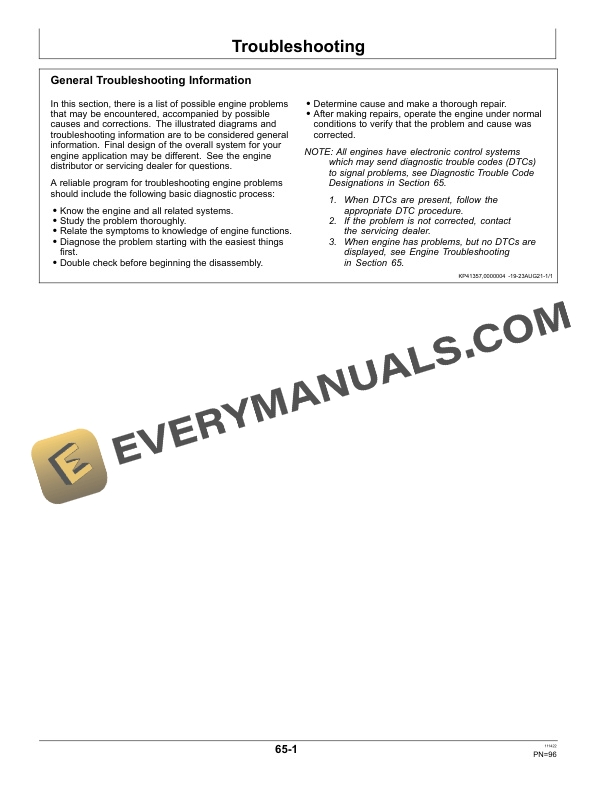
- 1.12.1. General Troubleshooting Information
- 1.12.2. Diagnostic Trouble Code Designations
- 1.12.3. Intermittent DTC Diagnostics
- 1.12.4. Engine Troubleshooting
- 1.12.5. Electrical System Layout
- 1.12.6. Precautions for Welding
- 1.13. Storage
- 1.13.1. Engine Storage Guidelines
- 1.13.2. Preparing Engine for LongTerm Storage
- 1.13.3. Removing Engine from LongTerm Storage
- 1.14. Specifications
- 1.14.1. Engine Crankcase Oil Fill Capacity
- 1.14.2. General OEM Engine Specifications
- 1.14.3. Unified Inch Bolt and Screw Torque Values
- 1.14.4. Metric Bolt and Screw Torque Values
- 1.15. Lubrication and Maintenance Records
- 1.15.1. Using Lubrication and Maintenance Records
- 1.15.2. Daily Prestarting Service
- 1.15.3. Hours of Operation or 12 Months Service
- 1.15.4. Hours of Operation or 72 Months of Service
- 1.15.5. Service As Required
- 1.16. Warranty
- 1.16.1. John Deere Warranty in OEM Applications
- 1.16.2. Emissions Control System Certification Label
- 1.16.3. Carbon Dioxide Emissions (CO)
- 1.16.4. EPA Nonroad Emissions Control Warranty StatementCompression Ignition
- 1.16.5. CARB Nonroad Emissions Control Warranty StatementCompression Ignition
- 2. Page Number
- 2.1. Section 01
- 2.2. Section 05
- 2.3. Section 10
- 2.4. Section 15
- 2.5. Section 20
- 2.6. Section 30
- 2.7. Section 35
- 2.8. Section 40
- 2.9. Section 41
- 2.10. Section 54
- 2.11. Section 55
- 2.12. Section 60
- 2.13. Section 65
- 2.14. Section 70
- 2.15. Section 75
- 2.16. Section 80
- 2.17. Section 85