Description
-
Model List:
- 1850 High Reach Loader
- 1. Contents
- 1.0.1. Recognize Safety Information
- 1.0.2. Understand Signal Words
- 1.0.3. Follow Safety Instructions
- 1.0.4. Replace Safety Signs
- 1.0.5. Live With Safety
- 1.0.6. Prevent Machine Runaway
- 1.0.7. Service Machines Safely
- 1.0.8. Practice Safe Maintenance
- 1.0.9. Work In Ventilated Area
- 1.0.10. Wear Protective Clothing
- 1.0.11. Support Machine Properly
- 1.0.12. Decommissioning Proper Recycling and Disposal of Fluids and Components
- 1.0.13. Use Steps and Handholds Correctly
- 1.0.14. Avoid Hot Exhaust
- 1.0.15. Handle Fuel SafelyAvoid Fires
- 1.0.16. Prepare for Emergencies
- 1.0.17. Install Shields and Guards
- 1.0.18. Avoid HighPressure Fluids
- 1.0.19. Service Cooling System Safely
- 1.0.20. Handling Batteries Safely
- 1.0.21. Protect Bystanders
- 1.0.22. Keep Riders off Machine
- 1.0.23. Use Caution on Hillsides
- 1.0.24. Use Caution When Flexing (Extending) Boom
- 1.0.25. Avoid Electrical Power Lines
- 1.0.26. Remove Paint Before Welding or Heating
- 1.0.27. Avoid Heating Near Pressurized Fluid Lines
- 1.0.28. Park Machine Safely
- 1.0.29. Service Tires Safely
- 1.1. Safety Signs
- 1.1.1. Replace Safety Signs
- 1.1.2. Operate and Service Machine Safely
- 1.1.3. Cab Safety
- 1.1.4. Radiator Fan
- 1.1.5. Hot Surfaces
- 1.1.6. Electrical System
- 1.1.7. Starter
- 1.1.8. Avoid Low Hanging Power Lines
- 1.1.9. Avoid Crushing Injuries
- 1.2. Controls and Instruments
- 1.2.1. Front Console
- 1.2.2. Lever Controls
- 1.2.3. Battery Disconnect Switch
- 1.2.4. Parking Brake
- 1.2.5. Hour Meter
- 1.3. Operators Station
- 1.3.1. Adjusting Operators Seat
- 1.3.2. Using Seat Belts
- 1.3.3. Operating Air Conditioning
- 1.3.4. Operating Horn
- 1.3.5. Operating Turn Signals (Optional)
- 1.3.6. Operating Flashers (Optional)
- 1.4. BreakIn Service
- 1.4.1. Initial StartUp Checks
- 1.4.2. Engine BreakIn
- 1.5. Operating the Engine
- 1.5.1. Prestarting Checks
- 1.5.2. Starting the Engine
- 1.5.3. After Starting and Warm Up
- 1.5.4. Normal Engine Operation
- 1.5.5. Stopping the Engine
- 1.5.6. Using a Booster Battery / Battery Charger
- 1.6. Operating the Loader
- 1.6.1. Loader in Motion
- 1.6.2. Shift the Loader
- 1.6.3. Field Operation
- 1.7. Wheels, Tires, and Treads
- 1.7.1. Service Tires Safely
- 1.7.2. Tire Inflation, Service, and Care
- 1.7.3. Procedure for Liquid Ballast (Weight)
- 1.8. Fuels, Coolants, and Lubricants
- 1.8.1. Use Correct Fuels, Coolant, and Lubricants
- 1.8.2. Fuel Specifications
- 1.8.3. Handle Fuel SafelyAvoid Fires
- 1.8.4. Filling Fuel System
- 1.8.5. Diesel Fuel
- 1.8.6. Lubricity of Diesel Fuel
- 1.8.7. Handling and Storing Diesel Fuel
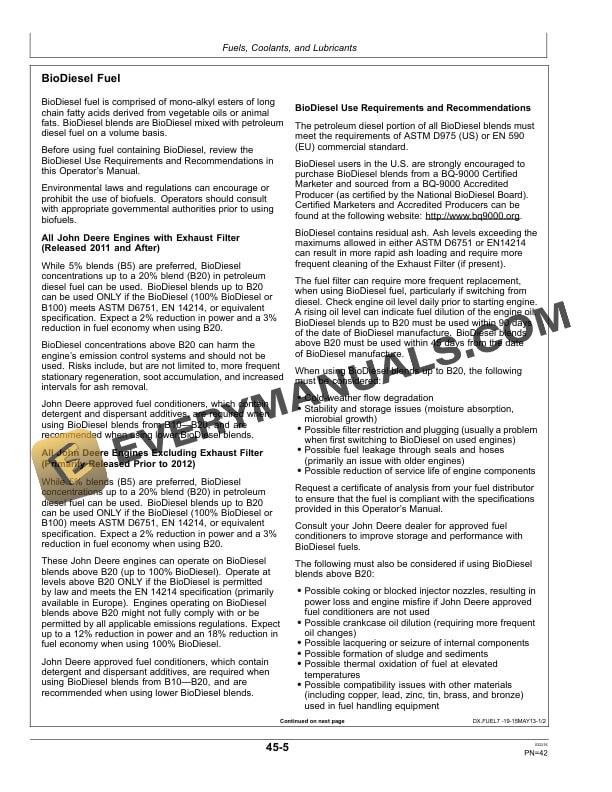
- 1.8.8. BioDiesel Fuel
- 1.8.9. Testing Diesel Fuel
- 1.8.10. Minimizing the Effect of Cold Weather on Diesel Engines
- 1.8.11. Diesel Engine Oil Tier 3 and Stage III
- 1.8.12. Diesel Engine BreakIn Oil NonEmissions Certified and Certified Tier 1, Tier 2, Tier 3, Stage I, Stage II, and Stage III
- 1.8.13. Oil Filters
- 1.8.14. Service Cooling System Safely
- 1.8.15. Filling Cooling System
- 1.8.16. Diesel Engine Coolant (engine with wet sleeve cylinder liners)
- 1.8.17. John Deere COOLGARD II Coolant Extender
- 1.8.18. Supplemental Coolant Additives
- 1.8.19. Additional Information About Diesel Engine Coolants and John Deere COOLGARD II Coolant Extender
- 1.8.20. Operating in Warm Temperature Climates
- 1.8.21. Drain Intervals for Diesel Engine Coolant
- 1.8.22. Testing Diesel Engine Coolant
- 1.8.23. Hydraulic Oil
- 1.8.24. Gear Oil
- 1.8.25. Mixing of Lubricants
- 1.8.26. Alternative and Synthetic Lubricants
- 1.8.27. Lubricant Storage
- 1.9. Lubrication and Maintenance
- 1.9.1. Observe Service Intervals
- 1.9.2. Hour Meter
- 1.9.3. Service Interval Chart Initial StartUp / Initial 100 Hours
- 1.9.4. Service Interval Chart Daily or 10 Hours / 70 Hours / 100 Hours
- 1.9.5. Service Interval Chart 250 Hours / 500 Hours
- 1.9.6. Service Interval Chart 1000 Hours / 2000 Hours
- 1.9.7. Service As Necessary
- 1.9.8. Initial StartUp Checks
- 1.9.9. First 100 Hours
- 1.9.10. Daily or Every 10 Hours
- 1.9.11. Every 70 Hours
- 1.9.12. Every 250 Hours
- 1.9.13. Every 500 Hours
- 1.9.14. Every 1000 Hours
- 1.9.15. Every 2000 Hours
- 1.9.16. As Necessary
- 1.10. Service
- 1.10.1. Accessing Oil Cooler and Radiator
- 1.10.2. Do Not Modify Fuel System
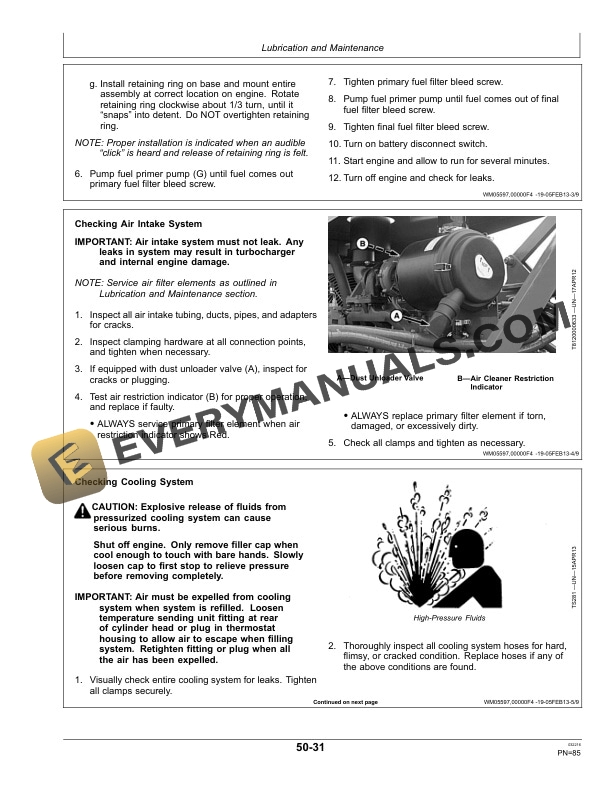
- 1.10.3. Bleeding Fuel System
- 1.11. Transporting
- 1.11.1. Operating Loader on Roads
- 1.11.2. Towing Loader
- 1.11.3. Freeing a Stuck Machine
- 1.11.4. Transporting on Carrier
- 1.12. Troubleshooting
- 1.12.1. Transmission
- 1.12.2. Hydraulic System
- 1.12.3. Electrical System
- 1.12.4. Loader Operation
- 1.13. Storage
- 1.13.1. End of Season Storage
- 1.13.2. Beginning of Season
- 1.13.3. Paint Finish Care
- 1.14. Specifications
- 1.14.1. Machine Specifications
- 1.14.2. Unified Inch Bolt and Screw Torque Values
- 1.14.3. Metric Bolt and Screw Torque Values
- 1.15. Identification Numbers
- 1.15.1. Identification Numbers
- 1.15.2. Product Identification Number
- 1.15.3. Engine Identification Number
- 1.15.4. Keep Proof of Ownership
- 1.15.5. Keep Machines Secure
- 1.16. John Deere Service Keeps You On The Job
- 1.16.1. John Deere Parts
- 1.16.2. The Right Tools
- 1.16.3. WellTrained Technicians
- 1.16.4. Prompt Service
- 2. Page Number
- 2.1. Section 05
- 2.2. Section 10
- 2.3. Section 15
- 2.4. Section 20
- 2.5. Section 25
- 2.6. Section 30
- 2.7. Section 35
- 2.8. Section 40
- 2.9. Section 45
- 2.10. Section 50
- 2.11. Section 55
- 2.12. Section 60
- 2.13. Section 65
- 2.14. Section 70
- 2.15. Section 75
- 2.16. Section 80