Description
Introduction To Engines
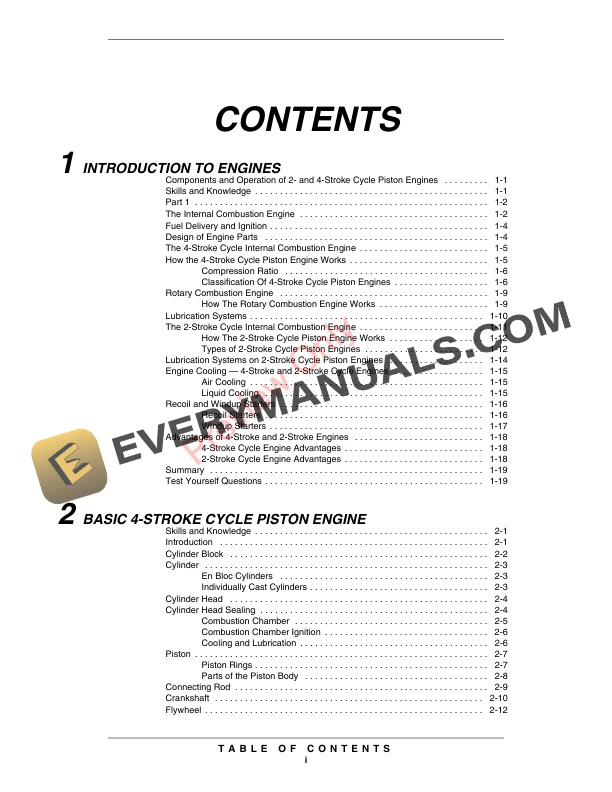
Components and Operation of 2- and 4-Stroke Cycle Piston Engines
Skills and Knowledge
Part 1
The Internal Combustion Engine
Fuel Delivery and Ignition
Design of Engine Parts
The 4-Stroke Cycle Internal Combustion Engine
How the 4-Stroke Cycle Piston Engine Works
Compression Ratio
Classification Of 4-Stroke Cycle Piston Engines
Rotary Combustion Engine
How The Rotary Combustion Engine Works
Lubrication Systems
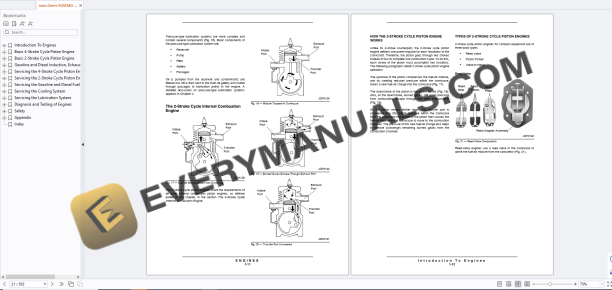
The 2-Stroke Cycle Internal Combustion Engine
How The 2-Stroke Cycle Piston Engine Works
Types of 2-Stroke Cycle Piston Engines
Lubrication Systems on 2-Stroke Cycle Piston Engines
Engine Cooling — 4-Stroke and 2-Stroke Cycle Engines
Air Cooling
Liquid Cooling
Recoil and Windup Starters
Recoil Starters
Windup Starters
Advantages of 4-Stroke and 2-Stroke Engines
4-Stroke Cycle Engine Advantages
2-Stroke Cycle Engine Advantages
Summary
Test Yourself Questions
Basic 4-Stroke Cycle Piston Engine
Skills and Knowledge
Introduction
Cylinder Block
Cylinder
En Bloc Cylinders
Individually Cast Cylinders
Cylinder Head
Cylinder Head Sealing
Combustion Chamber
Combustion Chamber Ignition
Cooling and Lubrication
Piston
Piston Rings
Parts of the Piston Body
Connecting Rod
Crankshaft
Flywheel
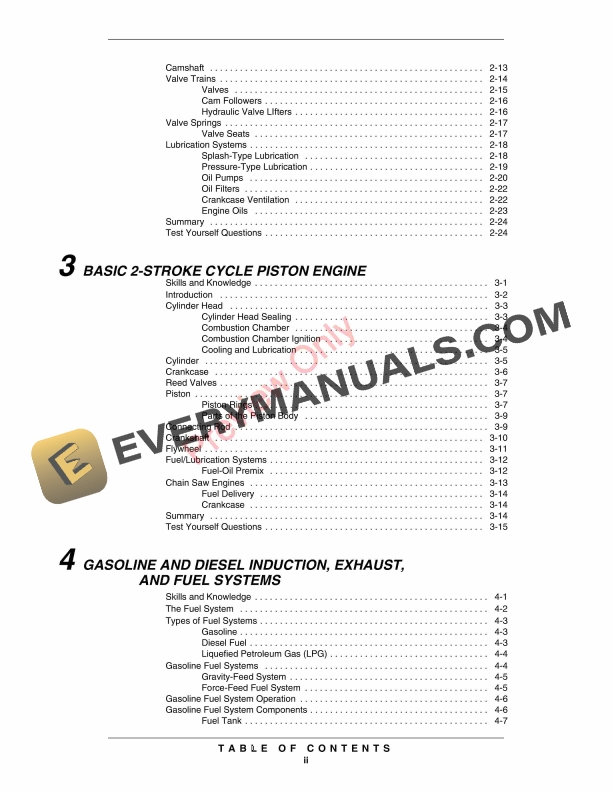
Camshaft
Valve Trains
Valves
Cam Followers
Hydraulic Valve LIfters
Valve Springs
Valve Seats
Lubrication Systems
Splash-Type Lubrication
Pressure-Type Lubrication
Oil Pumps
Oil Filters
Crankcase Ventilation
Engine Oils
Summary
Test Yourself Questions
Basic 2-Stroke Cycle Piston Engine
Skills and Knowledge
Introduction
Cylinder Head
Cylinder Head Sealing
Combustion Chamber
Combustion Chamber Ignition
Cooling and Lubrication
Cylinder
Crankcase
Reed Valves
Piston
Piston Rings
Parts of the Piston Body
Connecting Rod
Crankshaft
Flywheel
Fuel/Lubrication Systems
Fuel-Oil Premix
Chain Saw Engines
Fuel Delivery
Crankcase
Summary
Test Yourself Questions
Gasoline and Diesel Induction, Exhaust, and Fuel Systems
Skills and Knowledge
The Fuel System
Types of Fuel Systems
Gasoline
Diesel Fuel
Liquefied Petroleum Gas (LPG)
Gasoline Fuel Systems
Gravity-Feed System
Force-Feed Fuel System
Gasoline Fuel System Operation
Gasoline Fuel System Components
Fuel Tank
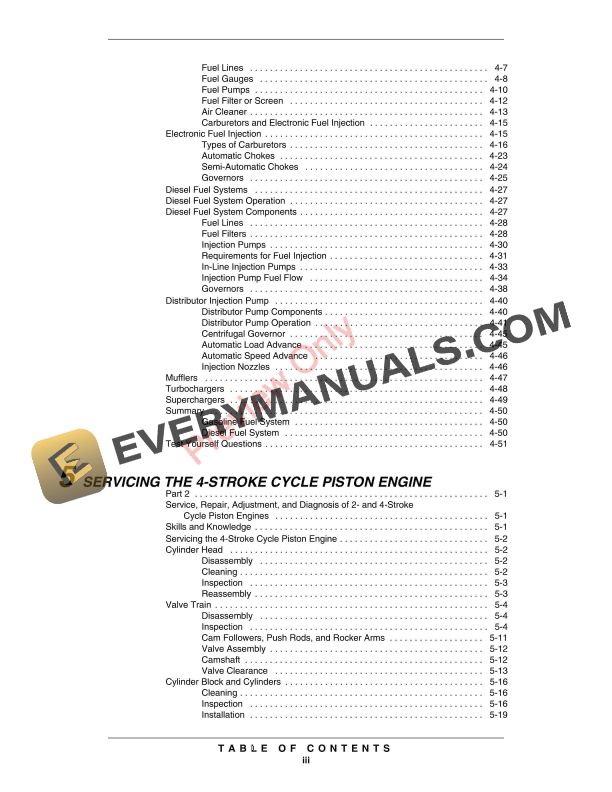
Fuel Lines
Fuel Gauges
Fuel Pumps
Fuel Filter or Screen
Air Cleaner
Carburetors and Electronic Fuel Injection
Electronic Fuel Injection
Types of Carburetors
Automatic Chokes
Semi-Automatic Chokes
Governors
Diesel Fuel Systems
Diesel Fuel System Operation
Diesel Fuel System Components
Fuel Lines
Fuel Filters
Injection Pumps
Requirements for Fuel Injection
In-Line Injection Pumps
Injection Pump Fuel Flow
Governors
Distributor Injection Pump
Distributor Pump Components
Distributor Pump Operation
Centrifugal Governor
Automatic Load Advance
Automatic Speed Advance
Injection Nozzles
Mufflers
Turbochargers
Superchargers
Summary
Gasoline Fuel System
Diesel Fuel System
Test Yourself Questions
Servicing the 4-Stroke Cycle Piston Engine
Part 2
Service, Repair, Adjustment, and Diagnosis of 2- and 4-Stroke Cycle Piston Engines
Skills and Knowledge
Servicing the 4-Stroke Cycle Piston Engine
Cylinder Head
Disassembly
Cleaning
Inspection
Reassembly
Valve Train
Disassembly
Inspection
Cam Followers, Push Rods, and Rocker Arms
Valve Assembly
Camshaft
Valve Clearance
Cylinder Block and Cylinders
Cleaning
Inspection
Installation
Piston and Connecting Rod
Disassembly
Cleaning
Piston Inspection
Analyzing Piston Failures
Connecting Rod and Crankpin Bearing Inspection
Reassembly of Piston and Piston Rings
Installation
Crankshaft, Bearings, and Flywheel
Disassembly and Inspection
Reassembly
Other Considerations During Crankshaft Assembly
Crankcase Ventilation
Summary
Test Yourself Questions
Servicing the 2-Stroke Cycle Piston Engine
Skills and Knowledge
Introduction
Cylinder Head
Disassembly
Cleaning
Inspection
Assembly
Cylinder
Disassembly
Inspection
Assembly
Piston and Connecting Rod
Disassembly
Cleaning
Inspection
Assembly
Flywheel, Crankcase, and Crankshaft
Disassembly
Inspection
Assembly
Reed Valves
Disassembly and Inspection
Assembly
Summary
Test Yourself Questions
Servicing the Gasoline and Diesel Fuel Systems
Skills and Knowledge
Gasoline Fuel System
Diesel Fuel System
Components Common to Both Systems
Introduction
Gasoline Fuel System Service
Carburetors
Carburetor Removal from Engine
Carburetor Disassembly
Carburetor Inspection and Repair
Carburetor Reassembly and Installation
Governor
Governor Disassembly
Governor Inspection and Repair
Governor Assembly and Installation
Fuel Filter
Diesel Fuel System Service
Fuel Injection Pump
Adjust Injection Pump Static Timing
Adjust Injection Pump Timing
Bleeding Air from Diesel Fuel Systems
Injection Nozzles
Fuel Filter
Precombustion Chamber
Governor
Turbocharger
Components Common to Both Systems
Air Cleaner
Servicing Fuel Pumps
Repairing the Fuel Pump
Fuel Tank Service
Fuel Lines
Summary
Gasoline Fuel System Components
Diesel Fuel System Components
Components Common To Both Systems
Test Yourself Questions
Servicing the Cooling System
Skills and Knowledge
Introduction
Air Cooling
Servicing The Air-Cooled engine
Liquid Cooling
Radiator
Radiator Cap
Coolant Recovery Reservoir
Fan and Fan Belts
Coolant Pump
Radiator Hoses
Thermostat
Servicing the Liquid Cooling System
Summary
Test Yourself Questions
Servicing the Lubrication System
Skills and Knowledge
Introduction
Oil Pump
Plunger Pump
Rotor Pump
External-Gear Pump
Oil Filter
Pressure Regulating Valve
Contamination of Oil
Protecting the Engine Against OIl Contamination
Oil Consumption
Changing Engine Oil
Summary
Test Yourself Questions
Diagnosis and Testing of Engines
Skills and Knowledge
Introduction
Basic Diagnosis — Seven Basic Steps
Know the System
Ask the Operator
Inspect the Engine
Operate the Engine
List the Possible Causes
Reach a Conclusion
Test Your Conclusion
Summary—Diagnosing Engine Problems
Troubleshooting Guides
Possible Causes of Gasoline Fuel System Problems (See Table 1)
Ignition System Causes
Other Causes
Possible Causes of Diesel Fuel System Problems (see Table 2)
Possible Causes of Diesel Engine Problems (See Table 3)
Testing the Engine
Category 1 — General Engine
Category 2 — Fuel System
Category 1 — General Engine
Testing Compression Pressure
Turbocharger Boost Pressure Check
Crankcase Pressure Testing
Crankcase Vacuum Test
Oil Pressure Testing
Cooling System Testing
Engine Power (Dynamometer) Testing
Category 2 — Fuel System
Carburetor Testing
Diesel Injection Pump Testing
Diesel Injection Nozzle Testing
Summary
Test Yourself Questions
Safety
Skills and Knowledge
Introduction
Park Machine Safely
Follow All Safety Instructions
Get Familiar with Each Machine
Recognize Safety Information
Understand Signal Words
Follow Safety Instructions
Practice Safe Maintenance
Use Proper Tools
Disconnect Electrical Circuit
Service Machine Safely
Work in a Clean Area
Illuminate Work Area Safely
Be Aware of Stored Energy
Support Machine Properly
Service Cooling System Safely
Handle Fuel Safely — Avoid Fires
Prevent Machine Runaway
Handle Batteries Safely
Prevent Battery Explosions
Work in a Ventilated Area
Handle Starting Fluid Safely
Avoid High-Pressure Fluids
Avoid Harmful Asbestos Dust
Stay Clear of Rotating Drive Lines
Avoid Heating Near Pressurized Fluid Lines
Wear Protective Clothing
Prepare for Emergencies
Handle Chemical Products Safely
Dispose of Waste Properly
Live with Safety
Summary
Test Yourself Questions
Appendix
Definition Of Terms
Suggested Reading
Answers to Test Yourself Questions
Index