

Description
-
Model List:
- 1435 Series II Front Mower
- 1445 Series II Front Mower
- 1545 Series II Front Mower
- 1565 Series II Front Mower
- 1. Introduction
- 1.1. Thank You for Purchasing a John Deere Product
- 1.2. Using Your Operators Manual
- 1.3. Machine Use
- 1.4. Special Messages
- 2. Product Identification
- 2.1. Record Identification Numbers
- 3. Table of Contents
- 4. Safety Labels
- 4.1. Pictorial Safety Signs
- 4.2. WARNING M133159
- 4.3. WARNING TCU13518
- 4.4. WARNING TCU13555
- 4.5. CAUTION TCU13520
- 4.6. CAUTION TCU13563
- 4.7. CAUTION TCU13553
- 4.8. CAUTION TCU27739
- 4.9. DANGER TCU13892
- 4.10. Tongue and Trailer Weight TCU13173
- 4.11. CE Certification, Specification and Sound Label
- 4.12. CE Certification, Specification and Sound Label
- 4.13. CE Certification, Specification and Sound Label
- 4.14. CE Certification, Specification and Sound Label
- 4.15. Operator Training Required
- 4.16. Preparation
- 4.17. Operating Safely
- 4.18. Checking Mowing Area
- 4.19. Parking Safely
- 4.20. Boarding and Exiting
- 4.21. Rotating Blades are Dangerous
- 4.22. Protect Children
- 4.23. Avoid Tipping
- 4.24. Use Seat Belt Properly
- 4.25. Keep ROPS Installed Properly
- 4.26. Not for Use in Forestry Applications
- 4.27. Keep Riders Off
- 4.28. Avoid High Pressure Fluids
- 4.29. Driving Safely on Public Roads
- 4.30. Checking Wheel Hardware
- 4.31. Wear Appropriate Clothing
- 4.32. Towing Loads Safely
- 4.33. Maintenance and Storage
- 4.34. Prevent Fires
- 4.35. Tire Safety
- 4.36. Handling Fuel Safely
- 4.37. Handling Waste Product and Chemicals
- 5. Operating Controls
- 5.1. Operator Controls
- 5.2. Air Conditioning Controls (If Equipped)
- 6. Operating Machine
- 6.1. Daily Operating Checklist
- 6.2. Avoid Damage to Plastic and Painted Surfaces
- 6.3. Miscellaneous Controls
- 6.4. Cab Classification According to EN156951 (for Application of Crop Protection Chemicals and Liqui…
- 6.5. Testing Safety Systems
- 6.6. Testing PTO Switch
- 6.7. Testing Seat and Park Brake Switch
- 6.8. Testing the Park Brake
- 6.9. Using Proper Ballast
- 6.10. Adjusting Seat (Deluxe Suspension)
- 6.11. Adjusting Seat (Comfort Adjust Suspension)
- 6.12. Seat, Adjusting (Air Ride Suspension)
- 6.13. Using Seat Belt
- 6.14. Adjusting Steering Column
- 6.15. Using PTO Knob
- 6.16. Using Key Switch
- 6.17. Using Throttle Lever
- 6.18. Opening Engine Cover
- 6.19. Opening Service Hatch
- 6.20. Using Hour Meter
- 6.21. Using Four Wheel Drive (4WD) (1435 and 1445)
- 6.22. Using Four Wheel Drive (4WD) (1545 and 1565)
- 6.23. Using TwoSpeed Transaxle (1545 and 1565)
- 6.24. Indicator Lamps
- 6.25. Using Hydrostatic Pedals
- 6.26. Using Brakes
- 6.27. Using Traction Assist Pedal
- 6.28. Using Fuel Shutoff Valve (1435)
- 6.29. Using Fuel Shutoff Valve (1445, 1545, 1565)
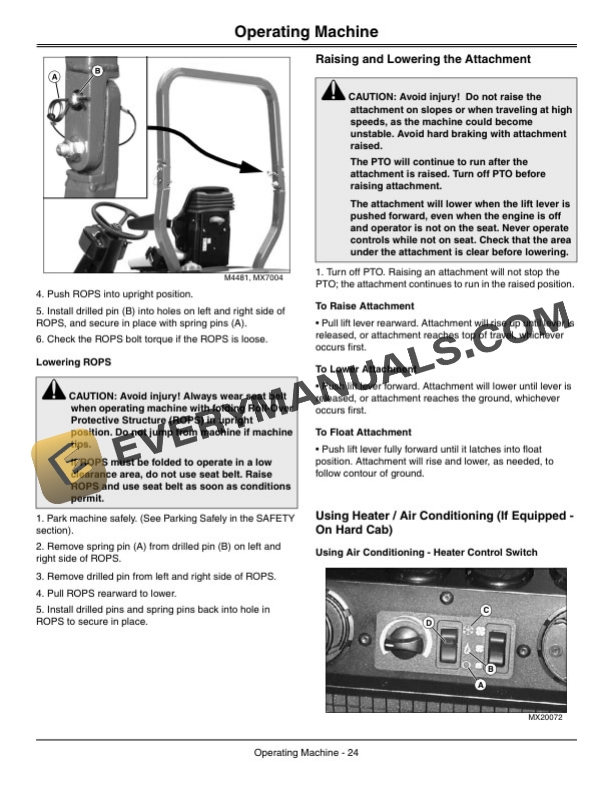
- 6.30. Raising and Lowering ROPS
- 6.31. Raising and Lowering the Attachment
- 6.32. Using Heater / Air Conditioning (If Equipped
- 6.33. Starting Engine
- 6.34. Stopping Engine
- 6.35. Transporting Machine
- 6.36. Moving Machine with Engine Off
- 6.37. Freeing a Mired Machine
- 6.38. Transporting Machine on Trailer
- 6.39. Using Power Outlet
- 7. Replacement Parts
- 7.1. Service Literature
- 7.2. Part Numbers
- 8. Service Intervals
- 8.1. Servicing Your Machine
- 8.2. BreakIn
- 8.3. Every 50 Hours or Yearly
- 8.4. Every 100 Hours
- 8.5. Every 200 Hours
- 8.6. Every 400 Hours
- 8.7. Every 500 Hours
- 8.8. Every 1500 Hours
- 8.9. Every 1500 Hours or Yearly
- 8.10. Every 2000 Hours or Two Years
- 8.11. Every 3000 Hours
- 8.12. Maintaining the Air Conditioning System
- 8.13. Service Intervals After Converting to BioDiesel Fuel
- 9. Service Lubrication
- 9.1. Lubricating Rear Axle Pivot Pin
- 9.2. Lubricating Rear Tie Rod
- 9.3. Lubricating Hydraulic Steering Cylinder
- 9.4. Lubricating Hydrostatic Linkage
- 9.5. Lubricating Engine Drive Shaft
- 9.6. Lubricating PTO Shaft
- 9.7. Lubricating Steering Spindles (2WD Only)
- 9.8. Lubricating Brake Pedal Linkage
- 9.9. Lubricating Operator Seat Slides
- 9.10. Lubricating Steering Column TiltLock
- 10. Service Engine
- 10.1. Avoid Fumes
- 10.2. Engine Oil
- 10.3. Removing Engine Cover
- 10.4. Raising and Lowering the Seat Platform
- 10.5. Checking Engine Oil Level
- 10.6. Changing Engine Oil and Filter
- 10.7. Cleaning Air Intake Screen
- 10.8. Cleaning Oil Cooler and Radiator
- 10.9. Checking Air Filter Restriction Indicator
- 10.10. Servicing Air Cleaner Elements
- 10.11. Cleaning Dust Unloading Valve
- 10.12. Checking Air Intake Hoses and Clamps
- 10.13. Checking Radiator Hoses and Clamps
- 10.14. Recommended Engine Coolant
- 10.15. Service Cooling System Safely
- 10.16. Checking Coolant Level
- 10.17. Servicing Cooling System
- 10.18. Servicing Diesel Fuel Filter (1435)
- 10.19. Draining Water Separator (1445, 1545, 1565)
- 10.20. Changing Diesel Fuel Filter (1445, 1545, 1565)
- 10.21. Servicing Gasoline Fuel Filter
- 10.22. Priming Diesel Fuel System
- 10.23. Checking and Adjusting Alternator Belt
- 10.24. Replacing Alternator Belt
- 11. Service Transmission
- 11.1. Transaxle Oil
- 11.2. Checking the Transaxle Oil Level
- 11.3. Changing the Transaxle Oil and Filter
- 11.4. Adjusting Forward and Reverse Pedals
- 11.5. Adjusting Transaxle Neutral
- 11.6. D Oil
- 11.7. Checking the 4WD Oil Level
- 11.8. Changing the 4WD Oil
- 12. Service Steering Brakes
- 12.1. Adjusting ToeIn
- 12.2. Adjusting Brakes
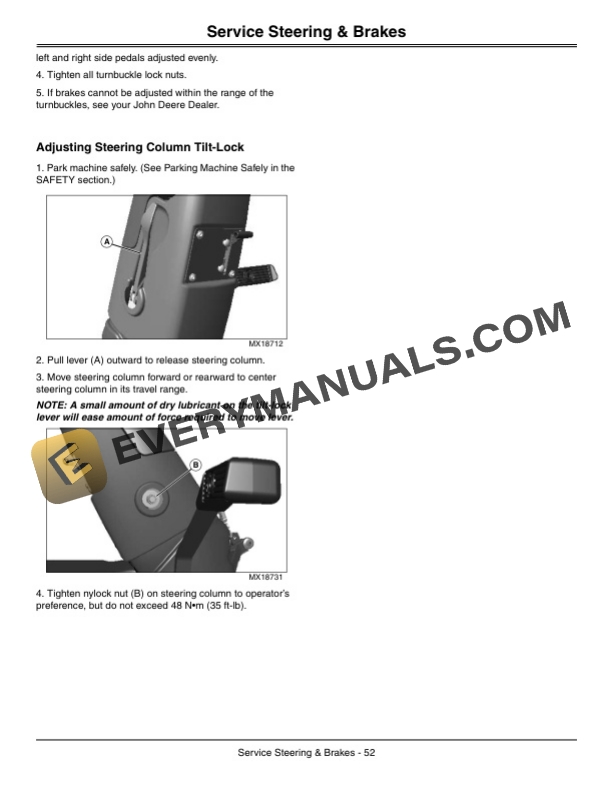
- 12.3. Adjusting Steering Column TiltLock
- 13. Service Electrical
- 13.1. Service the Battery Safely
- 13.2. Checking Battery Electrolyte Level
- 13.3. Removing and Installing the Battery
- 13.4. Cleaning Battery and Terminals
- 13.5. Using Booster Battery
- 13.6. Checking and Replacing Fuses
- 14. Service Miscellaneous
- 14.1. Using Proper Fuel (Diesel)
- 14.2. Filling Fuel Tank
- 14.3. Using Service Latches
- 14.4. Cleaning and Repairing Metal Surfaces
- 14.5. Cleaning Plastic Surfaces
- 14.6. Tightening ROPS Hardware
- 14.7. Removing and Installing Front Wheels
- 14.8. Removing and Installing Rear Wheels
- 15. Troubleshooting
- 15.1. Using Troubleshooting Chart
- 15.2. Electrical
- 15.3. Machine
- 16. Storage
- 16.1. Storing Safety
- 16.2. Preparing Machine for Storage
- 16.3. Preparing Fuel and Engine For Storage
- 16.4. Storage for BioDiesel Fuel
- 16.5. Removing Machine From Storage
- 17. Assembly
- 17.1. Parking Safely
- 17.2. Assemble Machine
- 17.3. Charge and Connect Battery
- 17.4. Check Tire Pressure
- 17.5. Checking Engine Oil Level
- 17.6. Raise ROPS
- 17.7. Test Safety Systems
- 17.8. Testing PTO Switch
- 17.9. Testing Seat and Park Brake Switch
- 17.10. Testing the Park Brake
- 18. Specifications
- 18.1. Capacities
- 18.2. Tire Inflation Pressures
- 18.3. Tire Inflation Pressures
- 18.4. Tightening Torques
- 18.5. Tongue and Trailer Weights
- 18.6. Slope Operation
- 18.7. Power TakeOff Speed
- 18.8. Travel Speeds (1435, 1445)
- 18.9. Travel Speeds (1545, 1565)
- 18.10. Tire and Load Information
- 18.11. Tire Dimensions
- 18.12. Tire Dimensions
- 18.13. Dimensions
- 18.14. Sound Measurements
- 18.15. Sound Level
- 18.16. Vibration Measurements
- 18.17. Vibration
- 19. Declaration of Conformity
- 19.1. EC Declaration of Conformity
- 20. Service Statement
- 20.1. John Deere Parts
- 20.2. The Right Tools
- 20.3. WellTrained Technicians
- 20.4. Prompt Service
- 21. Service Record
- 21.1. Record Service Dates