Description
-
Model List:
- TE Gator Utility Vehicles
- 1. Introduction
- 1.1. Thank You for Purchasing a John Deere Product
- 1.2. Using Your Operators Manual
- 1.3. Special Messages
- 1.4. Attachments for Your Machine
- 2. Product Identification
- 2.1. Record Identification Numbers
- 3. Table of Contents
- 4. Safety Labels
- 4.1. Safety Label Location
- 5. Safety Labels
- 5.1. Understanding The Machine Safety Labels
- 5.2. WARNING M154111
- 5.2.1. ROLLOVER OR FALLING OFF MAY CAUSE DEATH
- 5.3. CAUTION M150928
- 5.3.1. BEFORE LEAVING VEHICLE
- 5.4. WARNING M150928
- 5.4.1. YOUNG DRIVERS INCREASE CHANCE OF DEATH
- 5.5. WARNING M157240
- 5.5.1. AVOID INJURY FROM EXPLOSION
- 5.5.2. RIDERS CAN FALL OFF AND BE KILLED
- 5.6. DANGER POISON
- 5.6.1. CAUTION
- 5.7. Battery Charger Safety Labels
- 5.7.1. CAUTION
- 5.7.2. WARNING
- 5.7.3. CAUTION
- 5.8. SAE J2258 and ASME B56.8 Compliance
- 5.9. Supervisor Safety Responsibilities
- 5.10. Operator Training Required
- 5.11. Operating Safely
- 5.12. Parking Safely
- 5.13. Protect Children and Prevent Accidents
- 5.14. Avoid Excessive Speeds
- 5.15. Avoid Tipping
- 5.16. Keep Riders Off Vehicle
- 5.17. Transport Loads Safely
- 5.18. Towing Loads Safely With Utility Vehicle
- 5.19. Before Driving
- 5.20. Driving On Rough Terrain
- 5.21. Climbing Or Descending A Hill
- 5.22. Driving Across Slopes
- 5.23. Riding Through Water
- 5.24. Checking Wheel Hardware
- 5.25. Wear Appropriate Clothing
- 5.26. Practice Safe Maintenance
- 5.27. Prevent Fires
- 5.28. Do Not Modify Machine
- 5.29. Tire Safety
- 5.30. Handling Fuel Safely
- 5.30.1. To avoid personal injury or property damage, use extreme care in handling fuel. Fuel is extremely…
- 5.31. Handling Waste Product and Chemicals
- 6. Operating
- 6.1. Daily Operating Checklist
- 6.2. Avoid Damage to Plastic and Painted Surfaces
- 6.3. Operator Station Controls
- 6.3.1. Foot/Platform Controls
- 6.4. Using Hand Holds
- 6.5. Adjusting Standard Seat
- 6.6. Adjusting Driver Seat With Optional Lever System
- 6.7. Testing Safety Systems
- 6.7.1. Test 1 (REVERSE WARNING ALARM)
- 6.7.2. Test 2 (ROLLAWAY ALARM)
- 6.7.3. Test 3 (OPERATOR PRESENCE)
- 6.7.4. Test 4 (CHARGER INTERLOCK)
- 6.8. Using the Directional Control Switch
- 6.9. Using the LED Charge Meter and the Hour Meter
- 6.9.1. Charge Meter
- 6.9.2. Hour Meter
- 6.10. Using the LCD Charge Meter and the Hour Meter
- 6.10.1. Charge Meter
- 6.10.2. Hour Meter
- 6.11. Using the Service and Drive Switch
- 6.11.1. Service Position
- 6.11.2. Drive Position
- 6.12. Using Park Brake
- 6.12.1. Locking the Park Brake
- 6.12.2. Unlocking the Park Brake
- 6.13. Starting the Vehicle
- 6.14. Stopping and Parking the Vehicle
- 6.15. Using the Cargo Box
- 6.15.1. Raising and Lowering with Manual Lift
- 6.15.2. Raising and Lowering with Power Lift
- 6.15.3. Locking Box in Raised Position
- 6.15.4. Operating the Tailgate
- 6.15.5. Using Cargo Box Tie Downs
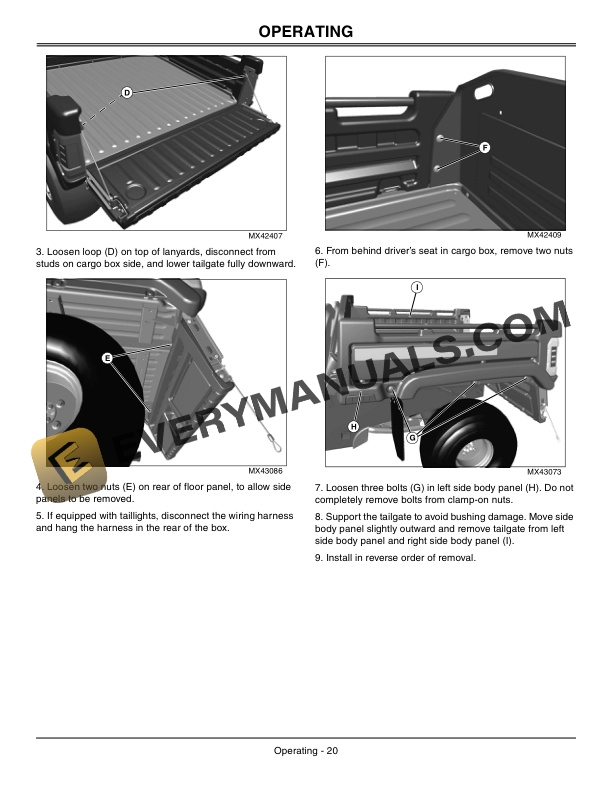
- 6.15.6. Removing the Tailgate
- 6.15.7. Operating in Flat Bed Mode
- 6.16. Loading the Cargo Box
- 6.16.1. Box Volume Capacity
- 6.17. Emptying Cargo Box
- 6.18. Towing Loads
- 6.19. Using Correct Tires and Inflation
- 6.19.1. Inflation
- 6.20. Towing the Utility Vehicle
- 6.21. Transporting the Utility Vehicle
- 6.22. Use Care In Handling and Servicing Batteries
- 6.22.1. Prevent Battery Explosions
- 6.22.2. Charging Safety
- 6.23. Using the Battery Charger
- 6.23.1. Battery Charger Safety
- 6.23.2. Charging Procedure
- 7. Replacement Parts
- 7.1. Service Literature
- 7.1.1. Order Service Parts Online
- 7.2. Part Numbers
- 8. Service Intervals
- 8.1. Servicing Your Machine
- 8.2. Break In
- 8.2.1. After First 5 Hours
- 8.2.2. After First 10 Hours
- 8.3. Every 25 Hours
- 8.4. Every 50 Hours
- 8.5. Every 200 Hours or Annually (whichever comes first)
- 8.6. As Needed
- 9. Service Battery
- 9.1. Battery Safety
- 9.2. Using Deep Cycle Batteries
- 9.2.1. Electrolyte and Specific Gravity
- 9.3. Battery Position and Connection Diagram
- 9.4. Checking Batteries
- 9.5. Tighten Battery Terminal Connections
- 9.6. Tighten Battery Hold Downs
- 9.7. Cleaning or Replacing Batteries
- 9.7.1. Cleaning Batteries
- 9.7.2. Replace Batteries
- 9.8. Checking Battery Electrolyte Levels
- 9.9. Battery Electrolyte Guidelines
- 9.9.1. Automatic Watering Devices
- 9.9.2. Checking Electrolyte LevelBefore Charging
- 9.9.3. Check Electrolyte LevelAfter Charging
- 9.10. Checking Battery Condition
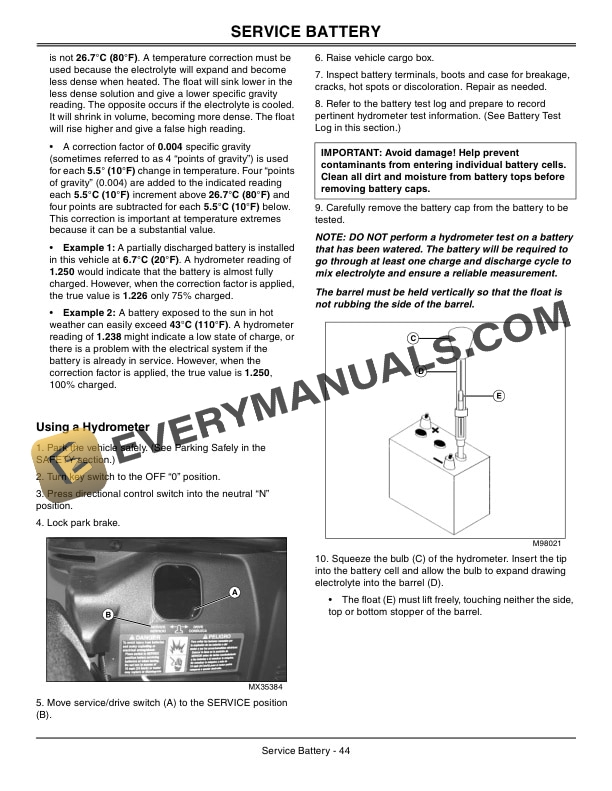
- 9.10.1. Hydrometer
- 9.11. Using a Hydrometer
- 9.12. Battery Test Log
- 10. Service Electrical
- 10.1. Replacing Headlight Bulb and Housing
- 10.1.1. Remove Headlight Bulb
- 10.1.2. Install Headlight Bulb
- 10.1.3. Replace Headlight Housing
- 10.2. Checking and Replacing Fuses
- 11. Service Miscellaneous
- 11.1. Wheel Hardware, Tightening
- 11.1.1. Front Wheel Bolts
- 11.1.2. Rear wheel Nuts
- 11.2. Lubricating Front King Pins
- 11.3. Removing and Installing Hood
- 11.3.1. Removing Hood
- 11.3.2. Installing Hood
- 11.4. Replacing Cargo Box Tailgate Bushings
- 11.5. Cleaning and Repairing Cargo Box
- 11.5.1. Repairing Accessory Tubes
- 11.5.2. Cargo Box Floor
- 11.6. Cleaning Plastic Hood and Body Panel Surfaces
- 11.7. Cleaning and Repairing Metal Surfaces
- 11.7.1. Cleaning
- 11.7.2. Repairing Minor Scratches (surface scratch)
- 11.7.3. Repairing Deep Scratches (bare metal or primer showing)
- 12. Troubleshooting
- 12.1. Using Troubleshooting Chart
- 12.2. Batteries
- 12.3. Battery Charger
- 12.4. Cargo Box
- 13. Storage
- 13.1. Storing Safety
- 13.2. Battery Storage
- 13.3. Batteries for Storage, Preparing Storage, Preparing Batteries for
- 13.4. Storing the Vehicle
- 13.5. Removing Vehicle from Storage
- 14. Specifications
- 14.1. Batteries
- 14.2. Torque Specifications
- 14.3. Controller
- 14.4. Electrical
- 14.5. Travel Speeds
- 14.6. Steering and Brakes
- 14.7. Vehicle Dimensions
- 14.8. Ground Clearance
- 14.9. Capacities
- 14.10. Charger
- 14.10.1. Inflation Pressure
- 14.11. Recommended Lubricants
- 15. Warranty
- 15.1. Product Warranty
- 15.2. California and U.S. EPA Emissions Control System Warranty Statement (Small OffRoad Gas Engines)
- 15.3. Tire Warranty
- 15.4. Battery Warranty
- 16. John Deere Quality Statement
- 16.1. John Deere Quality
- 17. Service Record
- 17.1. Record Service Dates