
Description
-
Model List:
- Trailed Air Blast (N160) Sprayer
- 1. Contents
- 1.1. Introduction to the Machine
- 1.1.1. General
- 1.1.2. Technical Features
- 1.2. Inspection Checklists
- 1.2.1. PreDelivery Inspection
- 1.2.2. Owners Record
- 1.2.3. Delivery Inspection
- 1.2.4. AfterSales Inspection
- 1.2.5. Inspection Before Each Day of Operation
- 1.2.6. Inspection Before Each Season
- 1.2.7. Recognize Safety Information
- 1.2.8. Understand Signal Words
- 1.2.9. Follow Safety Instructions
- 1.2.10. Prepare for Emergencies
- 1.2.11. Wear Protective Clothing
- 1.2.12. Protect Against Noise
- 1.2.13. General Machine Operation Safety
- 1.2.14. Mechanical Safety
- 1.2.15. Transport in the Field and on the Road
- 1.2.16. Working Area
- 1.2.17. Keep Riders Off Machine
- 1.2.18. Use Safety Lights and Devices
- 1.2.19. Protect Against High Pressure Spray
- 1.2.20. Respiratory Protection
- 1.2.21. Skin Protection
- 1.2.22. Maintenance of Means of Personal Protection
- 1.2.23. Service and Operate Chemical Sprayers Safely
- 1.2.24. Chemical Safety
- 1.2.25. Danger Symbols
- 1.2.26. NonPermissible Use
- 1.2.27. Clean Sprayer and Tractor of Hazardous Pesticides
- 1.2.28. Prevent Development of Micro Organisms
- 1.2.29. Park Machine Safely
- 1.2.30. Work In Ventilated Area
- 1.2.31. Remove Paint Before Welding or Heating
- 1.2.32. Avoid Heating Near Pressurized Fluid Lines
- 1.2.33. Welding Near Electronic Control Units
- 1.2.34. Work in Clean Area
- 1.2.35. Practice Safe Maintenance
- 1.2.36. Use Proper Tools
- 1.2.37. Avoid HighPressure Fluids
- 1.2.38. Check/Replace Hoses
- 1.2.39. Service Tires Safely
- 1.2.40. Follow Tire Recommendations
- 1.2.41. Decommissioning Proper Recycling and Disposal of Fluids and Components
- 1.2.42. Admissible Use
- 1.2.43. Additional Safety Measures
- 1.3. Safety Signs
- 1.3.1. Pictorial Safety Signs
- 1.3.2. Replace Safety Signs
- 1.3.3. Safety Sign Locations
- 1.3.4. Decal A Read Operator Manual
- 1.3.5. Decal B Shut off Engine, Remove Keys
- 1.3.6. Decal C Protection Against Noise
- 1.3.7. Decal D Maximum Pump Speed and Hydraulic System Pressure
- 1.3.8. Decal E Read Operator Manual for Lubrication Points
- 1.3.9. Decal F Clean Water
- 1.3.10. Decal G Danger of Poisoning
- 1.3.11. Decal H Dangerous Substances
- 1.3.12. Decal I Means of Personal Protection
- 1.3.13. Decal J Position of Gearbox Lever
- 1.3.14. Decal K Throwing Objects
- 1.3.15. Decal L Rotating Parts
- 1.3.16. Decal M Tank Drain
- 1.3.17. Decal N Engaging Parking Stand
- 1.3.18. Decal O Servicing the Filter
- 1.3.19. Decal P Machine Elevation
- 1.3.20. Decal Slow Moving Vehicle (SMV)
- 1.4. Machine Description
- 1.4.1. Basic Machine
- 1.4.2. A Control Unit
- 1.4.3. B Pump
- 1.4.4. C Hand Wash Tank
- 1.4.5. D Main Tank
- 1.4.6. E Circuit Cleaning Tank
- 1.4.7. F Air Group
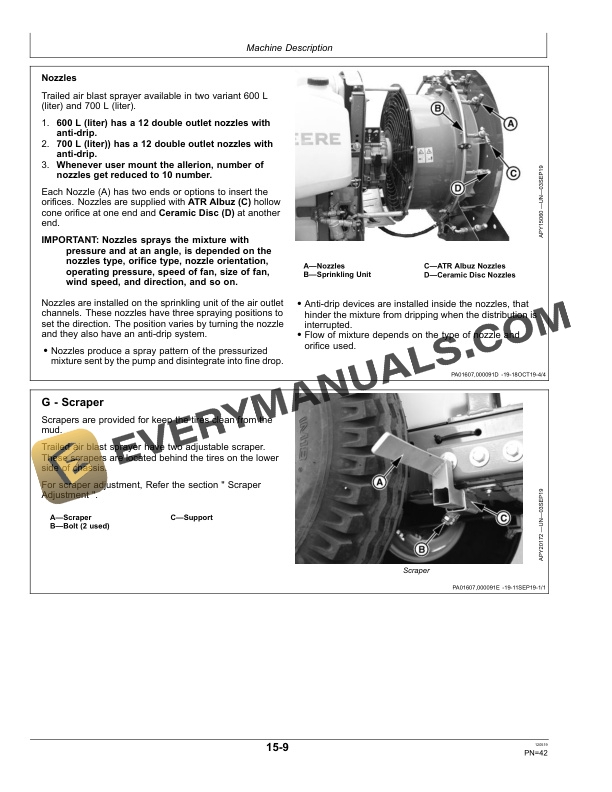
- 1.4.8. G Scraper
- 1.4.9. H Tire
- 1.4.10. I Chassis
- 1.4.11. J Tank Drain Tap
- 1.4.12. K Three Way Valve
- 1.4.13. L Parking Stand
- 1.4.14. M Drawbar Hitch
- 1.4.15. N Propeller Shaft (PTO Shaft)
- 1.4.16. O Primary filter
- 1.4.17. P Agitator
- 1.4.18. Q Level Gauge
- 1.4.19. R Powder Mixer Nozzle
- 1.4.20. S Secondary Filters
- 1.4.21. T Allerion
- 1.4.22. Flow Diagram
- 1.5. Preparing the Sprayer
- 1.5.1. Transmission Propeller Shaft (Power Takeoff Assembly)
- 1.5.2. General Review and Verification
- 1.5.3. Tighten Fasteners
- 1.6. Attaching and Detaching the Blast Sprayer (N160)
- 1.6.1. Attaching Trailed Air Blast Sprayer (N160) to Tractor
- 1.6.2. Detaching Blast Sprayer (N160) from the Tractor
- 1.7. Adjustments
- 1.7.1. Adjusting Drawbar Length
- 1.7.2. Vertical and Horizontal Adjustment of Controller
- 1.7.3. Axle Track width Adjustment
- 1.7.4. Scraper Adjustment
- 1.7.5. Axle Height Adjustment
- 1.7.6. Nozzles Adjustment
- 1.7.7. Air Stream Control Adjustment
- 1.7.8. Fan Rotation Speed Adjustment
- 1.8. Transporting
- 1.8.1. Public Road
- 1.8.2. Precautions for Highly Uneven Ground
- 1.8.3. Transport Safely
- 1.8.4. Transporting
- 1.9. Startup and Operation
- 1.9.1. Field Operation
- 1.9.2. Pressure Circuit
- 1.9.3. Nozzle Operation
- 1.9.4. Tank Filling
- 1.9.5. Preparation of the Mixture
- 1.9.6. Preparation of Mixture
- 1.9.7. Control Unit (Hidromatic Hydraulic Drive)
- 1.9.8. Before Performing the Trailed Air Blast Sprayer
- 1.9.9. StartUp Spraying
- 1.9.10. Remove Shipping Tow Eye
- 1.9.11. Lubrication
- 1.9.12. Sprayer Internal System Cleaning
- 1.9.13. Dilution of Residual Liquids and Cleaning Procedure
- 1.10. Operational parameters
- 1.10.1. Tractor Forward Speed During Operation
- 1.10.2. Nozzles Delivery
- 1.10.3. Pressure
- 1.10.4. Maneuvering
- 1.11. Adjusting the Machine
- 1.11.1. Volume of Liquid Distributed
- 1.11.2. Number of Operative Nozzles
- 1.11.3. Hollow Cone Spray Tips with Disk and Core
- 1.11.4. Smooth Cone Spray Tips with Disk and Core
- 1.11.5. ATR ALBUZ clip nozzles
- 1.12. Lubrication and Maintenance
- 1.12.1. Lubricate and Maintain the Machine Safely
- 1.12.2. Lubrication and Maintenance Procedures
- 1.12.3. Lubrication Symbols
- 1.12.4. Alternative Lubricants
- 1.12.5. Daily or Every 8 Hours Work Inspections
- 1.12.6. Weekly or Every 50 Hours Work Inspections
- 1.12.7. Annual Inspection
- 1.12.8. Every 200 Hours Inspections
- 1.12.9. Every 250 Hours Inspections
- 1.12.10. General Maintenance of Sprayer
- 1.12.11. Cleaning the Primary Filter
- 1.12.12. Secondary Filter Cleaning
- 1.12.13. Propeller Shaft Lubrication
- 1.12.14. Pump Lubrication
- 1.12.15. Gearbox Lubrication
- 1.12.16. Practice Safe Maintenance
- 1.12.17. PreTreatment Checks
- 1.12.18. Checks During Treatment
- 1.12.19. Technical Inspection of the Machine
- 1.13. Storage
- 1.13.1. Storage
- 1.13.2. Preservation Instructions
- 1.14. Troubleshooting
- 1.14.1. Sprayer Troubleshooting
- 1.15. Specifications
- 1.15.1. Products to be Processed
- 1.15.2. Dimensions and Weights
- 1.15.3. Axles and Wheels
- 1.15.4. Air Group (N160)
- 1.15.5. Tractor Compatibility
- 1.15.6. Sound Level
- 1.15.7. Physical Operating Conditions
- 1.16. Serial Number Plate
- 1.16.1. Serial Number
- 1.16.2. Metric Bolt and Screw Torque Values
- 1.16.3. Unified Inch Bolt and Screw Torque Values
- 1.17. John Deere Service Keeps You On The Job
- 1.17.1. John Deere Parts
- 1.17.2. The Right Tools
- 1.17.3. WellTrained Technicians
- 1.17.4. Prompt Service
- 2. Page Number
- 2.1. Section 01
- 2.2. Section 04
- 2.3. Section 05
- 2.4. Section 10
- 2.5. Section 15
- 2.6. Section 20
- 2.7. Section 25
- 2.8. Section 27
- 2.9. Section 30
- 2.10. Section 35
- 2.11. Section 37
- 2.12. Section 38
- 2.13. Section 40
- 2.14. Section 45
- 2.15. Section 42
- 2.16. Section 50
- 2.17. Section 55
- 2.18. Section IBC