

John Deere 10, 50, 125, 250 AMP 6V-12V Battery Charger – Engine Starter Operator Manual OMTY25862
$30
- Type Of Manual: Operator Manual
- Manual ID: OMTY25862
- Format: PDF
- Size: 1.1MB
- Number of Pages: 74
Description
-
Model List:
- 10 AMP – Engine Starter
- 50 AMP – Engine Starter
- 125 AMP – Engine Starter
- 250 AMP – Engine Starter
- 6V Battery Charger – Engine Starter
- 12V Battery Charger – Engine Starter
- 1. OMTY25862_19_13JUN12
- 1.1. Contents
- 1.1.0.1. Recognize Safety Information
- 1.1.0.2. Understand Signal Words
- 1.1.0.3. Follow Safety Instructions
- 1.1.0.4. Prevent Battery Explosions
- 1.1.0.5. Prevent Acid Burns
- 1.1.0.6. Wear Protective Clothing
- 1.1.0.7. Handle Chemical Products Safely
- 1.1.0.8. Dispose of Waste Properly
- 1.1.0.9. IMPORTANT SAFETY INSTRUCTIONS SAVE THESE INSTRUCTIONS
- 1.1.0.10. Personal Precautions
- 1.1.0.11. Battery Charger Connection Precautions
- 1.1.0.12. Safety Sign
- 1.1.1. Assembly Instructions
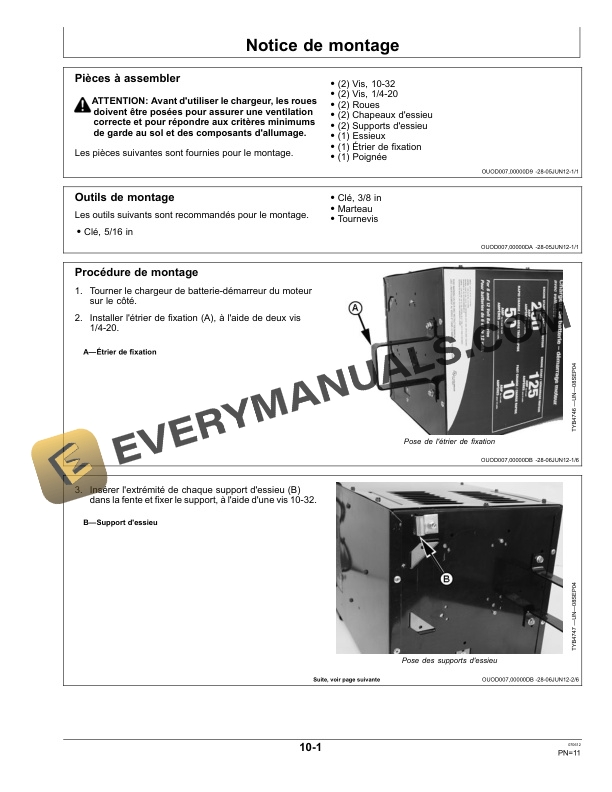
- 1.1.1.1. Assembly Parts
- 1.1.1.2. Assembly Tools
- 1.1.1.3. Assembly Procedure
- 1.1.2. Controls and Operation
- 1.1.2.1. Preparing Battery
- 1.1.2.2. Positioning Battery Charger
- 1.1.2.3. Checking Battery StateofCharge
- 1.1.2.4. Identifying Battery Reserve Capacity (RC) Rating
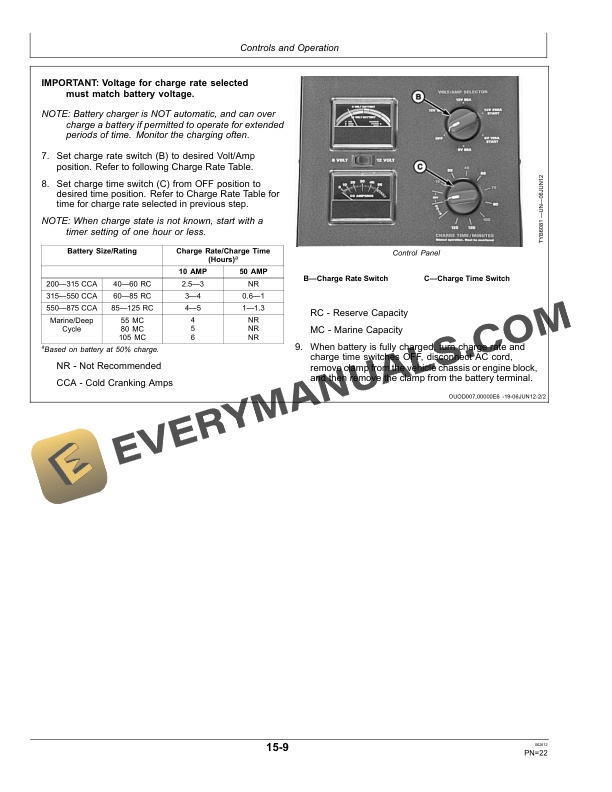
- 1.1.2.5. Estimating Battery Recharge Time
- 1.1.2.6. Activating and Charging a Dry Battery
- 1.1.2.7. Testing Battery Installed In Vehicle
- 1.1.2.8. Testing Battery Outside of Vehicle
- 1.1.2.9. Charging Battery Installed In Vehicle
- 1.1.2.10. Charging Battery Outside of Vehicle
- 1.1.2.11. Starting Engine
- 1.1.3. Troubleshooting
- 1.1.3.1. Troubleshooting Battery Charger
- 1.1.4. Storage
- 1.1.4.1. Storing Battery Charger
- 1.1.5. Specifications
- 1.1.5.1. Battery Charger Specifications
- 1.1.5.2. Record Product Information
- 1.1.6. Warranty
- 1.1.6.1. Warranty
- 1.1.7. John Deere Service Literature Available
- 1.1.7.1. Technical Information
- 1.1.8. John Deere Service Keeps You On The Job
- 1.1.8.1. John Deere Is At Your Service
- 1.2. Page Number
- 1.2.1. Section 05
- 1.2.2. Section 10
- 1.2.3. Section 15
- 1.2.4. Section 20
- 1.2.5. Section 25
- 1.2.6. Section 30
- 1.2.7. Section 35
- 2. OMTY25862_28_13JUN12
- 2.1. Table des mati?res
- 2.1.1. S?curit?
- 2.1.1.1. Reconna?tre les symboles de mise en garde
- 2.1.1.2. Comprendre les termes de mise en garde
- 2.1.1.3. Respecter les consignes de s?curit?
- 2.1.1.4. ?viter une explosion des batteries
- 2.1.1.5. ?viter les br?lures dues ? lacide des batteries
- 2.1.1.6. Porter des v?tements de protection
- 2.1.1.7. Manipulation des produits chimiques en toute s?curit?
- 2.1.1.8. ?limination correcte des d?chets
- 2.1.1.9. CONSIGNES DE S?CURIT? IMPORTANTES ? CONSERVER
- 2.1.1.10. S?curit? des personnes
- 2.1.1.11. Pr?cautions de raccordement du chargeur de batterie
- 2.1.1.12. Autocollant de s?curit?
- 2.1.2. Notice de montage
- 2.1.2.1. Pi?ces ? assembler
- 2.1.2.2. Outils de montage
- 2.1.2.3. Proc?dure de montage
- 2.1.3. Commandes et fonctionnement
- 2.1.3.1. Pr?paration de la batterie
- 2.1.3.2. Positionnement du chargeur de batterie
- 2.1.3.3. Contr?le de l?tat de charge de la batterie
- 2.1.3.4. Calcul de la capacit? nominale de r?serve dune batterie
- 2.1.3.5. Estimation du temps de charge de la batterie
- 2.1.3.6. Activation et charge dune batterie s?che
- 2.1.3.7. Contr?le dune batterie install?e dans un v?hicule
- 2.1.3.8. Contr?le de la batterie hors du v?hicule
- 2.1.3.9. Charge dune batterie install?e dans un v?hicule
- 2.1.3.10. Charge dune batterie hors du v?hicule
- 2.1.3.11. D?marrage du moteur
- 2.1.4. Pannes et rem?des
- 2.1.4.1. D?pannage du chargeur de batterie
- 2.1.5. Stockage
- 2.1.5.1. Remisage du chargeur de batterie
- 2.1.6. Caract?ristiques
- 2.1.6.1. Caract?ristiques du chargeur de batterie
- 2.1.6.2. Enregistrement des informations sur le produit
- 2.1.7. Garantie
- 2.1.7.1. Garantie
- 2.1.8. Publications dentretien John Deere
- 2.1.8.1. Documentation technique
- 2.1.9. Nous vous aidons ? faire votre travail
- 2.1.9.1. John Deere est toujours l? o? il le faut
- 2.2. Page R?f?rence
- 2.2.1. Section 05
- 2.2.2. Section 10
- 2.2.3. Section 15
- 2.2.4. Section 20
- 2.2.5. Section 25
- 2.2.6. Section 30
- 2.2.7. Section 35
- 2.2.8. Section SLIT
- 2.2.9. Section IBC
Related products
-50%

Original price was: $20.$10Current price is: $10.

-50%

Original price was: $20.$10Current price is: $10.
-50%

Original price was: $20.$10Current price is: $10.
-50%

Original price was: $20.$10Current price is: $10.

-50%

Original price was: $20.$10Current price is: $10.