
John Deere 13.5L OEM Diesel Engine (Tier 2 Emergency Standby Generators) Operator Manual OMDZ114317
$30
- Machine Type: Diesel Engine
- Model: 13.5L
- Manual Type: Operator Manual
- Language: English
- Serial Number:
- Part Number: OMDZ114317
- Format: PDF
- Size: 6.84 MB
- Pages: 196
Description
Contents:
Record Keeping
Record Engine Serial Number
Engine Option Codes
Record Engine Control Unit (ECU) Serial Number
Record Rear Power Take-Off (PTO) Serial Number (If Equipped)
Emergency Stationary Engine Rule
Safety
Recognize Safety Information
Understand Signal Words
Follow Safety Instructions
Replace Safety Signs
California Proposition 65 Warning
Illuminate Work Area Safely
Work in Clean Area
Use Proper Tools
Live With Safety
Prevent Machine Runaway
Handle Fuel Safely-Avoid Fires
Prepare for Emergencies
Handle Starting Fluid Safely
In Case of Fire
Handle Fluids Safely-Avoid Fires
Avoid Static Electricity Risk When Refueling
Service Machines Safely
Wear Protective Clothing
Protect Against Noise
Handling Batteries Safely
Prevent Acid Burns
Stay Clear of Rotating Drivelines
Install All Guards
Practice Safe Maintenance
Remove Paint Before Welding or Heating
Avoid Heating Near Pressurized Fluid Lines
Avoid High-Pressure Fluids
Do Not Open High-Pressure Fuel System
Protect Against High Pressure Spray
Prevent Battery Explosions
Avoid Hot Exhaust
Work In Ventilated Area
Service Cooling System Safely
Decommissioning – Proper Recycling and Disposal of Fluids and Components
Fuels, Lubricants, and Coolant
Diesel Fuel
Supplemental Diesel Fuel Additives
Lubricity of Diesel Fuel
Handling and Storing Diesel Fuel
Biodiesel Fuel
Testing Diesel Fuel
Fuel Filters
Minimizing the Effect of Cold Weather on Diesel Engines
Diesel Engine Break-In Oil – Non-Emissions Certified and Certified Tier 1, Tier 2, Tier 3, Stage I, Stage II, and Stage III
Diesel Engine Oil – Tier 2 and Stage II
Engine Oil and Filter Service Intervals – Tier 2 and Stage II – OEM Applications
Diesel Engine Oil and Filter Service Intervals
Mixing of Lubricants
Alternative and Synthetic Lubricants
Lubricant Storage
Oil Filters
Diesel Engine Coolant (engine with wet sleeve cylinder liners)
Water Quality for Mixing with Coolant Concentrate
Operating in Warm Temperature Climates
Testing Coolant Freeze Point
Disposing of Coolant
Instrument Panel and Diagnostic Gauge
Instrument Panels
PV101 Instrument Panels
PV101 Diagnostic Gauge – Using
PV101 Diagnostic Gauge – Main Menu
PV101 Diagnostic Gauge – Essential Menus
DG14 Diagnostic Gauge – Using
DG14 Diagnostic Gauge – Main Menu
DG14 Diagnostic Gauge – Essential Menus
PV480 Instrument Panel
PV480 Diagnostic Gauge – Using
PV480 Diagnostic Gauge – Main Menu
PV480 Diagnostic Gauge – Essential Menus
Main Menu Navigation
Engine Configuration Data
Accessing Stored Trouble Codes
Accessing Active Trouble Codes
Engine Shutdown Codes
Adjusting Backlighting
Adjusting Contrast
Selecting Units Of Measurement
Setup 1-Up Display
Setup 4-Up Display
John Deere PowerSight
Engine Operation
Engine Break-In Service
Auxiliary Gear Drive Limitations
Generator Set (Standby) And All Other OEM Engine Applications
Starting the Engine
Restarting Engine Which Has Run Out Of Fuel
Warming Engine
Normal Engine Operation
Cold Weather Operation
Changing Engine Speed
Avoid Excessive Engine Idling
Stopping the Engine
Using a Booster Battery or Charger
Lubrication and Maintenance
Required Emission-Related Information
Observe Service Intervals
Use Correct Fuels, Lubricants, and Coolant
Lubrication and Maintenance Service Interval Chart-Industrial Unit and Generator (Prime Power)
Lubrication and Maintenance Service Interval Chart-Generator (Standby) Applications
Lubrication & Maintenance – Daily
Daily Prestarting Checks
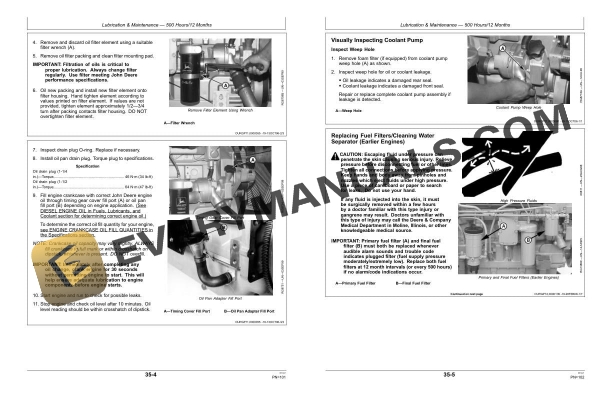
Lubrication & Maintenance – 500 Hours/12 Months
Servicing Fire Extinguisher
Servicing Battery
Changing Engine Oil and Replacing Oil Filter
Visually Inspecting Coolant Pump
Replacing Fuel Filters/Cleaning Water Separator (Earlier Engines)
Replacing Fuel Filters/Cleaning Water Separator (Later Engines)
Checking and Adjusting Engine Speeds
Checking Engine Mounts
Checking Crankcase Vent Tube and Valve
Checking Air Intake System
Check Engine Electrical Ground Connection
Checking Belt Tensioner Spring Tension and Belt Wear
Checking Cooling System
Testing Diesel Engine Coolant
Replenishing Supplemental Coolant Additives (SCAs) Between Coolant Changes
Pressure Testing Cooling System
Lubrication & Maintenance – 2000 Hours/24 Months
Checking Crankshaft Vibration Damper
Testing Thermostats Opening Temperature
Lubrication & Maintenance – 2500 Hours
Checking and Adjusting Engine Valve Clearance and Electronic Unit Injector Preload
Do Not Modify Fuel System
Service as Required
Additional Service Information
Adding Coolant
Pre-Start Cleaning Guide
Flushing and Refilling Cooling System
Replacing Air Cleaner Filter Elements
Draining Fuel Filter Water Separator Bowl
Bleeding Fuel System (Earlier Engines)
Bleeding Fuel System (Later Engines)
Replacing Fan/Alternator V-Belts
V-Belt Routing
Checking Fuses
Air Compressors
Rear Power Take-Off (PTO)
Troubleshooting
General Troubleshooting Information
Instrument Panel Method for Retrieving Diagnostic Trouble Codes
Displaying Of Diagnostic Trouble Codes (DTCs)
Listing of Diagnostic Trouble Codes (DTCs)
Intermittent Fault Diagnostics
Displaying Diagnostic Gauge Software
Engine Troubleshooting
Engine Troubleshooting (Continued)
Electrical Troubleshooting
Lubrication System Troubleshooting
Cooling System Troubleshooting
Air Intake and Exhaust System Troubleshooting
Low Pressure Fuel System Troubleshooting
Electrical System Layout
Electrical System Layout- Continued
Precautions for Welding on Vehicles Equipped with Electronic Engine Control Unit (ECU)
Precautions for Electrical System When Steam Cleaning Engine
Engine Wiring Diagram (Engines With Full-Featured Instrument Panel)
Engine Wiring Diagram (Engines With Full-Featured Instrument Panel) (Continued)
Engine Wiring Diagram (Engines With Full-Featured Instrument Panel) (Continued)
Storage
Engine Storage Guidelines
Preparing Engine for Long Term Storage
Removing Engine from Long-Term Storage
Specifications
General OEM Engine Specifications
Engine Power Ratings And Fuel System Specifications
Engine Crankcase Oil Fill Quantities
Unified Inch Bolt and Screw Torque Values
Metric Bolt and Screw Torque Values
Lubrication and Maintenance Records
Using Lubrication and Maintenance Records
Daily (Prestarting) Service
500 Hours of Operation/or 12 Months Service
2000 Hours of Operation/or 24 Months Service
2500 Hours of Operation Service
Service as Required
Warranty
John Deere Warranty in OEM Applications
Emissions Control System Certification Label
EPA Non-road Emissions Control Warranty Statement-Compression Ignition
CARB Non-road Emissions Control Warranty Statement-Compression Ignition
Related products