
John Deere H425 Harvester Head Operator Instruction F722912
$30
- Type Of Manual: Operator Instruction
- Manual ID: F722912
- Format: PDF
- Size: 17.1MB
- Number of Pages: 226
Description
-
Model List:
- H425 Harvester Head
- 1. Table of Contents
- 2. Foreword
- 2.1. Copyright
- 2.2. Foreword
- 2.3. Declaration of Incorporation
- 2.4. General assembly instructions
- 2.5. Product identification
- 2.6. Base machine requirements
- 2.7. Standard warranty
- 3. Safety
- 3.1. Follow Laws and Regulations
- 3.1.1. Recognize Safety Information
- 3.1.2. Understand Signal Words
- 3.1.3. Prepare for Emergencies
- 3.1.4. Wear Protective Clothing
- 3.1.5. Handle Chemical Products Safely
- 3.1.6. Cabin protective structures
- 3.2. Operating the harvester head
- 3.2.1. Attach Do not Operate Tag
- 3.2.2. Pay Attention to Bystanders
- 3.2.3. Operate the Boom Safely
- 3.2.4. Keep Danger Zone Clear
- 3.2.5. Avoid saw chain shots
- 3.2.6. Avoid Crush Points
- 3.2.7. Avoid Power Lines
- 3.2.8. What To Do If the Machine Catches Fire
- 3.2.9. After a fire
- 3.3. Maintenance
- 3.3.1. Keep Machine in Good Condition
- 3.3.2. Use Proper Clothing
- 3.3.3. Use Proper Tools
- 3.3.4. Support Machine Properly
- 3.3.5. Avoid High Pressure Fluids
- 3.3.6. Avoid Heating near Pressurized Fluid Lines
- 3.3.7. Make Welding Repairs Safely
- 3.3.8. Dispose of Waste Properly
- 3.4. Safety Decal Locations
- 4. Specifications
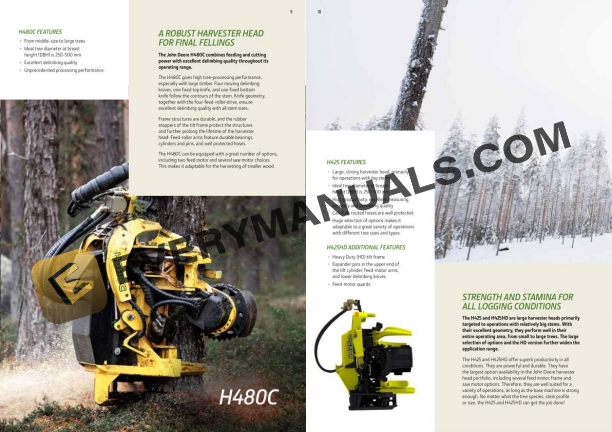
- 4.1. Harvester head brochure
- 4.2. Harvester head specifications
- 4.3. General hydraulic system requirements
- 4.4. General hose and fitting requirements
- 4.5. Key characteristics
- 4.6. Harvester head components (H425)
- 5. Transportation and storage
- 5.1. Preparing for storage
- 5.2. Harvester head fastening for transportation
- 6. Harvesting instructions
- 6.1. Planning the work
- 6.1.1. Example of map sketch
- 6.2. Thinning
- 6.2.1. Thinning with harvester alone
- 6.2.2. Thinning with harvester and chain saw
- 6.2.3. Thinning between logging roads
- 6.3. Regeneration harvesting
- 6.3.1. Felling into trees
- 6.3.2. Felling outwards from the stand
- 6.3.3. Felling in both directions
- 6.4. Felling
- 6.4.1. Felling stage
- 6.4.2. Felling on slope
- 6.4.3. Felling trees with large roots
- 6.5. Delimbing and crosscutting
- 7. Systems and Components
- 7.1. Delimbing knives
- 7.1.1. Delimbing quality
- 7.1.2. Advantages of sharp knives
- 7.1.3. Delimbing knives cylinders
- 7.2. Four roller feeding
- 7.2.1. Feed rollers
- 7.2.2. Multispeed system
- 7.2.3. Grabbing
- 7.3. Saw unit, SuperCut 100S
- 7.3.1. Saw feeding mechanism
- 7.3.2. Saw chains and saw bars (SuperCut 100S)
- 7.3.3. Chain oil lubrication system
- 7.3.4. Chain grease lubrication system
- 7.3.5. Chain shot guard
- 7.3.6. Saw sensor
- 7.4. Sensors
- 7.5. Length measuring
- 7.5.1. Length measuring device with steel measuring wheel arm (H423/H425)
- 7.5.2. Length measuring device with cast measuring wheel arm and BEI256 sensor (H423/H424/H425)
- 7.5.3. Measuring wheel alternatives
- 7.6. Diameter measuring device, upper knives
- 7.7. PEvo harvester head valve
- 7.7.1. Hydraulic functions
- 7.7.2. PEvo connectors
- 7.7.3. HHC (L22) connectors (H425)
- 7.8. Hydraulic hoses
- 7.9. Optional equipment
- 7.9.1. MultiTree Handling unit
- 7.9.2. Color marking unit
- 7.9.3. Stump treatment
- 7.9.4. Top saw unit
- 7.9.5. Processing delimbing knife
- 7.10. Tutorial videos for main harvester head components
- 8. General maintenance
- 8.1. General
- 8.2. Preparations
- 8.3. Welding instructions
- 8.4. H415/H425 tightening torques
- 8.5. Conical sleeve pin tightening
- 8.6. Fluids and lubricants
- 8.7. Filling capacities
- 8.8. Hydraulic pressure measurements
- 8.8.1. Main relief valve pressure
- 8.8.2. Low pressure
- 8.8.3. Pilot pressure
- 8.8.4. Saw chain tensioning pressure
- 8.8.5. Top saw bar feed pressure
- 8.8.6. Length measuring pressure
- 8.8.7. Color marking pump pressure
- 8.8.8. MAF pressure
- 8.9. Control system pressure settings of delimbing knives and feed rollers
- 8.10. Special tools
- 8.10.1. Extractor tool for Deutsch connectors
- 8.10.2. Saw motor installation tool
- 8.10.3. Assembly tool for feed cylinder piston gasket
- 8.10.4. Check valve installation tool
- 8.10.5. Hook spanners
- 8.10.6. Length measuring wheel bearing puller
- 8.10.7. Sharpening gauge
- 8.10.8. Special wrench tool
- 9. Periodic maintenance
- 9.1. Service intervals
- 9.2. Every 10 hours
- 9.2.1. Check diameter measuring device
- 9.2.2. Check chain lubrication system
- 9.2.3. Fill chain oil tank
- 9.2.4. Fill grease lubrication container
- 9.2.5. Maintain color marking unit
- 9.3. Every 25 hours
- 9.3.1. Grease front side of head
- 9.3.2. Grease right side of head
- 9.3.3. Grease left side of head
- 9.3.4. Grease saw unit
- 9.3.5. Grease hose bracket swivel
- 9.3.6. Grease multitree handling unit
- 9.3.7. Grease multitree handling tilt
- 9.3.8. Grease multispeed motor shaft seal
- 9.3.9. Grease top saw
- 9.4. Every 50 hours
- 9.4.1. Grease upper knife shaft housing
- 9.4.2. Grease diameter sensor housing
- 9.4.3. Grease the bar holder (SuperCut 100S)
- 9.4.4. Grease rotator and link
- 9.4.5. Check harvester head mounting
- 9.4.6. Tighten rotator vertical pins (HX 30)
- 9.5. Every 1000 hours
- 9.5.1. Measure hydraulic pressures
- 9.5.2. Check
- 9.5.3. Clean saw chain oil strainer
- 9.5.4. Clean color marking tank strainer
- 9.5.5. Clean rotator magnetic plug
- 9.5.6. Sharpen delimbing knives
- 9.5.7. Tighten rotator screws
- 9.5.8. Tighten rotator vertical pins (HX 30)
- 9.6. As required
- 9.6.1. Saw unit maintenance
- 9.6.2. Top saw maintenance
- 9.6.3. Inspect chain shot guard
- 9.6.4. Color marking maintenance
- 9.6.5. Grease lubrication maintenance
- 9.6.6. Replace length sensor, device with steel measuring wheel arm
- 9.6.7. Replace length sensor, device with cast measuring wheel arm and contactless BEI256 sensor
- 9.6.8. Adjust diameter sensor
- 9.6.9. Multispeed feeding
- 9.6.10. Stump treatment system maintenance
- 9.6.11. Tighten the conical sleeve pins of feed roller arms
- 10. Attachments
- 10.1. Declaration of Incorporation template_harvester_head_en
- 10.2. JD_Harvesterheads_200_400series_EN
Related products

-50%

Original price was: $20.$10Current price is: $10.

-50%

Original price was: $20.$10Current price is: $10.

-50%

Original price was: $20.$10Current price is: $10.