
Description
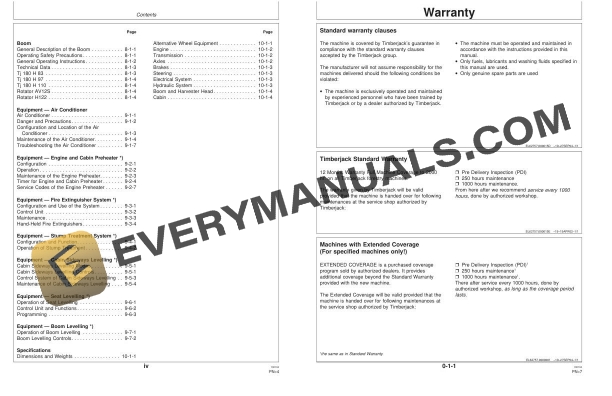
Contents:
Warranty
Standard warranty clauses
Timberjack Standard Warranty
Machines with Extended Coverage (For specified machines only!)
Periodic Maintenance
Safety – Safety Features
Timberjack 1070D Harvester Safety Features
Safety – General Precautions
General
Recognize Safety Information
Understand Signal Words
Prepare for Emergencies
Wear Protective Clothing
Handle Fluids Safely – Avoid Fires
Handle Chemical Products Safely
Replace Safety Signs
Maintain Safety Cabin
Install Radio Transmitters Properly
Safety – Operating Precautions
Inspect Machine
Attach Do not Operate Tag
Prevent Machine Runaway
Use Handholds and Steps
Handle Starting Fluids Safely
Pay Attention to Bystanders
Keep Riders of the Machine
Use Seat Belt
Avoid Risks under Difficult Conditions
Stop Working if Machine Gives an Alarm
Keep Danger Zone Clear
Avoid Crush Points
Avoid Power Cables
Driving/Transporting on Public Roads
Ensure Safety before Driving on Frozen Waters
Prevent Fires
What to Do if the Machine Fires?
Safety – Maintenance Precautions
General
Before Servicing
Use Proper Clothing
Use Proper Tools
Support Machine Properly
Shut Down Engine, Disconnect Battery Cable
Service Cooling System Safely
Prevent Battery Explosions
Prevent Acid Burns
Start Only from Operator’s Seat
Beware of Exhaust Fumes
Avoid High Pressure Fluids
Avoid Heating near Pressurized Fluid Lines
Make Welding Repairs Safely
Service Tires Safely
Refueling and Servicing Fuel System
Dispose of Waste Properly
Cabin and Controls
Cab Component Locator
Main Switch
Control Lights
Dashboard
Boom Controls
Control Keypads
Air Conditioner, Operation Instructions
Pedals
Adjusting the Operator’s Seat
Operating Instructions
General
Safety Switches and Emergency Stop
Boom
Brakes
Steering
High/Low Gear and Front Wheel Drive
Differential Locks
Frame Brake
Before Starting the Engine for the First Time in a Working Day
Starting the Engine
Cold Weather Starting
After Starting
Turning off the Engine
Off-Road Driving
On-Road Driving
Transporting and Towing
Transporting the Machine
Towing the Machine
Releasing the Parking Brake
Disengaging the Power Transmission System
Releasing the Work Brake
Releasing the Steering
Stowing a Disabled Boom
Maintenance – General
Maintenance
Servicing Safety Precautions
Assembly Instructions
Tightening Torque for Bolted Joints
Welding Instructions
Instructions for Cleaning of Lexan/Marguard Windows
Wheels
Changing Wheels
Anti-Slip Fitting
Bogie Tracks, Fitting
Maintenance – Lubricants and Fluids
Recommended Lubricants and Fluids
Capacities
Diesel Fuel
Engine Oil
Coolant
Grease
Hydraulic Oil
Brake Fluid
Gear Oil
Maintenance Intervals
Checklist – Base Machine
Reguired Parts
Maintenance – Every 10 Hours or Daily
Check the Hydraulic Oil Level
Check the Engine Oil Level
Remove Sediment and Water from the Primary Fuel Filter
Check the Coolant Level
Check the Air Filter Indicator
Check the Radiator Grille Cleanness
Check the Tires Visually for Air Pressure and Overall Shape
Other Procedures
At the End of the Day Make the Following Maintenance and Check-Ups
Fill Up the Fuel Tank
Maintenance – Every 50 Hours or Weekly
Check the Driving Brake Oil Level and Window Washer Fluid Level
Grease the Center Hinge Bearings and Steering Cylinder Bearings
Other Procedures
Maintenance – Every 250 Hours
Clean the Machine
Check the Drive Belts Condition
Check Oil Levels in the High/Low Gear, Differentials, Bogie Casings and Hub Gears
Grease Bogie Bearings
Check the Proper Function of the Door Safety Switch
Other Procedures
Maintenance – Every 500 Hours
Change Engine Oil And Oil Filter
Clean Crank Case Vent Tube
Check Air Intake System
Replace Fuel Filters
Check Belt Tensioner and Belt Wear
Check Cooling System and Coolant Solution
Remove Sediment and Water from the Fuel Tank
Check the Batteries for Charge and Electrolyte Level
Check Wear on Frame Brake Linings
Grease the Driveshafts
Other Procedures
Maintenance – Every 1000 Hours
Change Hydraulic Oil and Return Filters (2 pcs)
Change the Off-line Filter *) Element
Change the Hydraulic Tank Breather
Change the Filter of the Driving Pump
Change the Brake Pedal Circuit Oil
Check the Exhaust Manifold
Other Procedures
Maintenance – Every 2000 Hours
Check Valve Clearance
Check Crankshaft Vibration Damper
Change the Coolant
Change Oil in the High/Low Gear, Differentials, Bogie Casings and Hub Gears
Other Procedures
Maintenance – Periodic Maintenance
Maintenance after every Six Months
Annual Maintenance
Maintenance – As Required
When Necessary, Service and Adjust the Following
Adjusting the Rotator Link Brakes
Cleaning the Fuel Tank Filler Filter
Bleeding the Fuel System
Maintenance – Boom
Maintenance Intervals
Every 10 Hours or Daily
Every 50 Hours or Weekly
Every 250 Hours
Every 1000 Hours
Every 2000 Hours
Maintenance – Machine Storage
Preparing Machine for Storage
After Storage
Hydraulic System – General
Working Hydraulic System
Hydrostatic System
Hydraulic Tank
Vacuum Pump
Taking an Oil Sample from Hydraulic System
Hydraulic System – Bleeding
Bleeding Air from the Hydraulic Tank
Bleeding Air from the Hydrostatic System
Bleeding Air From the Working Hydraulic System
Bleeding the Brakes
Hydrostatic System – Checking and Adjusting
Supply Pressure on the Drive Pump
Drive Pressure
Drive motor, checking flushing pressure
Drive motor, pressure cut-off
Drive motor, adjustment in TMC
Working Hydraulics – Checking and Adjusting
General
Pressure Difference Dp
Main Pressure Relief Valve
Maximum Pressure Settings of the Working Hydraulic Pump
Pilot Pressure, Working Hydraulics
Boom Valve, LS Pressure Limits
The Back-Pressure Valve of the Boom Tank Line
Brake System – Checking and Adjusting
Checking the Brakes
Mechanical Adjustment of Brakes
Checking the Service Brake
Checking the Work Brake
Checking the Load and Release Range
Checking the Relief Valve of the Brake Charging Pressure
Hydraulic System – Hydraulic Scheme
Hydraulic Scheme
Electrical System
General
Using Booster Batteries
Main Switch and Switch Panel
Switch Panel Fuses
Instrument Compartment
Relays, Instrument Compartment
Fuse box, Instrument Compartment
PC board, Instrument Compartment
Electrical System – Sensors
Engine
Hydraulic Tank
Transmission
Brake System
Fuel System
Position Sensors
Electrical System – Electrical Scheme
Electrical Scheme
Transmission
Transmission Operation
Hydrostatic System
Control of Transmission
Brakes
Boom
General Description of the Boom
Operating Safety Precautions
General Operating Instructions
Technical Data
Tj 180 H 83
Tj 180 H 97
Tj 180 H 110
Rotator AV12S
Rotator H122
Equipment – Air Conditioner
Air Conditioner
Danger and Precautions
Configuration and Location of the Air Conditioner
Maintenance of the Air Conditioner
Troubleshooting the Air Conditioner
Equipment – Engine and Cabin Preheater *)
Configuration
Operation
Maintenance of the Engine Preheater
Timer for Engine and Cabin Preheater
Service Codes of the Engine Preheater
Equipment – Fire Extinguisher System *)
Configuration and Use of the System
Control Unit
Maintenance
Hand-Held Fire Extinguishers
Equipment – Stump Treatment System *)
Configuration and Function
Operation of Stump Treatment
Equipment – Cabin Sideways Levelling *)
Cabin Sideways Levelling Modes
Cabin Sideways Levelling Controls
Control System of Cabin Sideways Levelling
Maintenance of Cabin Sideways Levelling
Equipment – Seat Levelling *)
Operation of Seat Levelling
Control Unit and Functions
Programming
Equipment – Boom Levelling *)
Operation of Boom Levelling
Boom Levelling Controls
Specifications
Dimensions and Weights
Alternative Wheel Equipment
Engine
Transmission
Axles
Brakes
Steering
Electrical System
Hydraulic System
Boom and Harvester Head
Cabin