
Description
-
Model List:
- 2320 Compact Utility Tractor
- 1. Introduction
- 1.1. Thank You for Purchasing a John Deere Product
- 1.2. Using Your Operators Manual
- 1.3. Machine Use
- 1.4. Special Messages
- 2. Product Identification
- 2.1. Record Identification Numbers
- 3. Table of Contents
- 4. Safety Labels
- 4.1. Safety Label Location
- 4.2. Pictorial Safety Signs
- 4.3. CAUTION LVU805494
- 4.4. CAUTION HOT SURFACE
- 4.5. WARNING LVU23360
- 4.6. WARNING LVU802017
- 4.7. Drawbar EEC Label
- 4.8. RollOver Protective Structure Label
- 4.9. Wagon Hitch EEC Information
- 4.10. Recognize Safety Information
- 4.11. Understand Signal Words
- 4.12. Follow Safety Instructions
- 4.13. Prepare for Emergencies
- 4.14. Wear Protective Clothing
- 4.15. Protect Against Noise
- 4.16. Handle Fuel Safely Avoid Fires
- 4.17. Fire Prevention
- 4.18. Use Foldable ROPS and Seat Belt Properly
- 4.19. Stay Clear of Rotating Drivelines
- 4.20. Use Steps and Handholds Correctly
- 4.21. Read Operator Manuals for ISOBUS Implements
- 4.22. Use Seat Belt Properly
- 4.23. Vibration
- 4.24. Operating the Tractor Safely
- 4.25. Avoid Backover Accidents
- 4.26. Limited Use in Forestry Operation
- 4.27. Operating the Loader Tractor Safely
- 4.28. Keep Riders Off Machine
- 4.29. Passenger Seat
- 4.30. Use Safety Lights and Devices
- 4.31. Towing Trailers and Implements Safely (Mass)
- 4.32. Use Caution On Slopes and Uneven Terrain
- 4.33. Freeing a Mired Machine
- 4.34. Avoid Contact with Agricultural Chemicals
- 4.35. Handle Agricultural Chemicals Safely
- 4.36. Handling Batteries Safely
- 4.37. Avoid Heating Near Pressurized Fluid Lines
- 4.38. Remove Paint Before Welding or Heating
- 4.39. Handle Electronic Components and Brackets Safely
- 4.40. Practice Safe Maintenance
- 4.41. Avoid Hot Exhaust
- 4.42. Work in a Ventilated Area
- 4.43. Support Machine Properly
- 4.44. Prevent Machine Runaway
- 4.45. Park Machine Safely
- 4.46. Transport Tractor Safely
- 4.47. Servicing Cooling System Safely
- 4.48. Service Accumulator Systems Safely
- 4.49. Service Tires Safety
- 4.50. Service FrontWheel Drive Tractor Safely
- 4.51. Tightening Wheel Retaining Bolts / Nuts
- 4.52. Avoid High Pressure Fluids
- 4.53. Do Not Open HighPressure Fuel System
- 4.54. Store Attachments Safely
- 4.55. Dispose of Waste Properly
- 5. Operating Controls
- 5.1. Operator Station Controls
- 5.2. Floor Panel Controls
- 6. Operating
- 6.1. Daily Operating Checklist
- 6.2. Avoid Damage to Plastic and Painted Surfaces
- 6.3. Operator Station Controls
- 6.4. Floor Panel Controls
- 6.5. Cab Classification According to EN156951 (for Application of Crop Protection Chemicals and Liqui…
- 6.6. Adjusting Seat
- 6.7. Using Seat Belt
- 6.8. Using Light Switch
- 6.9. Using Key Switch
- 6.10. Using Horn
- 6.11. Using Instrument Panel
- 6.12. Using Turn Signal Switch
- 6.13. Using Hazard Warning Light Switch
- 6.14. Testing Safety Systems
- 6.15. Testing the Neutral Start Switch
- 6.16. Testing the PowerTakeOff (PTO) Switch
- 6.17. Testing the Seat Switch
- 6.18. Testing MidPTO/Seat Switch Interface
- 6.19. Testing Rear PTO/Park Brake Interface
- 6.20. Using Brake Pedals
- 6.21. Using Park Brake
- 6.22. Using Throttle
- 6.23. Using Fuel ShutOff Valve
- 6.24. Starting the Engine
- 6.25. Cold Weather Starting Aids
- 6.26. Warming and Idling the Engine
- 6.27. Starting a Stalled Engine
- 6.28. Stopping Machine
- 6.29. Operating the Hydrostatic Transmission
- 6.30. Using Cruise Control
- 6.31. Using Differential Lock (Traction Assist)
- 6.32. Using Mechanical Front Wheel Drive (MFWD)
- 6.33. Using the PowerTakeOff (PTO) Safely
- 6.34. Using Rear and Mid PTO (Operator on Seat)
- 6.35. Using Rear PTO (Operator Off Seat)
- 6.36. Using Drawbar Hitch
- 6.37. Using 3Point Hitch
- 6.38. Connecting Implement Hydraulic Hoses
- 6.39. Using Hydraulic Dual Selective Control Valve (SCV)
- 6.40. Using Selective Control Valve (SCV) Lock Lever
- 6.41. Locking Out Dual SCV Regen Function
- 6.42. Operating Cab (If Equipped)
- 6.43. Selecting Ballast
- 6.44. Ballasting Machine
- 6.45. Transporting Machine on Trailer
- 6.46. Transporting Machine
- 6.47. Towing Loads
- 6.48. Using Safety Chain
- 6.49. Raising and Lowering RollOver Protective Structure (ROPS)
- 6.50. Front Loader Installation
- 7. Replacement Parts
- 7.1. Service Literature
- 7.2. Part Numbers
- 8. Service Intervals
- 8.1. Servicing Your Machine
- 8.2. As Needed
- 8.3. After First 10 Hours
- 8.4. Every 10 Hours or Daily
- 8.5. After First 50 Hours
- 8.6. Every 50 Hours
- 8.7. Every 200 Hours
- 8.8. Every 400 Hours
- 8.9. Every 600 Hours
- 8.10. Every 1200 Hours
- 8.11. Every Two Years or 2000 Hours
- 9. Service Lubrication
- 9.1. Lubricating Machine Grease Fittings
- 9.2. Lubricating Hydraulic Selective Control Valve (SCV) Linkage
- 9.3. Lubricating Hood Latch
- 9.4. Lubricating 3Point Hitch
- 10. Service Engine
- 10.1. Avoid Fumes
- 10.2. Engine Oil
- 10.3. Checking Engine Speeds
- 10.4. Checking Engine Oil Level
- 10.5. Changing Engine Oil and Filter
- 10.6. Cleaning Dust Unloading Valve
- 10.7. Servicing Air Filter Elements
- 10.8. Checking Air Filter Intake Hoses and Clamps
- 10.9. Service Cooling System Safely
- 10.10. Recommended Engine Coolant
- 10.11. Servicing Cooling System
- 10.12. Checking Radiator Hoses and Clamps
- 10.13. Cleaning Radiator Cooling Screen and Fins
- 10.14. Servicing the Alternator Belt
- 10.15. Checking and Cleaning Fuel Filter Sediment Bowl and Replacing Filter
- 10.16. Fuel Injection Pump
- 10.17. Fuel Injection Nozzles
- 10.18. Cleaning Front Grille Screens
- 11. Service Transmission
- 11.1. Gear Case Oil
- 11.2. Checking Front Axle Oil Level
- 11.3. Changing Front Axle Oil
- 11.4. Transmission and Hydraulic Oil
- 11.5. Checking Transmission Oil Level
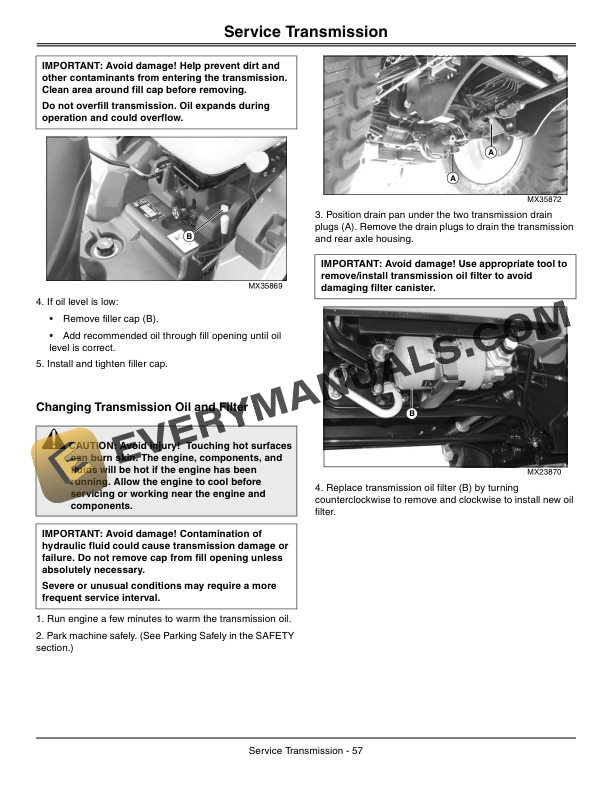
- 11.6. Changing Transmission Oil and Filter
- 12. Service Electrical
- 12.1. Service the Battery Safely
- 12.2. Checking Battery Electrolyte Level
- 12.3. Removing and Installing Battery
- 12.4. Cleaning Battery and Terminals
- 12.5. Using Booster Battery
- 12.6. Replacing Headlight Bulb
- 12.7. Replacing Taillight and Warning Light Bulbs
- 12.8. Replacing Fuses
- 13. Service Miscellaneous
- 13.1. Using Proper Fuel (Diesel)
- 13.2. Filling Fuel Tank
- 13.3. Lifting Points for Jacking up the Tractor
- 13.4. Raising and Lowering Hood
- 13.5. Checking Wheel Bolts and Hardware
- 13.6. Removing and Installing Wheels
- 13.7. Checking Tire Pressure
- 13.8. Selecting Front Tire Rolling Direction
- 13.9. Cleaning Plastic Surfaces
- 13.10. Cleaning and Repairing Metal Surfaces
- 14. Troubleshooting
- 14.1. Using Troubleshooting Chart
- 14.2. Electrical System
- 14.3. Machine
- 14.4. Steering
- 15. Storage
- 15.1. Storing Safety
- 15.2. Preparing Machine for Storage
- 15.3. Preparing Fuel and Engine For Storage
- 15.4. Removing Machine From Storage
- 16. Assembly
- 16.1. Delivery Instructions
- 16.2. Checking Tire Pressure
- 16.3. Check Fluid Levels
- 16.4. Check Battery
- 16.5. Checking Machine Safety System
- 16.6. Check All Lights
- 16.7. Check Wheel Bolt Torque
- 16.8. Check Machine for Proper Ballast
- 17. Specifications
- 17.1. Drivetrain
- 17.2. Electrical System
- 17.3. Front Wheels and Tires
- 17.4. Rear Wheels and Tires
- 17.5. Front Tire Inflation Pressures (Maximum)
- 17.6. Rear Tire Inflation Pressures (Maximum)
- 17.7. Tire Combinations
- 17.8. Tire Loads
- 17.9. Fluid Capacities
- 17.10. Ground Speeds
- 17.11. Dimensions
- 17.12. Weight Specifications
- 17.13. Sound Level
- 17.14. PTO Options
- 17.15. Point Hitch
- 17.16. Coupling Devices
- 17.17. Torque Values Metric Hardware
- 17.18. Torque Values Inch Fastener Hardware
- 18. Declaration of Conformity
- 18.1. EC Declaration of Conformity
- 19. Service Statement
- 19.1. John Deere Parts
- 19.2. The Right Tools
- 19.3. WellTrained Technicians
- 19.4. Prompt Service
- 20. Service Record
- 20.1. Record Service Dates