

Description
-
Model List:
- MX5 Rotary Cutter
- MX6 Rotary Cutter
- MX7 Rotary Cutter
- 1. Contents
- 1.0.1. Recognize Safety Information
- 1.0.2. Understand Signal Words
- 1.0.3. Follow Safety Instructions
- 1.0.4. Protect Bystanders
- 1.0.5. Stay Clear of Rotating Blades
- 1.0.6. Operate Tractor and Cutter Safely
- 1.0.7. Back Up Safely
- 1.0.8. Leaving Cutter Unattended
- 1.0.9. Keep Riders Off Machine
- 1.0.10. Stay Clear of Rotating Drivelines
- 1.0.11. Use Safety Lights and Devices
- 1.0.12. Store Attachments Safely
- 1.0.13. Prepare for Emergencies
- 1.0.14. Avoid HighPressure Fluids
- 1.0.15. Wear Protective Clothing
- 1.0.16. Transport Cutter Safely
- 1.0.17. Avoid Serious Injury or Death from Accidental Lowering of Cutter
- 1.0.18. Practice Safe Maintenance
- 1.0.19. Remove Paint Before Welding or Heating
- 1.0.20. Safety Features
- 1.1. Safety Signs
- 1.1.1. Replace Safety Signs
- 1.1.2. Safety SignsDrivelines
- 1.1.3. Safety SignsDriveline Shield
- 1.1.4. Safety SignsHitch
- 1.1.5. Safety SignsDeck
- 1.2. Preparing the Tractor
- 1.2.1. Selecting Tractor Size
- 1.2.2. Positioning Tractor Drawbar
- 1.2.3. Selecting Tractor PTO Speed
- 1.2.4. Adjusting Tractor Hitch
- 1.2.5. Checking Ballast, Wheel Spacing, and Tire Inflation
- 1.2.6. Determining Front Ballast
- 1.3. Preparing the Cutter
- 1.3.1. Prestarting Checklist
- 1.3.2. Preparing Hitch Pins
- 1.3.3. Install Hitch Pin Bushings for Quick Coupler Hitch
- 1.3.4. Installing Category 2 Hitch Pin Conversion Kit (MX5 and MX6)
- 1.4. Attaching and Detaching
- 1.4.1. Attach Cutter to Tractor with Quick Coupler
- 1.4.2. Attach Cutter to Tractor with ThreePoint Hitch
- 1.4.3. Assembling Main PTO Driveline Telescoping Members (If Necessary)
- 1.4.4. Attaching PTO Driveline
- 1.4.5. Detach Cutter From Tractor
- 1.5. Transporting
- 1.5.1. Preparing Cutter For Transport
- 1.5.2. Follow Safe Transport Procedures
- 1.5.3. Making Turns
- 1.5.4. Keep Riders Off Machine
- 1.6. Operating the Cutter
- 1.6.1. Preparing Cutter for Operation
- 1.6.2. Adjust Cut Height and Tailwheel Position
- 1.6.3. Keep Riders Off Machine
- 1.6.4. Follow Safe Operating Procedures
- 1.6.5. Operating the Cutter for Best Performance
- 1.6.6. Cutting Technique
- 1.6.7. Turning Cutter
- 1.6.8. Attachments Available
- 1.7. Lubrication and Maintenance
- 1.7.1. Lubricating and Maintaining Machine Safely
- 1.7.2. Gear Case Oil
- 1.7.3. Alternative and Synthetic Lubricants
- 1.7.4. Mixing of Lubricants
- 1.7.5. Lubricant Storage
- 1.7.6. Perform Lubrication and Maintenance
- 1.7.7. Observe Lubrication Symbols
- 1.7.8. Every 8 Hours or Daily
- 1.7.9. Every 24 Hours
- 1.7.10. Every 50 Hours
- 1.7.11. Annually
- 1.7.12. As Required
- 1.8. Service
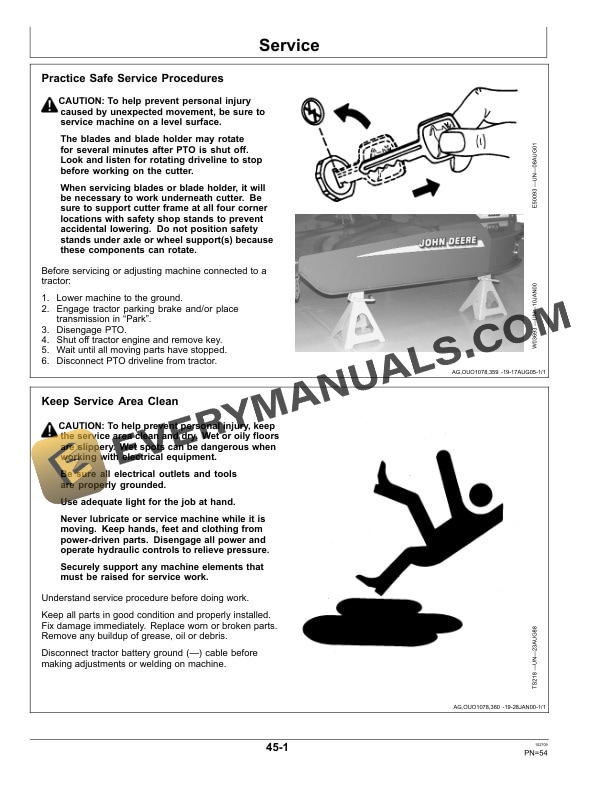
- 1.8.1. Practice Safe Service Procedures
- 1.8.2. Keep Service Area Clean
- 1.8.3. Removing and Installing PTO DrivelineMX5 and MX6
- 1.8.4. Removing and Installing PTO DrivelineMX7
- 1.8.5. Disassembling and Inspecting Slip ClutchMX5 and MX6
- 1.8.6. Disassembling and Inspecting Slip ClutchMX7
- 1.8.7. Assembling Slip Clutch
- 1.8.8. Checking Blade Wear
- 1.8.9. Replacing Blades
- 1.8.10. Direction of Blade Rotation
- 1.8.11. Replacing Skid Shoes
- 1.8.12. Metric Bolt and Screw Torque Values
- 1.8.13. Unified Inch Bolt and Screw Torque Values
- 1.9. Assembly
- 1.9.1. Perform Predelivery Service Safely
- 1.9.2. Install Optional Equipment or Attachments
- 1.9.3. Remove Shipping Dunnage and Parts
- 1.9.4. Check Blade Hardware Torque
- 1.9.5. Fill Gear Case
- 1.9.6. Install Front Safety Shield (Chain)
- 1.9.7. Install Rear Safety Shield (Chain)
- 1.9.8. Install TailwheelMX5 and MX6
- 1.9.9. Install Axle Support(s), Spindle(s) and Tailwheel(s)MX7
- 1.9.10. Install Hitch
- 1.9.11. Install PTO DrivelineMX5 and MX6
- 1.9.12. Install PTO DrivelineMX7
- 1.9.13. Final Inspection and Adjustments
- 1.10. John Deere Service Keeps You On The Job
- 1.10.1. John Deere Is At Your Service
- 2. Page Number
- 2.1. Section 05
- 2.2. Section 10
- 2.3. Section 15
- 2.4. Section 20
- 2.5. Section 25
- 2.6. Section 30
- 2.7. Section 35
- 2.8. Section 40
- 2.9. Section 45
- 2.10. Section 50