

Case Bergmann Dumper 4010 Operating Instruction 50-020-1011-900 PDF
$20
- Type Of Manual: Operating Instruction
- Manual ID: 50-020-1011-900
- Format: PDF
- Size: 13.1MB
- Number of Pages: 284
Description
-
Model List:
- Bergmann Dumper 4010
- 1. Contents
- 2. Basic data
- 2.1. Manufacturer
- 2.2. Machine data
- 2.3. Scope of the documentation (constituent part of the machine)
- 3. General
- 3.1. Preface
- 3.2. About this documentation
- 3.2.1. Target group
- 3.2.2. Explanations of terms
- 3.2.3. Usage/storage
- 3.2.4. Text formats
- 3.3. Signs on the machine
- 3.3.1. Type plate
- 3.3.2. Chassis number
- 3.3.3. Position of the signs
- 3.4. CE declaration of conformity
- 3.5. Declaration on noise emissions
- 3.6. Information about vibrations
- 3.7. Warranty and liability
- 3.7.1. Warranty
- 3.7.2. Copyright
- 3.8. Spare parts/spare part orders
- 3.9. Disposal
- 3.10. Regional regulations
- 4. Safety
- 4.1. Safety concept in the documentation
- 4.2. Required personnel qualification
- 4.3. Designated use
- 4.3.1. Application limits
- 4.4. Use not in accordance with the designated use
- 4.5. Applied standards
- 4.6. Possible residual hazards
- 4.6.1. Overview of residual hazards
- 4.6.2. Countermeasures
- 4.6.3. Organizational measures by the owner/user
- 4.7. Safety instructions in the documentation
- 4.7.1. Structure of safety instructions
- 4.7.2. Hazard classes
- 4.7.3. Note
- 4.8. Pictograms used
- 4.8.1. Warning symbol
- 4.8.2. Prohibition symbol
- 4.8.3. Mandatory symbol
- 4.9. Safety devices
- 4.10. Safety and information signs
- 4.10.1. Position of the safety signs
- 4.11. General safety regulations
- 4.12. Safe working when exposed to noise and vibration
- 4.13. Safe working on mechanical systems
- 4.14. Safe working on hydraulic systems
- 4.15. Safe working on electrical systems
- 4.16. Safe working when driving and tipping
- 4.17. Safe working in the vicinity of electric cables
- 4.18. Machinespecific danger notes
- 4.19. Danger areas on the machine
- 4.19.1. Danger area during operation
- 4.19.1.1. Danger area/space requirement for maintenance and repair work
- 4.19.2. Danger area of the bodies
- 4.20. EMERGENCY STOP devices
- 4.21. Responsibility of the owner/user
- 4.22. Machine status
- 4.23. Selection of personnel
- 4.24. Test by an technical expert
- 4.25. Fire protection
- 4.26. Environmental protection
- 5. Technical data
- 5.1. Machine
- 5.1.1. Diesel engine
- 5.1.2. Electrical system
- 5.1.3. Hydraulic system
- 5.1.4. Track undercarriage
- 5.1.5. Airconditioning system
- 5.2. Optional accessories
- 5.2.1. Central lubrication device
- 6. Structure and function
- 6.1. Technical description of the machine
- 6.2. Technical description of the basic machine (series production equipment)
- 6.2.1. Track undercarriage
- 6.2.2. Drive system
- 6.2.3. Hydraulic system
- 6.2.4. Electrical system
- 6.2.5. Operators cab
- 6.3. Technical description of the bodies
- 6.3.1. Rear tipping trough
- 6.3.2. Round tipping trough
- 6.3.3. Platform
- 6.4. Technical description of the optional equipment
- 6.4.1. Crane (optional)
- 6.4.2. Swiveling operator stand (optional)
- 6.4.3. Cab with dual seating (optional)
- 6.4.4. Additional lighting (option)
- 6.4.5. Hardox reinforced trough (optional)
- 6.4.6. Electrical filling pump (optional)
- 6.4.7. ECO mode (optional)
- 6.4.8. Central lubrication device (option)
- 6.4.9. Reversing camera (option)
- 6.4.10. Reverse warning device (option)
- 6.4.11. Rear window roller blind (option)
- 6.4.12. Radio (option)
- 6.4.13. Electrical filling pump
- 7. Transport, packing, storage
- 7.1. Safe working when packing, transporting and unpacking at the place of use
- 7.1.1. Transport/setup
- 7.2. Packing
- 7.3. Transport inspection
- 7.4. Storage
- 7.5. Transportation of the subassemblies
- 7.6. Transporting on low loader and by railway
- 7.7. Lifting the machine
- 7.7.1. Hand signals for guidance
- 7.7.2. Transport components
- 8. Installation, initial startup and function test
- 8.1. Safety instructions for installation and initial startup
- 8.2. Assembly
- 8.3. Initial startup and function test of the machine
- 8.3.1. Preparatory activities
- 8.3.2. Carrying out the function test/initial startup
- 8.3.3. Checks after initial startup/function test
- 9. Operation
- 9.1. Safety instructions
- 9.2. Operation of the machine
- 9.2.1. Opening and closing
- 9.2.1.1. Side window
- 9.2.2. Seats, steering wheel, mirrors
- 9.2.2.1. Operators seat
- 9.2.2.2. Adjusting the steering wheel
- 9.2.2.3. Adjusting the mirrors
- 9.2.2.4. Mirror heater
- 9.2.3. Light and windscreen wiper
- 9.2.3.1. Working light
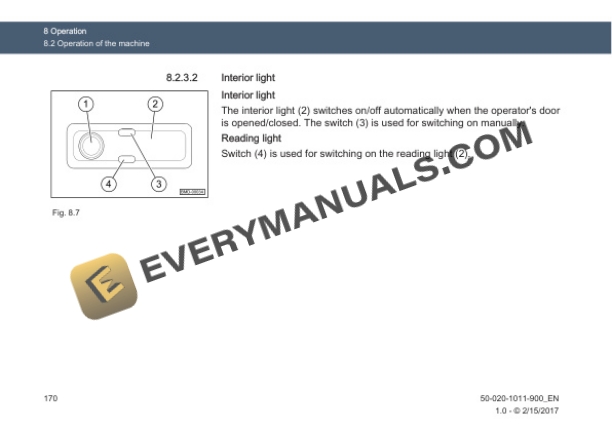
- 9.2.3.2. Interior light
- 9.2.3.3. Windscreen wiper
- 9.2.3.4. Rear window wiper
- 9.2.4. Heating/air conditioning and ventilation
- 9.2.4.1. Heating/air conditioning control
- 9.2.4.2. Round ventilation nozzle
- 9.2.4.3. Rectangular ventilation nozzles
- 9.2.5. Instrument panel and display
- 9.2.5.1. Instrument panel left
- 9.2.5.2. Instrument panel right
- 9.2.5.3. Instrument panel top
- 9.2.5.4. Display
- 9.2.6. Driving and control elements
- 9.2.6.1. Switching the battery main switch on/off
- 9.2.6.2. Battery disconnection switch
- 9.2.6.3. Ignition switch
- 9.2.6.4. EMERGENCY STOP switch
- 9.2.6.5. Foot pedals
- 9.2.6.6. Dial switch
- 9.2.6.7. Joystick console
- 9.2.6.8. Horn
- 9.2.7. Storage and useful information
- 9.2.7.1. Roller blind
- 9.2.7.2. Cab door storage compartment
- 9.2.7.3. Cab beverage holder
- 9.2.8. Optional equipment
- 9.2.8.1. Swiveling operator stand
- 9.2.8.2. Rotating beacon
- 9.2.8.3. Reversing camera
- 9.2.8.4. Radio
- 9.3. Checks before starting work
- 9.4. Switching on the machine
- 9.4.1. Warming up the machine
- 9.5. Travel mode
- 9.5.1. Onroad driving
- 9.5.2. Selecting the travel mode and driving
- 9.6. Tipping
- 9.7. Crane operation
- 9.8. Checks during operation
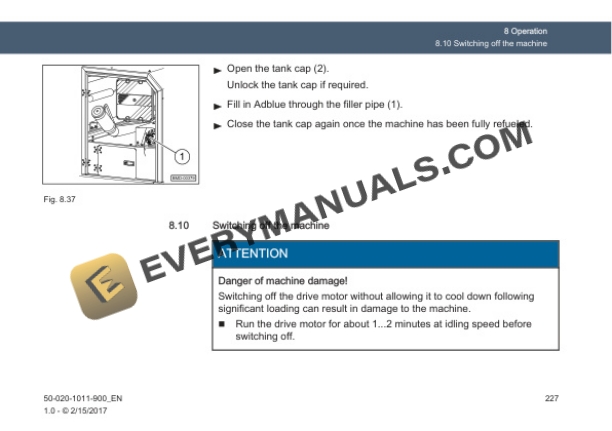
- 9.9. Refueling the machine
- 9.10. Switching off the machine
- 9.11. Recovering the machine
- 10. Daily maintenance work
- 10.1. Safety instructions
- 10.2. Carrying out maintenance work
- 10.2.1. Opening/closing the maintenance doors on the drive unit
- 10.3. Maintenance work to be carried out
- 10.3.1. Visual checks visual inspection
- 10.3.2. Lubricating the machine
- 10.3.2.1. Lubrication points on the basic machine
- 10.3.2.2. Lubrication point overview for the track undercarriage
- 10.3.2.3. Overview of rear tipping trough lubrication points
- 10.3.2.4. Overview of round tipping trough lubrication points
- 10.3.2.5. Overview of crane lubrication points
- 10.3.3. Checking the fill levels
- 11. Malfunctions and troubleshooting
- 11.1. General safety instructions for troubleshooting
- 11.2. Malfunctions
- 11.2.1. General malfunctions
- 11.2.2. Malfunctions of the electrical system
- 11.2.3. Malfunctions of the hydraulic system
- 11.2.4. Display error codes
- 11.2.5. Lowering the trough manually
- 12. Disassembly
- 13. Taking out of operation, putting back into operation and disposal
- 13.1. Taking out of operation
- 13.2. Returning to operation
- 13.3. Disposal
- 14. Spare part stocking and customer service
- 14.1. Spare part and customer service addresses
- 15. Appendix
- 15.1. The most important hand signals for providing guidance
- 15.2. CE declaration of conformity
- 15.3. Tightening torques
- 15.4. Diagrams in original scale