
John Deere 7500A and 8000A E-Cut Hybrid Fairway Mowers Operator Manual OMUC10908
$30
- Type Of Manual: Operator Manual
- Manual ID: OMUC10908
- Format: PDF
- Size: 9.5MB
- Number of Pages: 116
Description
-
Model List:
- 7500A E-Cut Hybrid Fairway Mower
- 8000A E-Cut Hybrid Fairway Mower
- 1. Introduction
- 1.1. Thank You for Purchasing a John Deere Product
- 1.2. Using Your Operators Manual
- 1.3. Machine Use
- 1.4. Special Messages
- 1.5. Attachments for Your Machine
- 1.6. Service Literature
- 2. Contents
- 3. Product Identification
- 3.1. Record Identification Numbers
- 4. Safety Labels NoText
- 4.1. Safety Label Location
- 4.2. Understanding The NoText Machine Safety Labels
- 4.3. RollOver Protective Structure
- 4.4. Avoid Injury From Equipment Fires
- 4.5. Avoid Injury From Exposure to Loud Noise
- 4.6. Read Operators Manual
- 4.7. Avoid Injury From Thrown Objects
- 4.8. Avoid Injury From Tipping
- 4.9. Avoid Injury From Revolving Blades
- 4.10. Avoid Injury From Crushing
- 4.11. Operator Training Required
- 4.12. Preparation
- 4.13. Operating Safely
- 4.14. Checking Mowing Area
- 4.15. Parking Safely
- 4.16. Rotating Blades Are Dangerous
- 4.17. Protect Children
- 4.18. Avoid Tipping
- 4.19. Use Seat Belt Properly
- 4.20. Keep ROPS Installed Properly
- 4.21. Keep Riders Off
- 4.22. Driving Safely on Public Roads
- 4.23. Checking Wheel Hardware
- 4.24. Wear Appropriate Clothing
- 4.25. Maintenance and Storage
- 4.26. Avoid High Pressure Fluids
- 4.27. Prevent Fires
- 4.28. Tire Safety
- 4.29. Handling Fuel Safely
- 4.30. Handling Waste Product and Chemicals
- 5. Machine Cleanout
- 5.1. General Cleaning Guidelines
- 5.2. Cleanout Areas
- 6. Operating Controls
- 6.1. Operator Station Controls
- 7. Operating Machine
- 7.1. Daily Operating Checklist
- 7.2. Avoid Damage to Plastic and Painted Surfaces
- 7.3. Understanding the TechControl Display
- 7.4. Understanding the TechControl Display Main Menu
- 7.5. Understanding Mode Icon
- 7.6. Engine Speed Icon
- 7.7. Understanding Machine Fault Diagnostic Icon
- 7.8. Understanding DTC Diagnostic Icon
- 7.9. Starting Notifications
- 7.10. TechControl Display Setup
- 7.11. Using the Hour Meter
- 7.12. Using Key Switch
- 7.13. Using Seat Belt
- 7.14. Adjusting Seat
- 7.15. Adjusting Command Arm
- 7.16. Using Park Brake
- 7.17. Using Tilt Steering
- 7.18. Safety Interlock System
- 7.19. Starting The Engine
- 7.20. Using PreHeater
- 7.21. Warming and Idling Engine
- 7.22. Stopping Engine
- 7.23. Testing Safety Systems
- 7.24. Testing Safety System Starting Engine
- 7.25. Testing Safety System Engine Running
- 7.26. Using Throttle Lever
- 7.27. Using MowTransport (PTO) Switch
- 7.28. Using LiftLower Lever
- 7.29. Emergency Stopping
- 7.30. Using Travel Pedals
- 7.31. Using Cruise Control
- 7.32. Using Fuel Shutoff Valve
- 7.33. Transporting Machine
- 7.34. Driving Mower to Work Site
- 7.35. Moving Machine Manually
- 8. Operating Cutting Units
- 8.1. Using the TechControl for Mower Setup
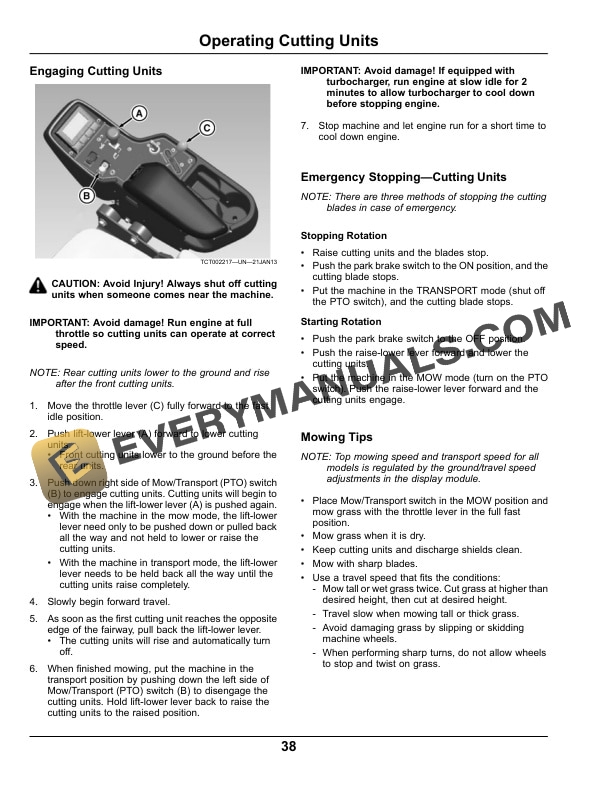
- 8.2. Engaging Cutting Units
- 8.3. Emergency StoppingCutting Units
- 8.4. Mowing Tips
- 8.5. Removing and Emptying Grass Catchers
- 8.6. Activating Cutting Unit Down Pressure
- 8.7. Using AntiSteer Pins
- 8.8. Operating Turf Conditioner
- 8.9. Cleaning Cutting Units
- 9. Service Intervals
- 9.1. Servicing Your Machine
- 9.2. Before Each Use
- 9.3. After Each Use
- 9.4. BreakIn (After First 5 Hours)
- 9.5. BreakIn (After First 50 Hours)
- 9.6. Every 50 Hours
- 9.7. Every 250 Hours
- 9.8. Every 500 Hours or Yearly
- 9.9. Every 750 Hours or Yearly
- 9.10. Every 1000 Hours or Yearly
- 9.11. Every 2000 Hours or 24 Months
- 9.12. Service Intervals After Converting to Bio HyGard
- 9.13. Service Intervals After Converting to BioDiesel Fuel
- 10. Service Lubrication
- 10.1. Grease Locations Lift System and Cutting Units
- 10.2. Grease Locations Machine
- 11. Service Engine
- 11.1. Engine Faults
- 11.2. Engine OilDiesel
- 11.3. Avoid Fumes
- 11.4. Raising Hood
- 11.5. Raising and Lowering Seat
- 11.6. Checking Engine Oil Level
- 11.7. Changing Engine Oil and Filter
- 11.8. Checking Air Restriction Indicator
- 11.9. Changing Primary Air Cleaner Element
- 11.10. Changing Secondary Air Cleaner Element
- 11.11. Cleaning Dust Unloading Valve
- 11.12. Cleaning under Hood and Seat
- 11.13. Cleaning Radiator and Oil Cooler
- 11.14. Service Cooling System Safely
- 11.15. Recommended Engine Coolant
- 11.16. Service Cooling System
- 11.17. Checking Radiator Hoses and Clamps
- 11.18. Changing Fuel Filter
- 11.19. Priming Diesel Fuel System
- 11.20. Checking Water Separator Bowl
- 11.21. Fuel Injection Pump
- 11.22. Servicing AlternatorFan Belt
- 11.23. Checking and Adjusting 48V Alternator Belt
- 11.24. Replacing 48V Alternator Belt
- 12. Service Transmission
- 12.1. Hydraulic Oil Faults
- 12.2. Transmission and Hydraulic Oil
- 12.3. Converting From HYGARD to BIO HYGARD
- 12.4. Biodegradable Oil
- 12.5. Service Safely
- 12.6. Checking and Adding Hydraulic Oil
- 12.7. Changing Hydraulic Oil and Filter
- 12.8. Changing Hydraulic Oil Strainer
- 13. Service Cutting Units
- 13.1. Avoid Injury from Contacting Blades
- 13.2. General Cutting Reel Fault
- 13.3. Adjusting Cutting Unit Shield (QA5)
- 13.4. Removing and Installing Cutting Units (QA5)
- 13.5. Adjusting BedknifetoReel (QA5)
- 13.6. Adjusting HeightofCut Range (QA5)
- 13.7. Adjusting Front Roller Parallel with Bedknife (QA5)
- 13.8. Adjusting HeightofCut (QA5)
- 13.9. Removing and Installing Bedknife Shoe (QA5)
- 13.10. Replacing Bedknife (QA5)
- 13.11. Removing and Installing Front Roller (QA5)
- 13.12. Removing and Installing Rear Roller (QA5)
- 13.13. Adjusting Bedknife and Bedbar Position for Worn Reel (QA5)
- 13.14. Adjusting (Optional) Rear Roller Power Brush (QA5)
- 13.15. Adjusting Fairway Tender Conditioner (FTC) (QA5)
- 13.16. Adjust DepthofCut (Vertical Cutting Units)
- 13.17. Adjusting Rear Stabilizer
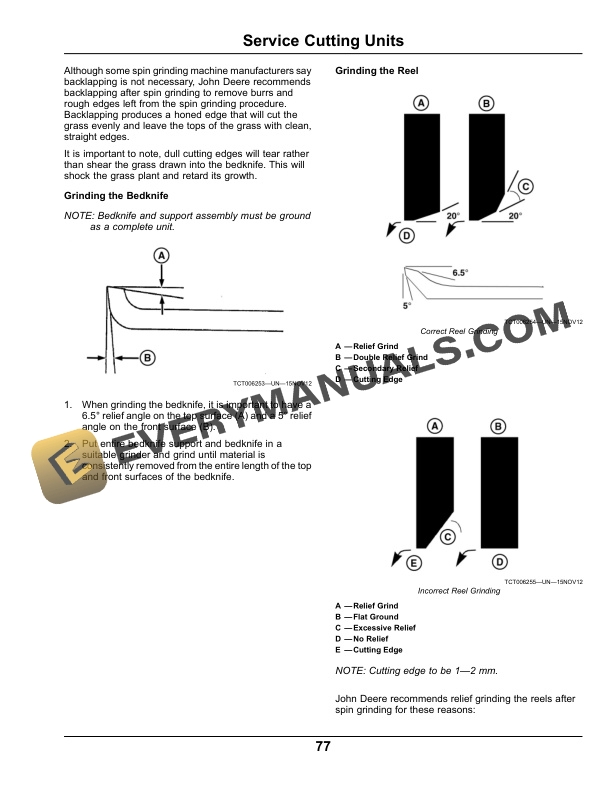
- 13.18. Backlapping Cutting Units
- 13.19. Grinding Reel and Bedknife
- 14. Service Electrical
- 14.1. Service the Battery Safely
- 14.2. Battery Voltage Faults
- 14.3. Cleaning Battery and Terminals
- 14.4. Checking Battery Electrolyte Level
- 14.5. Using Booster Battery
- 14.6. Removing and Installing Battery
- 14.7. Replacing Fuses
- 15. Service Miscellaneous
- 15.1. TechControl Service Menu
- 15.2. Diesel Fuel
- 15.3. Filling Fuel Tank
- 15.4. Checking Tire Pressure
- 15.5. Checking and Adjusting ToeIn
- 15.6. Cleaning Plastic Surfaces
- 15.7. Cleaning and Repairing Metal Surfaces
- 16. Troubleshooting
- 16.1. Using Troubleshooting Chart
- 16.2. Electrical System
- 16.3. Steering
- 16.4. Cutting Units
- 16.5. Diagnostic Trouble Codes (DTC) List
- 17. Assembly
- 17.1. Parking Safely
- 17.2. Checking Tire Pressure
- 17.3. Charge Battery
- 17.4. Install Headlight Kit
- 17.5. Locate Down Pressure Pins
- 17.6. Adjusting HeightofCut Range (QA5)
- 17.7. Installing Front Roller (QA5)
- 17.8. Adjusting Front Roller Parallel with Bedknife (QA5)
- 17.9. Adjusting ReeltoBedknife (QA5)
- 17.10. Installing Rear Roller (QA5)
- 17.11. Adjusting HeightofCut (QA5)
- 17.12. Adjusting Cutting Unit Shield (QA5)
- 17.13. Installing Cutting Units (QA5)
- 17.14. Checking Fluid Levels
- 17.15. Checking Machine Safety System
- 18. Storage
- 18.1. Storing Safety
- 18.2. Preparing Machine for Storage
- 18.3. Preparing Fuel and Engine For Storage
- 18.4. Removing Machine From Storage
- 18.5. Storage for BioDiesel Fuel
- 19. Specifications
- 19.1. Drive Train and Travel Speeds
- 19.2. Electrical System
- 19.3. Fuel System
- 19.4. Steering and Brakes
- 19.5. Capacities
- 19.6. Dimensions
- 19.7. Weights
- 19.8. Torque Values
- 19.9. Reel Drive
- 19.10. Recommended Lubricants
- 19.11. Sound Measurements
- 19.12. Vibration Measurements
- 20. Declaration of Conformity
- 20.1. EC Declaration of Conformity
- 20.2. EC Declaration of Conformity
- 21. John Deere Quality Statement
- 21.1. John Deere Quality
- 22. Service Records
- 22.1. Record Service Dates
Related products
-50%

Original price was: $20.$10Current price is: $10.

-50%

Original price was: $20.$10Current price is: $10.


-50%

Original price was: $20.$10Current price is: $10.
-50%

Original price was: $20.$10Current price is: $10.
-50%

Original price was: $20.$10Current price is: $10.