
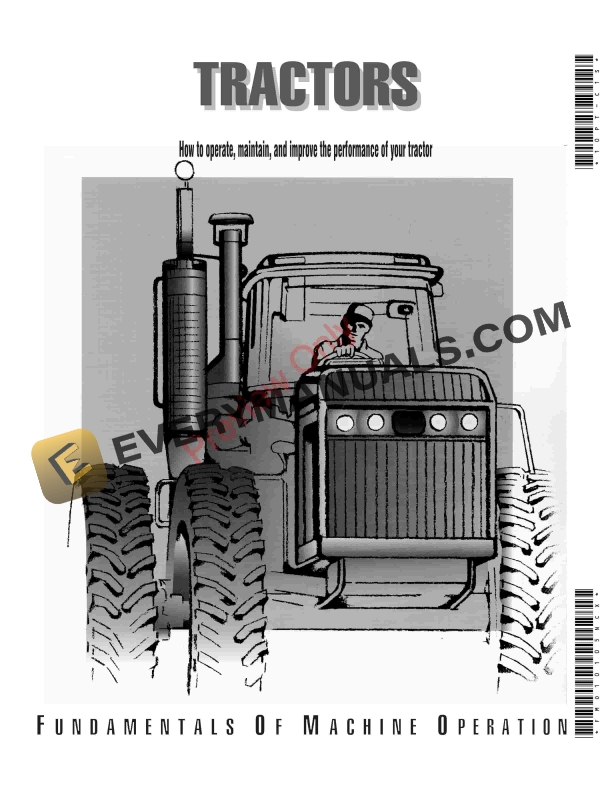
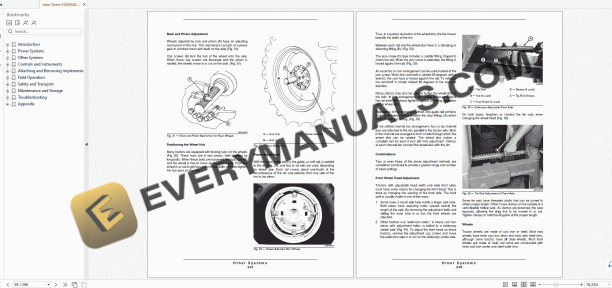
John Deere FOSFMO Tractors Textbook 5th Edition Fundamentals Of Machine Operation FMO10105NCX PDF
$55
- Machine: FOS/FMO Tractors – Textbook – 5th Edition
- Model: Model FMO
- Type Of Manual: Fundamentals Of Machine Operation
- Manual ID: FMO10105NCX
- Version: 12AUG14
- Language: English
- Format: PDF
Description
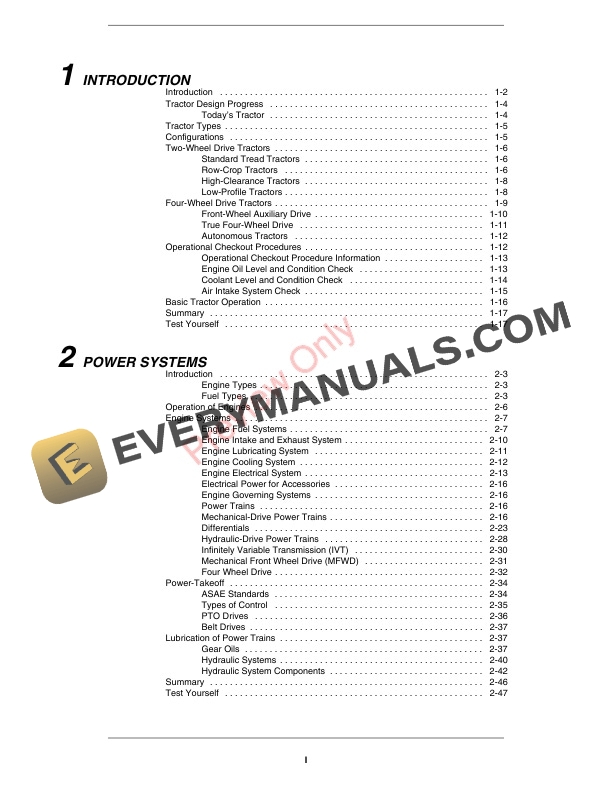
Introduction
Tractor Design Progress
Today’s Tractor
Tractor Types
Configurations
Two-Wheel Drive Tractors
Standard Tread Tractors
Row-Crop Tractors
High-Clearance Tractors
Low-Profile Tractors
Four-Wheel Drive Tractors
Front-Wheel Auxiliary Drive
True Four-Wheel Drive
Autonomous Tractors
Operational Checkout Procedures
Operational Checkout Procedure Information
Engine Oil Level and Condition Check
Coolant Level and Condition Check
Air Intake System Check
Basic Tractor Operation
Summary
Test Yourself
Power Systems
Introduction
Engine Types
Fuel Types
Operation of Engines
Engine Systems
Engine Fuel Systems
Engine Intake and Exhaust System
Engine Lubricating System
Engine Cooling System
Engine Electrical System
Electrical Power for Accessories
Engine Governing Systems
Power Trains
Mechanical-Drive Power Trains
Differentials
Hydraulic-Drive Power Trains
Infinitely Variable Transmission (IVT)
Mechanical Front Wheel Drive (MFWD)
Four Wheel Drive
Power-Takeoff
ASAE Standards
Types of Control
PTO Drives
Belt Drives
Lubrication of Power Trains
Gear Oils
Hydraulic Systems
Hydraulic System Components
Summary
Test Yourself
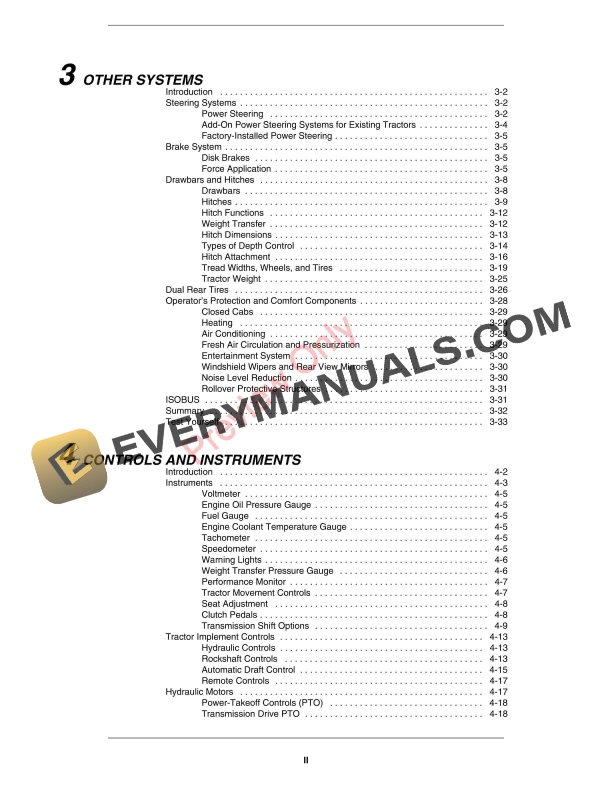
Other Systems
Introduction
Steering Systems
Power Steering
Add-On Power Steering Systems for Existing Tractors
Factory-Installed Power Steering
Brake System
Disk Brakes
Force Application
Drawbars and Hitches
Drawbars
Hitches
Hitch Functions
Weight Transfer
Hitch Dimensions
Types of Depth Control
Hitch Attachment
Tread Widths, Wheels, and Tires
Tractor Weight
Dual Rear Tires
Operator’s Protection and Comfort Components
Closed Cabs
Heating
Air Conditioning
Fresh Air Circulation and Pressurization
Entertainment System
Windshield Wipers and Rear View Mirrors
Noise Level Reduction
Rollover Protective Structures
ISOBUS
Summary
Test Yourself
Controls and Instruments
Introduction
Instruments
Voltmeter
Engine Oil Pressure Gauge
Fuel Gauge
Engine Coolant Temperature Gauge
Tachometer
Speedometer
Warning Lights
Weight Transfer Pressure Gauge
Performance Monitor
Tractor Movement Controls
Seat Adjustment
Clutch Pedals
Transmission Shift Options
Tractor Implement Controls
Hydraulic Controls
Rockshaft Controls
Automatic Draft Control
Remote Controls
Hydraulic Motors
Power-Takeoff Controls (PTO)
Transmission Drive PTO
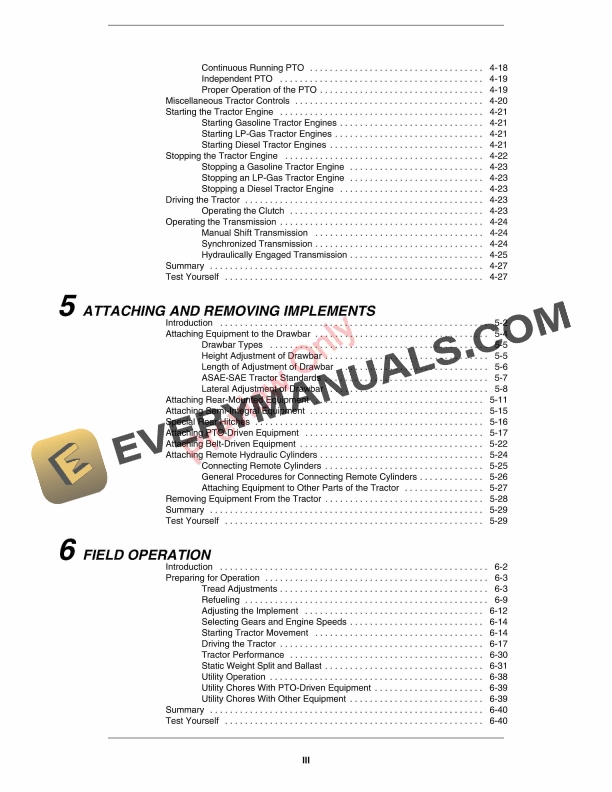
Continuous Running PTO
Independent PTO
Proper Operation of the PTO
Miscellaneous Tractor Controls
Starting the Tractor Engine
Starting Gasoline Tractor Engines
Starting LP-Gas Tractor Engines
Starting Diesel Tractor Engines
Stopping the Tractor Engine
Stopping a Gasoline Tractor Engine
Stopping an LP-Gas Tractor Engine
Stopping a Diesel Tractor Engine
Driving the Tractor
Operating the Clutch
Operating the Transmission
Manual Shift Transmission
Synchronized Transmission
Hydraulically Engaged Transmission
Summary
Test Yourself
Attaching and Removing Implements
Introduction
Attaching Equipment to the Drawbar
Drawbar Types
Height Adjustment of Drawbar
Length of Adjustment of Drawbar
ASAE-SAE Tractor Standards
Lateral Adjustment of Drawbar
Attaching Rear-Mounted Equipment
Attaching Semi-Integral Equipment
Special Rear Hitches
Attaching PTO-Driven Equipment
Attaching Belt-Driven Equipment
Attaching Remote Hydraulic Cylinders
Connecting Remote Cylinders
General Procedures for Connecting Remote Cylinders
Attaching Equipment to Other Parts of the Tractor
Removing Equipment From the Tractor
Summary
Test Yourself
Field Operation
Introduction
Preparing for Operation
Tread Adjustments
Refueling
Adjusting the Implement
Selecting Gears and Engine Speeds
Starting Tractor Movement
Driving the Tractor
Tractor Performance
Static Weight Split and Ballast
Utility Operation
Utility Chores With PTO-Driven Equipment
Utility Chores With Other Equipment
Summary
Test Yourself
Safety and Transport
Introduction
Accidents
Accidents and the Family
Recognizing Safety Information
Understanding Signal Words
Following Safety Instructions
Safety
Safety Is Important
Hand Signals
Pre-Operation Safety
Starting the Tractor
Stopping the Tractor
Operating Safety
Common Machine Hazards
Avoid High-Pressure Fluids
Field Repair and Maintenance Safety
Summary of Tractor Safety
Transport
Preparing the Tractor and Implement for the Highway
How to Drive on the Highway With Implements
Entering a Public Road
Operating on the Road
Turning Off the Road
Selecting a Safe Operating Speed
Towing the Tractor
Transporting By Truck or Trailer
Railroad Crossing Safety
Transport Summary
Test Yourself
Maintenance and Storage
Introduction
General Maintenance
Daily Maintenance
Periodic Maintenance and Service
Typical Maintenance Intervals
Sample Periodic Maintenance Chart
Storage
Summary of Tractor Maintenance and Storage
Test Yourself
Troubleshooting
Introduction
Troubleshooting Charts
Appendix
Nebraska Tractor Tests
Interpretative Notes for All Nebraska Test Reports
PTO Performance
Drawbar Performance
Sound Level Measurement
Test Results
Suggested Readings
Acres (Hectares) Per-Hour Chart
Checking Tire Inflation Pressure
Unified Inch Bolt and Cap Screw Torque Values
Metric Bolt and Cap Screw Torque Values
Determining Maximum Rear Ballast
Using Liquid Ballast—Rear Tires
Weights and Measures
Measurement Conversion Chart
Answers to Test Yourself Questions
Related products