

John Deere X750, X754, X758 Heavy Duty Garden Tractors Operator Manual OMM172667
$30
- Type Of Manual: Operator Manual
- Manual ID: OMM172667
- Format: PDF
- Size: 7.4MB
- Number of Pages: 88
Description
-
Model List:
- X750 Heavy Duty Garden Tractor
- X754 Heavy Duty Garden Tractor
- X758 Heavy Duty Garden Tractor
- 1. Introduction
- 1.1. Thank You for Purchasing a John Deere Product
- 1.2. Using Your Operators Manual
- 1.3. Special Messages
- 1.4. Attachments for Your Machine
- 2. Contents
- 3. Product Identification
- 3.1. Record Identification Numbers
- 4. Safety LabelsText
- 4.1. Safety Label Location
- 4.2. Understanding The Machine Safety Labels
- 4.3. WARNING
- 4.4. HOT SURFACE
- 4.5. CAUTION
- 4.6. WARNING
- 4.7. Canadian Electromagnetic Compatibility (EMC) Compliance
- 5. Safety LabelsNo Text
- 5.1. Safety Label Location
- 5.2. Understanding The NoText Machine Safety Labels
- 5.3. Read Operators Manual
- 5.4. Keep Children Away from Mower
- 5.5. Avoid Injury From Tipping
- 5.6. Hot Surface
- 5.7. Prevent Equipment Fires
- 5.8. Rotating Shaft (Only When Equipped With PTO)
- 5.9. Operating Safely
- 5.10. Using a Spark Arrestor
- 5.11. Checking Mowing Area
- 5.12. Parking Safely
- 5.13. Rotating Blades are Dangerous
- 5.14. Protect Children
- 5.15. Operating on Slopes
- 5.16. Keep Riders Off
- 5.17. Stay Clear of Rotating Drivelines
- 5.18. Checking Wheel Hardware
- 5.19. Towing Loads Safely
- 5.20. Wear Appropriate Clothing
- 5.21. Driving Safely on Public Roads
- 5.22. Practice Safe Maintenance
- 5.23. Avoid High Pressure Fluids
- 5.24. Prevent Fires
- 5.25. Handling Fuel Safely
- 5.26. Tire Safety
- 5.27. Handling Waste Product and Chemicals
- 6. Machine Cleanout
- 6.1. Prevent Fires
- 7. Operating Controls
- 7.1. Operator Station Controls
- 8. Operating
- 8.1. Daily Operating Checklist
- 8.2. Avoid Damage to Plastic and Painted Surfaces
- 8.3. Adjusting Tilt Steering Wheel
- 8.4. Install Seat (Standard Models)
- 8.5. Adjusting Seat (Standard)
- 8.6. Adjusting Seat (Special Edition)
- 8.7. Using Mower Height Control Knob
- 8.8. Adjusting Mower Level Using Deck Leveling Gauge Method 1
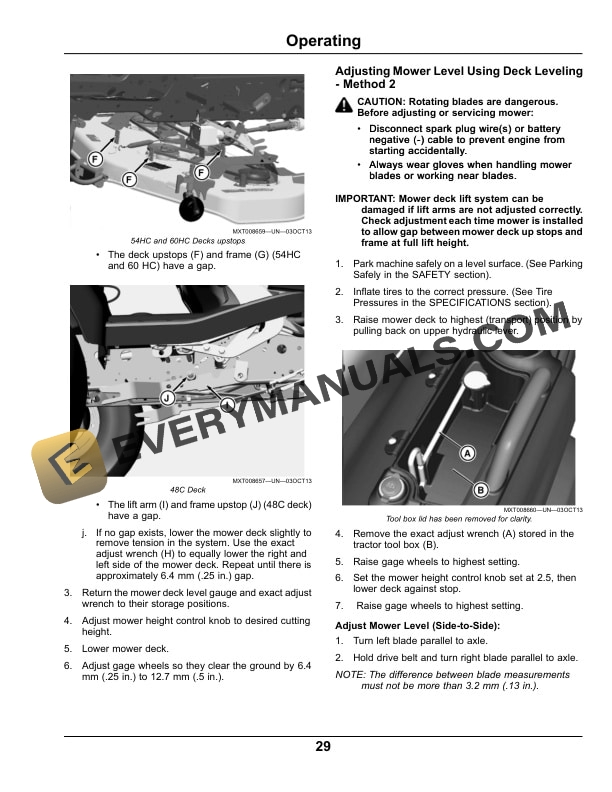
- 8.9. Adjusting Mower Level Using Deck Leveling Method 2
- 8.10. Testing Safety Systems
- 8.11. Testing PTO, RIO Switch
- 8.12. Testing Seat Switch
- 8.13. Testing Park Brake Switch
- 8.14. Testing Reverse Implement Option (RIO)
- 8.15. Using Fuel ShutOff Valve
- 8.16. Using Park Brake
- 8.17. Using Key Switch
- 8.18. Using Indicator Lights
- 8.19. Using Light Switch
- 8.20. Starting the Engine
- 8.21. Idling the Engine
- 8.22. Stopping the Engine
- 8.23. Emergency Stopping
- 8.24. Using Travel Pedals
- 8.25. Using Cruise Control
- 8.26. Using Reverse Implement Option (RIO)
- 8.27. Using Traction Assist
- 8.28. Using Full Time 4Wheel Drive (HFWD)
- 8.29. Using 12Volt Outlet
- 8.30. Installing Attachments
- 8.31. Connecting Attachment Hydraulic Hoses
- 8.32. Using Hydraulic Control Levers
- 8.33. Using the PowerTakeOff (PTO) Safely
- 8.34. Using the PTO (PowerTakeOff)
- 8.35. Moving Machine by Hand
- 8.36. Unplugging Mower, Bagger, or Material Collection System
- 8.37. Transporting Machine on Trailer
- 8.38. Ballasting Machine Safely
- 8.39. Ballasting Machine
- 8.40. Installing Rear Wheel Weights
- 8.41. Using Tire Chains
- 8.42. Blade Choices
- 9. Replacement Parts
- 9.1. Service Literature
- 9.2. Part Numbers
- 10. Service Intervals
- 10.1. Servicing Your Machine
- 10.2. After First 50 Hours
- 10.3. Every 200 Hours or Annually
- 10.4. Every 200 Hours
- 10.5. Every 400 Hours
- 10.6. Every 1000 Hours or Every 2 Years
- 11. Service Lubrication
- 11.1. Lubricating Rear Steering Pivot (4WS Models)
- 11.2. Lubricating Steering Cylinder Ball Joints (2WD Models)
- 11.3. Lubricating Front Axle (2WD Models)
- 11.4. Lubricate Drive Shaft (2WD Models)
- 11.5. Lubricating Machine Grease Fittings (4WD Models)
- 12. Service Engine
- 12.1. Engine Warranty Maintenance Statement
- 12.2. Avoid Fumes
- 12.3. Engine Oil
- 12.4. Checking Engine Oil Level
- 12.5. Changing Engine Oil and Filter
- 12.6. Cleaning Air Intake Screens
- 12.7. Checking Air Restriction Indicator
- 12.8. Cleaning Dust Unloading Valve
- 12.9. Servicing Air Cleaner Elements
- 12.10. Checking Air Cleaner Intake Hoses and Clamps
- 12.11. Diesel Engine Coolant
- 12.12. Servicing Cooling System
- 12.13. Cleaning Radiator Screen and Fins
- 12.14. Checking Radiator Hoses and Clamps
- 12.15. Servicing Alternator Belt
- 12.16. Checking Fuel Filter Sediment Bowl
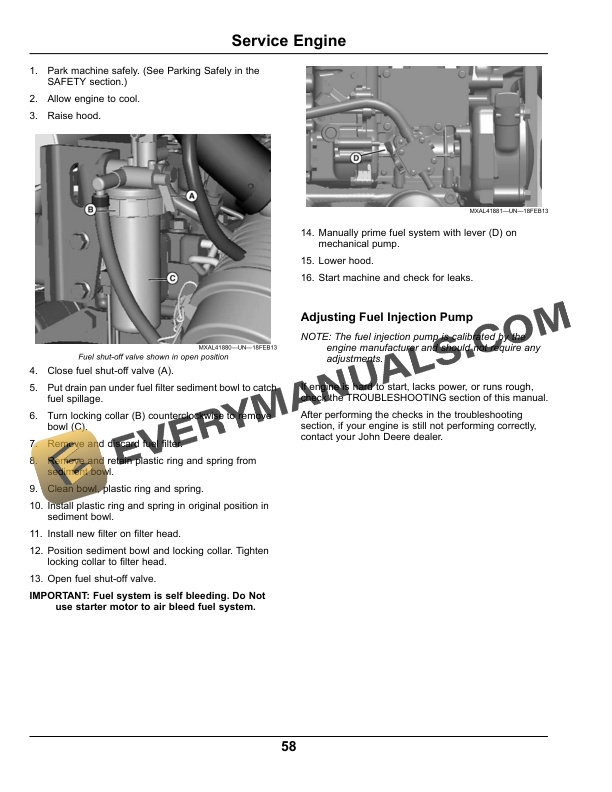
- 12.17. Cleaning Fuel Filter Sediment Bowl and Replacing Filter
- 12.18. Adjusting Fuel Injection Pump
- 13. Service Transmission
- 13.1. Transmission Oil
- 13.2. Checking Transaxle Oil Level (All Models)
- 13.3. Changing Transaxle Oil and Filter (Except Full Time 4Wheel Drive (HFWD) System)
- 13.4. Changing HFWD System Hydraulic Oil and Filter (Transaxle and HFWD Front Axle)
- 14. Service Electrical
- 14.1. Electrical
- 14.2. Service the Battery Safely
- 14.3. Checking Battery Electrolyte Level
- 14.4. Removing and Installing the Battery
- 14.5. Cleaning Battery and Terminals
- 14.6. Using Booster Battery
- 14.7. Replacing Headlight Bulb
- 14.8. Adjusting Headlights
- 14.9. Replacing Taillight Bulb
- 14.10. Replacing Fuses and Relays
- 15. Service Miscellaneous
- 15.1. Diesel Fuel
- 15.2. Filling Fuel Tank
- 15.3. Lifting Machine
- 15.4. Checking Wheel Bolt Tightness
- 15.5. Cleaning Plastic Surfaces
- 15.6. Cleaning and Repairing Metal Surfaces
- 15.7. Raising and Lowering Hood
- 15.8. Removing and Installing Hood
- 15.9. Removing and Installing Wheel Assembly (Models with Wheel Bolt)
- 16. Troubleshooting
- 16.1. Using Troubleshooting Chart
- 16.2. Electrical
- 16.3. Machine
- 16.4. Steering
- 17. Storage
- 17.1. Storing Safety
- 17.2. Preparing Machine for Storage
- 17.3. Preparing Fuel and Engine For Storage
- 17.4. Removing Machine From Storage
- 18. Specifications
- 18.1. Specifications
- 19. Warranty
- 19.1. Warranty
- 19.2. John Deere, California and U.S. EPA Emission Control System Warranty (NonRoad Diesel)
- 19.3. Tire Warranty
- 19.4. Limited Battery Warranty For Factory Installed Batteries
- 20. John Deere Quality Statement
- 20.1. John Deere Quality
- 21. Service Record
- 21.1. Record Service Dates
- 22. Slope Gauge
- 22.1. Slope Gauge Template
Related products
-50%

Original price was: $20.$10Current price is: $10.
-50%

Original price was: $20.$10Current price is: $10.
-50%

Original price was: $20.$10Current price is: $10.
-50%

Original price was: $20.$10Current price is: $10.
-50%

Original price was: $20.$10Current price is: $10.

-50%

Original price was: $20.$10Current price is: $10.