


Description
-
Model List:
- PowerTech 8.1 L Marine Diesel Engines
- 1. Contents
- 1.1. Record Keeping
- 1.1.1. Record Engine Serial Number
- 1.1.2. ENGINE OPTION CODES
- 1.1.3. Recognize Safety Information
- 1.1.4. Understand Signal Words
- 1.1.5. Follow Safety Instructions
- 1.1.6. Replace Safety Signs
- 1.1.7. Illuminate Work Area Safely
- 1.1.8. Work in Clean Area
- 1.1.9. Use Proper Tools
- 1.1.10. Live With Safety
- 1.1.11. Prevent Machine Runaway
- 1.1.12. Handle Fuel SafelyAvoid Fires
- 1.1.13. Prepare for Emergencies
- 1.1.14. Handle Starting Fluid Safely
- 1.1.15. In Case of Fire
- 1.1.16. Handle Fluids SafelyAvoid Fires
- 1.1.17. Avoid Static Electricity Risk When Refueling
- 1.1.18. Service Machines Safely
- 1.1.19. Wear Protective Clothing
- 1.1.20. Protect Against Noise
- 1.1.21. Handling Batteries Safely
- 1.1.22. Prevent Acid Burns
- 1.1.23. Stay Clear of Rotating Drivelines
- 1.1.24. Install All Guards
- 1.1.25. Practice Safe Maintenance
- 1.1.26. Remove Paint Before Welding or Heating
- 1.1.27. Avoid Heating Near Pressurized Fluid Lines
- 1.1.28. Avoid HighPressure Fluids
- 1.1.29. Do Not Open HighPressure Fuel System
- 1.1.30. Protect Against High Pressure Spray
- 1.1.31. Prevent Battery Explosions
- 1.1.32. Avoid Hot Exhaust
- 1.1.33. Work In Ventilated Area
- 1.1.34. Service Cooling System Safely
- 1.1.35. Decommissioning Proper Recycling and Disposal of Fluids and Components
- 1.2. Fuels, Lubricants, and Coolant
- 1.2.1. Diesel Fuel
- 1.2.2. Diesel Fuel Additive Products
- 1.2.3. Lubricity of Diesel Fuel
- 1.2.4. Handling and Storing Diesel Fuel
- 1.2.5. MINIMIZING THE EFFECT OF COLD WEATHER ON DIESEL ENGINES
- 1.2.6. Diesel Engine BreakIn Oil NonEmissions Certified and Certified Tier 1, Tier 2, Tier 3, Stage I, Stage II, and Stage III
- 1.2.7. Diesel Engine Oil NonEmissions Certified and Certified Tier 1 and Stage I
- 1.2.8. Extended Diesel Engine Oil Service Intervals NonEmissions Certified and Certified Tier 1 and Stage I
- 1.2.9. Mixing of Lubricants
- 1.2.10. Oilscan and CoolScan
- 1.2.11. Alternative and Synthetic Lubricants
- 1.2.12. Lubricant Storage
- 1.2.13. Multipurpose Extreme Pressure (EP) Grease
- 1.2.14. Diesel Engine Coolant (engine with wet sleeve cylinder liners)
- 1.2.15. Additional Information About Diesel Engine Coolants and John Deere LIQUID COOLANT CONDITIONER
- 1.2.16. Testing Diesel Engine Coolant
- 1.2.17. Supplemental Coolant Additives
- 1.2.18. Operating in Warm Temperature Climates
- 1.2.19. Decommissioning Proper Recycling and Disposal of Fluids and Components
- 1.3. Engine Operating Guidelines
- 1.3.1. Sea Trials for Performance and Warranty
- 1.3.2. PRECAUTIONS FOR WELDING ON VESSELS EQUIPPED WITH ELECTRONIC ENGINE CONTROL UNIT (ECU)
- 1.3.3. JOHN DEERE INSTRUMENT (GAUGE) PANEL
- 1.3.4. USING DIAGNOSTIC GAUGE TO ACCESS ENGINE INFORMATION
- 1.3.5. USING TOUCH SWITCHES TO DISPLAY INFORMATION
- 1.3.6. CHANGING UNITS OF MEASURE (ENGLISH OR METRIC)
- 1.3.7. VIEWING ENGINE CONFIGURATION DATA
- 1.3.8. VIEWING ACTIVE ENGINE SERVICE CODES (DFC)
- 1.3.9. VIEWING STORED SERVICE CODES (DFC) IN THE ENGINE ECU
- 1.3.10. NORMAL ENGINE OPERATION
- 1.3.11. BREAKIN SERVICE
- 1.3.12. AUXILIARY GEAR DRIVE LIMITATIONS
- 1.3.13. GENSET POWER UNITS
- 1.3.14. STARTING THE ENGINE
- 1.3.15. COLD WEATHER OPERATION
- 1.3.16. WARMING ENGINE
- 1.3.17. IDLING ENGINE
- 1.3.18. STOPPING THE ENGINE
- 1.3.19. USING A BOOSTER BATTERY OR CHARGER
- 1.4. HelmView Display Panel
- 1.4.1. Product Information
- 1.4.2. Display Features
- 1.4.3. Navigation
- 1.4.4. Setting up your display for the first time
- 1.4.5. Product Features
- 1.4.6. Reprogramming the Display
- 1.4.7. Group Numbers
- 1.5. Lubrication and Maintenance
- 1.5.1. Required EmissionRelated Information
- 1.5.2. OBSERVE SERVICE INTERVALS
- 1.5.3. USE CORRECT FUELS, LUBRICANTS AND COOLANT
- 1.5.4. Lubrication and Maintenance Service Interval ChartPropulsion and Prime Power Units
- 1.5.5. Lubrication and Maintenance Service Interval ChartStandby Generator Sets
- 1.6. Lubrication Maintenance/Daily
- 1.6.1. DAILY PRESTART CHECKS
- 1.7. Lubrication Maintenance/250 Hour/6 Month
- 1.7.1. SERVICING FIRE EXTINGUISHER
- 1.7.2. SERVICING BATTERY
- 1.7.3. CHANGING ENGINE OIL AND REPLACING OIL FILTER
- 1.7.4. VISUALLY INSPECT WATER PUMP
- 1.7.5. CHECKING ENGINE MOUNTS
- 1.7.6. INSPECT AND REPLACE ZINC PLUGS ENGINES EQUIPPED WITH HEAT EXCHANGER
- 1.8. Lubrication Maintenance/600 Hour/12 Month
- 1.8.1. CLEANING CRANKCASE VENT TUBE
- 1.8.2. CHECKING AIR INTAKE SYSTEM
- 1.8.3. REPLACING FUEL/WATER SEPARATOR FILTER ELEMENT
- 1.8.4. REPLACING FINAL FUEL FILTER ELEMENT
- 1.8.5. CHECKING BELT TENSION AND BELT WEAR
- 1.8.6. CHECKING COOLING SYSTEM
- 1.8.7. Testing Diesel Engine Coolant
- 1.8.8. CHECKING AND ADJUSTING ENGINE SPEEDS
- 1.8.9. CHECKING CRANKSHAFT VIBRATION DAMPER
- 1.8.10. PRESSURE TEST COOLING SYSTEM
- 1.8.11. INSPECT AND CLEAN HEAT EXCHANGER CORE (IF EQUIPPED)
- 1.9. LubricationMaintenance/2000 Hour/24Month
- 1.9.1. FLUSHING COOLING SYSTEM
- 1.9.2. CHECKING AND ADJUSTING ENGINE VALVE CLEARANCE
- 1.9.3. REPLACE SEA WATER PUMP IMPELLER WITH PUMP INSTALLED ON ENGINE
- 1.9.4. REMOVE AND INSTALL SEA WATER PUMP
- 1.9.5. DISASSEMBLE, INSPECT AND REPAIR SEA WATER PUMP
- 1.9.6. ASSEMBLE SEA WATER PUMP
- 1.10. Service As Required
- 1.10.1. ADDITIONAL SERVICE INFORMATION
- 1.10.2. DO NOT MODIFY FUEL SYSTEM
- 1.10.3. DRAIN FUEL/WATER SEPARATOR BOWL (WHEN AUDIBLE ALARM SIGNALS WATER IN FUEL)
- 1.10.4. ADDING COOLANT
- 1.10.5. SERVICING AIR CLEANER FILTER ELEMENT
- 1.10.6. REPLACING AIR CLEANER FILTER ELEMENT
- 1.10.7. REPLACING BELT
- 1.10.8. CHECKING FUSES
- 1.10.9. BLEEDING THE FUEL SYSTEM
- 1.11. Troubleshooting
- 1.11.1. GENERAL TROUBLESHOOTING INFORMATION
- 1.11.2. Precautions for Welding
- 1.11.3. Precautions For Welding On Vessels Equipped With Electronic Engine Control Unit (ECU)
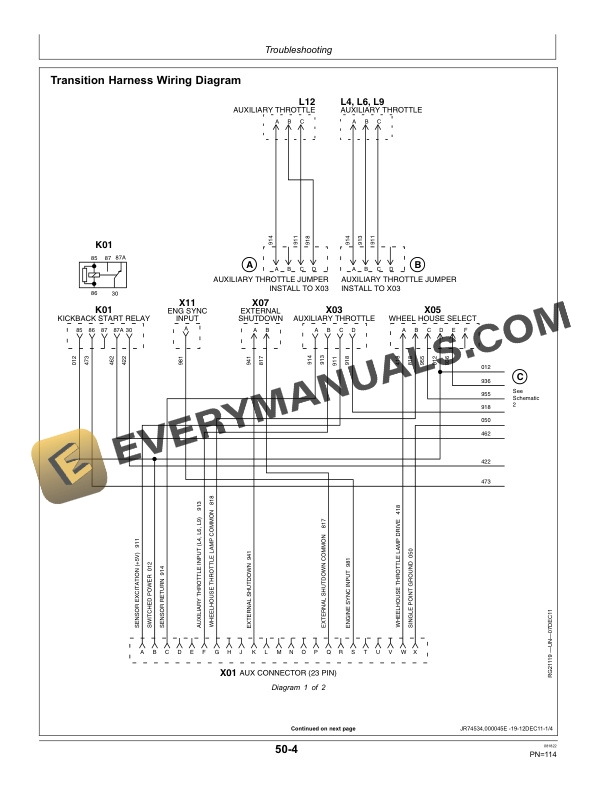
- 1.11.4. Transition Harness Wiring Diagram
- 1.11.5. ENGINE WIRING DIAGRAM FOR JOHN DEERE MAIN (WHEEL HOUSE) INSTRUMENT PANEL
- 1.11.6. ENGINE WIRING DIAGRAM FOR JOHN DEERE OPTIONAL FLYBRIDGE INSTRUMENT PANEL
- 1.11.7. ENGINE WIRING DIAGRAM FOR JOHN DEERE LEVEL III ELECTRONIC CONTROL UNIT (ECU)
- 1.11.8. ENGINE COOLANT AND SEA WATER FLOW (HEAT EXCHANGER ENGINES)
- 1.11.9. ENGINE TROUBLESHOOTING
- 1.11.10. ELECTRICAL TROUBLESHOOTING
- 1.11.11. DIAGNOSTIC FAULT CODE PROCEDURE
- 1.11.12. LISTING OF DIAGNOSTIC FAULT CODES (DFC)
- 1.11.13. INTERMITTENT FAULT DIAGNOSTICS
- 1.12. Storage
- 1.12.1. ENGINE STORAGE GUIDELINES
- 1.12.2. USE AR41785 ENGINE STORAGE KIT
- 1.12.3. PREPARING FOR LONG TERM STORAGE
- 1.12.4. REMOVING ENGINE FROM LONG TERM STORAGE
- 1.12.5. GENERAL ENGINE INFORMATION
- 1.13. Specifications
- 1.13.1. GENERAL ENGINE SPECIFICATIONS
- 1.13.2. POWER AND SPEED SPECIFICATIONS PROPULSION APPLICATIONS
- 1.13.3. POWER AND SPEED SPECIFICATIONS GENERATOR SET APPLICATIONS
- 1.13.4. ENGINE CRANKCASE OIL FILL QUANTITIES
- 1.13.5. Unified Inch Bolt and Screw Torque Values
- 1.13.6. Metric Bolt and Screw Torque Values
- 1.14. Lubrication and Maintenance Records
- 1.14.1. USING LUBRICATION AND MAINTENANCE RECORDS
- 1.14.2. DAILY (PRESTART) SERVICE
- 1.14.3. HOUR SERVICE
- 1.14.4. HOUR/12 MONTH SERVICE
- 1.14.5. HOUR/24 MONTH SERVICE
- 1.14.6. SERVICE AS REQUIRED
- 1.15. Emissions System Warranty
- 1.15.1. John Deere Warranty in OEM Applications
- 1.15.2. Emissions Control System Certification Label
- 1.15.3. Marine CompressionIgnition Engine Emission Control Warranty Statement
- 1.15.4. European Union (EU) Declaration of Emissions Conformity
- 1.16. John Deere Service Literature Available
- 1.16.1. OPERATION AND SERVICE MANUAL
- 1.16.2. PARTS CATALOG
- 1.16.3. TECHNICAL AND SERVICE MANUALS
- 1.16.4. FMO AND FOS MANUALS
- 1.16.5. PUBLICATIONS FOR THIS ENGINE
- 2. Page Number
- 2.1. Section 01
- 2.2. Section 05
- 2.3. Section 10
- 2.4. Section 15
- 2.5. Section 16
- 2.6. Section 20
- 2.7. Section 25
- 2.8. Section 30
- 2.9. Section 35
- 2.10. Section 40
- 2.11. Section 45
- 2.12. Section 50
- 2.13. Section 55
- 2.14. Section 60
- 2.15. Section 65
- 2.16. Section 75
- 2.17. Section 70