


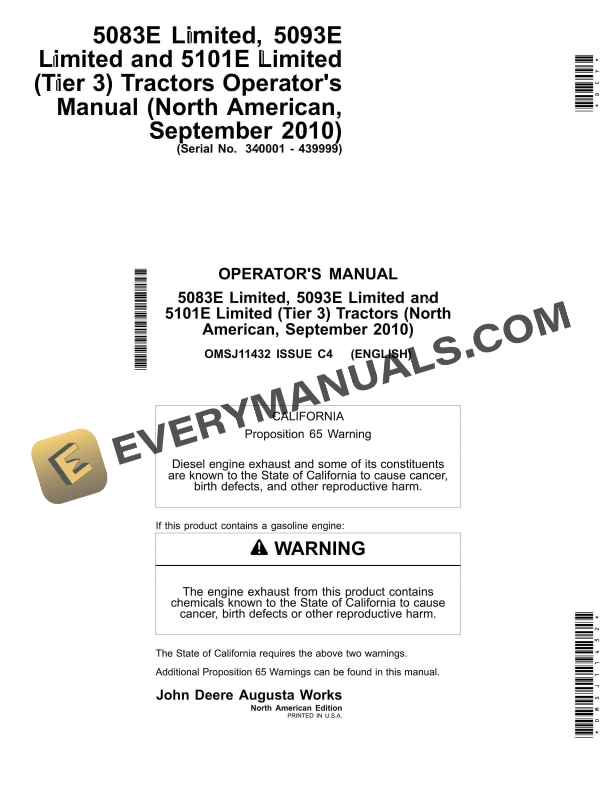


John Deere 5083E Limited, 5093E Limited, 5101E Limited (Tier 3) Tractor Operator Manual OMSJ11432
$30
- Type Of Manual: Operator Manual
- Manual ID: OMSJ11432
- Format: PDF
- Size: 3.7MB
- Number of Pages: 122
Description
-
Model List:
- 5083E Limited Tractor
- 5093E Limited Tractor
- 5101E Limited (Tier 3) Tractor
- 1. Contents
- 1.0.1. Recognize Safety Information
- 1.0.2. Understand Signal Words
- 1.0.3. Follow Safety Instructions
- 1.0.4. Prepare for Emergencies
- 1.0.5. Wear Protective Clothing
- 1.0.6. Protect Against Noise
- 1.0.7. Handle Fuel SafelyAvoid Fires
- 1.0.8. Handle Starting Fluid Safely
- 1.0.9. Fire Prevention
- 1.0.10. In Case of Fire
- 1.0.11. Avoid Static Electricity Risk When Refueling
- 1.0.12. Keep ROPS Installed Properly
- 1.0.13. Use Foldable ROPS and Seat Belt Properly
- 1.0.14. Stay Clear of Rotating Drivelines
- 1.0.15. Use Steps and Handholds Correctly
- 1.0.16. Read Operator Manuals for ISOBUS Implements
- 1.0.17. Use Seat Belt Properly
- 1.0.18. Operating the Tractor Safely
- 1.0.19. Avoid Backover Accidents
- 1.0.20. Limited Use in Forestry Operation
- 1.0.21. Operating the Loader Tractor Safely
- 1.0.22. Keep Riders Off Machine
- 1.0.23. Instructional Seat
- 1.0.24. Use Safety Lights and Devices
- 1.0.25. Use a Safety Chain
- 1.0.26. Transport Towed Equipment at Safe Speeds
- 1.0.27. Use Caution On Slopes and Uneven Terrain
- 1.0.28. Freeing a Mired Machine
- 1.0.29. Avoid Contact with Agricultural Chemicals
- 1.0.30. Handle Agricultural Chemicals Safely
- 1.0.31. Handling Batteries Safely
- 1.0.32. Avoid Heating Near Pressurized Fluid Lines
- 1.0.33. Remove Paint Before Welding or Heating
- 1.0.34. Handle Electronic Components and Brackets Safely
- 1.0.35. Practice Safe Maintenance
- 1.0.36. Avoid Hot Exhaust
- 1.0.37. Clean Exhaust Filter Safely
- 1.0.38. Work In Ventilated Area
- 1.0.39. Support Machine Properly
- 1.0.40. Prevent Machine Runaway
- 1.0.41. Park Machine Safely
- 1.0.42. Transport Tractor Safely
- 1.0.43. Service Cooling System Safely
- 1.0.44. Service Accumulator Systems Safely
- 1.0.45. Service Tires Safely
- 1.0.46. Service FrontWheel Drive Tractor Safely
- 1.0.47. Tightening Wheel Retaining Bolts/Nuts
- 1.0.48. Avoid HighPressure Fluids
- 1.0.49. Do Not Open HighPressure Fuel System
- 1.0.50. Store Attachments Safely
- 1.0.51. Dispose of Waste Properly
- 1.1. Safety Signs
- 1.1.1. Replace Safety Signs
- 1.1.2. Safety Signs
- 1.2. Controls and Instruments
- 1.2.1. Front Console Switches and Controls
- 1.2.2. Tractor ControlsRightHand Side Panel
- 1.2.3. Tractor ControlsLeftHand Panel
- 1.2.4. Ignition Switch
- 1.2.5. Gauges and Indicator Lights
- 1.2.6. Heater and Air Conditioning Controls
- 1.2.7. Operating Lights
- 1.2.8. Using SevenTerminal Outlet
- 1.2.9. Operating Rotating Beacon LightIf Equipped
- 1.3. Operator Station
- 1.3.1. Adjusting Seat
- 1.3.2. Adjusting Steering Wheel Tilt
- 1.3.3. Accessory Electrical Outlet
- 1.3.4. Opening Windows
- 1.3.5. Adjusting Blower Speed
- 1.3.6. Controlling Temperature
- 1.3.7. Deicing, Demisting or Defrosting Windshield
- 1.3.8. Optimizing A/C and Heater Performance
- 1.3.9. Operating Windshield Wiper and Washer
- 1.3.10. Operating Rear Window Wiper and WasherIf Equipped
- 1.3.11. Using Dome Light
- 1.3.12. Using Control Illumination Light
- 1.3.13. Installing a Monitor
- 1.3.14. Operating Radio
- 1.3.15. Setting Clock (If Equipped)
- 1.3.16. Operating Cassette Tape or Compact Disc PlayerIf Equipped
- 1.4. BreakIn Period
- 1.4.1. Observe Engine Operation Closely
- 1.5. Prestarting Checks
- 1.5.1. Service Daily Before StartUp
- 1.6. Operating Engine
- 1.6.1. Before Starting the Engine
- 1.6.2. Operating Ignition Switch
- 1.6.3. Starting the Engine
- 1.6.4. Cold Weather Starting
- 1.6.5. Using Engine Coolant Heater
- 1.6.6. Checking Engine Indicators and Gauges
- 1.6.7. Changing Engine Speeds
- 1.6.8. Recommended Engine Speeds and Operating Procedures
- 1.6.9. Stopping the Engine
- 1.6.10. Using a Booster Battery or Charger
- 1.7. Driving and Transporting Tractor
- 1.7.1. Ballasting Front End for Transport
- 1.7.2. Using Safety Chain
- 1.7.3. Driving on Public Roads
- 1.7.4. Operating PowrReverser Transmission
- 1.7.5. Ground Speed EstimatesPowrReverser Transmission
- 1.7.6. Correction Factors for Other Tire Sizes
- 1.7.7. Selecting a Gear
- 1.7.8. Operating Mechanical Front Wheel Drive
- 1.7.9. Creeper Gear OperationIf Equipped
- 1.7.10. Ground Speed EstimatesCreeper Transmission
- 1.7.11. Operating Brakes
- 1.7.12. Using Differential Lock
- 1.7.13. Stopping the Tractor
- 1.7.14. Deliver Safely
- 1.7.15. Transport Tractor Safely
- 1.7.16. Towing Tractor
- 1.8. Rockshaft Controls
- 1.8.1. Using Rockshaft Position Control
- 1.8.2. Using Rockshaft Draft Control
- 1.8.3. Adjusting Rockshaft RateofDrop
- 1.9. Point Hitch
- 1.9.1. Match Tractor Power to Implement
- 1.9.2. Point Hitch Components
- 1.9.3. Preparing Implement
- 1.9.4. Converting Category II Hitch to Category I
- 1.9.5. Positioning Center Link
- 1.9.6. Attaching Implements to 3Point Hitch
- 1.9.7. Adjusting Hitch Side Sway
- 1.9.8. Leveling the Hitch
- 1.9.9. Adjusting Lateral Float
- 1.10. Hydraulic System Controls and Operations
- 1.10.1. SCV Control Lever and Coupler Identification
- 1.10.2. MidMount Valve Coupler Identification
- 1.10.3. Use Correct Hose Tips
- 1.10.4. Connecting or Disconnecting HighPressure Hoses
- 1.10.5. Connecting Cylinder HosesRear SCV
- 1.10.6. Connecting Cylinder HosesMidMount Valve
- 1.10.7. Connecting and Operating SingleActing Cylinder
- 1.10.8. Operating SCV Control Lever
- 1.10.9. Using Power Beyond AttachmentIf Equipped
- 1.10.10. Operating Joystick Control LeverIf Equipped
- 1.10.11. Correcting Reversed Cylinder Response
- 1.10.12. Warming TransmissionHydraulic System Oil
- 1.11. Drawbar and PTO
- 1.11.1. Match Tractor Power to Implement
- 1.11.2. Observing Drawbar Load Limitations
- 1.11.3. Selecting Drawbar Position
- 1.11.4. Adjusting Drawbar Length and Offset
- 1.11.5. Attaching PTODriven Implement
- 1.11.6. Selecting Correct PTO Speeds
- 1.11.7. Operating Tractor PTO
- 1.12. Performance Ballasting
- 1.12.1. Planning for Maximum Productivity
- 1.12.2. Selecting Ballast Carefully
- 1.12.3. Using Cast Iron Weights
- 1.12.4. Installing Rear Cast Iron Weights
- 1.12.5. Using Implement Codes
- 1.13. Storage
- 1.13.1. Storing Tractor
- 1.13.2. Removing Tractor from Storage
- 1.14. Troubleshooting
- 1.14.1. Engine Troubleshooting
- 1.14.2. Transmission Troubleshooting
- 1.14.3. Hydraulic System Troubleshooting
- 1.14.4. Brakes Troubleshooting
- 1.14.5. Rockshaft and QuickCoupler/3Point Hitch Troubleshooting
- 1.14.6. Remote Hydraulic Cylinder Troubleshooting
- 1.14.7. Electrical System Troubleshooting
- 1.14.8. Heater and A/C System Troubleshooting
- 1.14.9. Wipers, Work Lights, Dome Light and Radio Troubleshooting
- 1.15. Specifications
- 1.15.1. Machine Specifications
- 1.15.2. Drain and Refill Capacities
- 1.15.3. Permissible Load Specifications
- 1.15.4. Metric Bolt and Screw Torque Values
- 1.15.5. Unified Inch Bolt and Screw Torque Values
- 1.15.6. Limited Battery Warranty
- 1.16. Identification Numbers
- 1.16.1. Identification Numbers
- 1.16.2. Record Tractor Identification Number
- 1.16.3. Record Front Axle Serial Number
- 1.16.4. Record Engine Serial Number
- 1.16.5. Record Transmission Serial Number
- 1.16.6. Record Cab Serial Number
- 1.16.7. Keep Proof of Ownership
- 1.16.8. Keep Machines Secure
- 1.17. Maintenance and Service Intervals
- 1.17.1. Service Interval Chart
- 1.17.2. Service Interval Chart
- 1.17.3. ServiceAs Required
- 1.18. John Deere Service
- 1.18.1. Technical Information
- 1.18.2. John Deere Is At Your Service
- 2. Page Number
- 2.1. Section 05
- 2.2. Section 10
- 2.3. Section 20
- 2.4. Section 25
- 2.5. Section 30
- 2.6. Section 40
- 2.7. Section 45
- 2.8. Section 50
- 2.9. Section 55
- 2.10. Section 60
- 2.11. Section 65
- 2.12. Section 70
- 2.13. Section 75
- 2.14. Section 80
- 2.15. Section 85
- 2.16. Section 90
- 2.17. Section 95
- 2.18. Section 100
- 2.19. Section 105
Related products
-50%

Original price was: $20.$10Current price is: $10.

-50%

Original price was: $20.$10Current price is: $10.

-50%

Original price was: $20.$10Current price is: $10.
-50%

Original price was: $20.$10Current price is: $10.

-50%

Original price was: $20.$10Current price is: $10.