

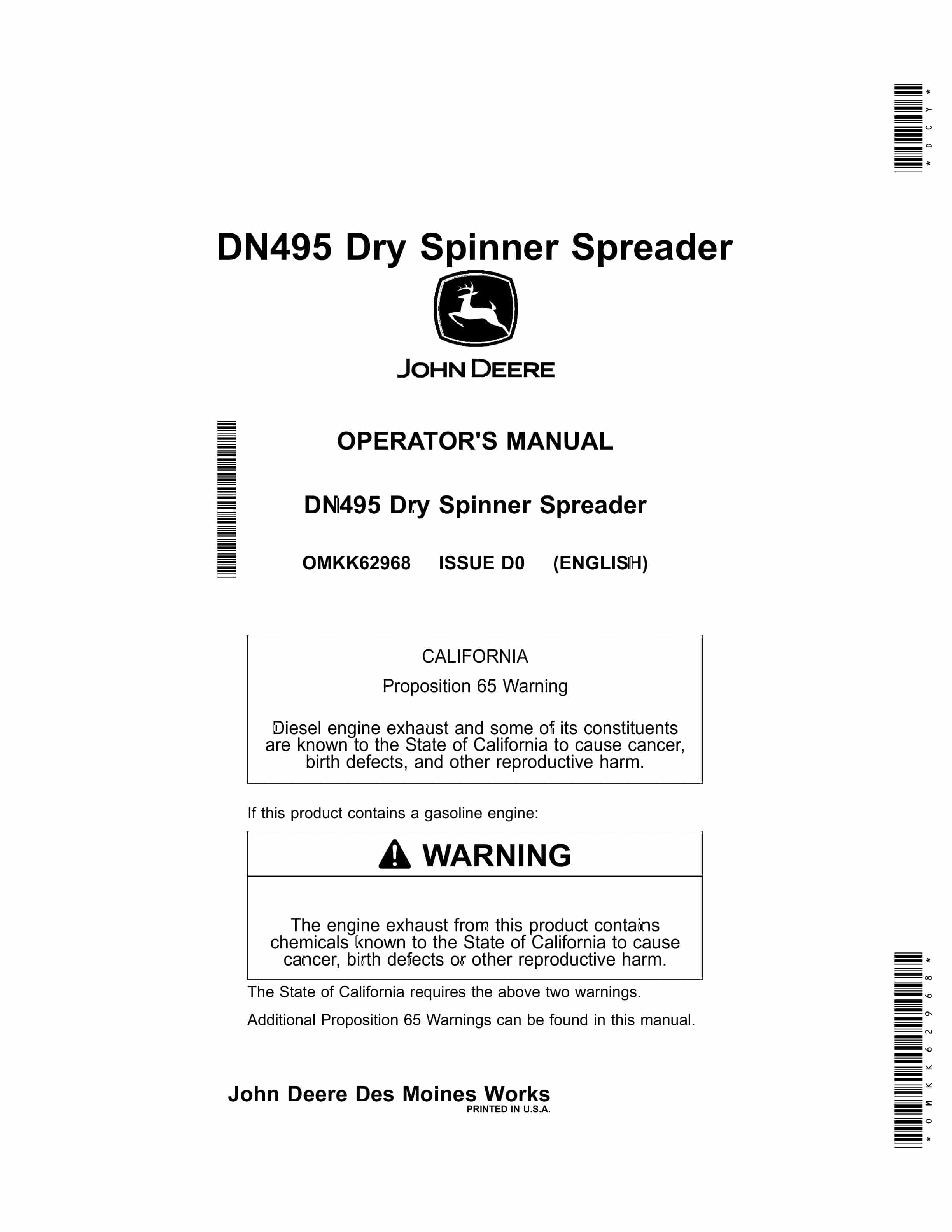


John Deere DN495 Dry Spinner Spreader Operator Manual OMKK62968
$30
- Type Of Manual: Operator Manual
- Manual ID: OMKK62968
- Format: PDF
- Size: 6.4MB
- Number of Pages: 136
Description
-
Model List:
- DN495 Dry Spinner Spreader
- 1. Introduction
- 1.1. Foreword
- 1.2. Predelivery
- 1.3. Delivery
- 1.4. AfterSale
- 1.5. Owner Register
- 1.6. Component Identification
- 1.7. Recognize Safety Information
- 1.8. Understand Signal Words
- 1.9. Follow Safety Instructions
- 1.10. Prepare for Emergencies
- 1.11. Wear Protective Clothing
- 1.12. Protect Against Noise
- 1.13. Practice Safe Maintenance
- 1.14. Park Machine Safely
- 1.15. Remove Paint Before Welding or Heating
- 1.16. Avoid Heating Near Pressurized Fluid Lines
- 1.17. Avoid HighPressure Fluids
- 1.18. Decommissioning Proper Recycling and Disposal of Fluids and Components
- 1.19. Handle Chemical Products Safely
- 1.20. Service Spreader Equipment Safely
- 1.21. Use Proper Tools
- 1.22. Work In Ventilated Area
- 1.23. Handling Batteries Safely
- 1.24. Service Drive Belts Safely
- 1.25. Using Compressed Air For Cleaning
- 1.26. Maintain a Safety Area Around the Machine
- 1.27. Working Area
- 1.28. Avoid Backover Accidents
- 1.29. Before Operating
- 1.30. Operate Safely
- 1.31. Avoid Injury from Thrown Objects
- 1.32. Use Safety Lights and Devices
- 1.33. Keep Riders Off Machine
- 1.34. Passenger Seat
- 1.35. Use Steps and Handholds Correctly
- 1.36. Use Seat Belt Properly
- 1.37. Use Caution On Hillsides
- 1.38. Transport and Operate Safely
- 1.39. Prevent Machine Runaway
- 1.40. Handle Fuel SafelyAvoid Fires
- 1.41. Handle Agricultural Chemicals Safely
- 1.42. Spreading Dusty Materials
- 1.43. Avoid Exposure To Chemicals
- 1.44. Clean Vehicle of Hazardous Chemicals, Including Pesticides
- 1.45. NonPermissible Use
- 1.46. Emergency Exit
- 2. Safety Signs Location
- 2.1. Replace Safety Signs
- 2.2. Conveyor Cover Decal
- 2.3. Spreader Front Decal
- 2.4. LeftHand Rear Side Decals
- 2.5. LeftHand Front Decal
- 2.6. LeftHand Rear Decals
- 2.7. Roll Tarp Decals (If Equipped)
- 2.8. LeftHand Front Corner Decals
- 2.9. RightHand Rear Decals
- 2.10. Fender Decal
- 2.11. RightHand Rear Corner DecalsSingle Bin
- 2.12. RightHand Rear Corner DecalsSecond Product Bin
- 2.13. RightHand Rear Side Decals
- 2.14. RightHand Front Corner Decals
- 2.15. Rear DecalsMultiBin
- 2.16. Top Side DecalMultiBin
- 3. Installation Instructions
- 3.1. Hose Installation Guide
- 3.2. Install Beacon Light KitIf Equipped
- 3.3. Install Inverted V
- 3.4. Install Second Product BinSpreaders with Belt Over Chain Conveyors
- 3.5. Install Second Product Bin Hillside Divider
- 3.6. Install Dual Conveyor Cover
- 3.7. Install Micronutrient Bin Hillside Divider
- 3.8. Install Micronutrient Bin Cover
- 3.9. Install StarFire Receiver Bracket (EU Exports Only)
- 3.10. Install Speed Limit Decal
- 3.11. Remove Second Product Bin and Install Endgate
- 4. Safety Features
- 4.1. Safety Features
- 5. Dry Application System Application
- 5.1. Access Dry Application System
- 5.2. Dry Application System Main Page
- 5.3. Edit Rate Presets
- 5.4. Bin Details
- 5.5. Bin Counter Reset
- 5.6. Prime Controls
- 5.7. Bin Chaining
- 5.8. Bin Covers
- 5.9. Bin Purge
- 5.10. Chain Oiler
- 5.11. Bin and Product Alarms
- 5.12. Target Rate Alarm
- 5.13. Product Density Alarm
- 5.14. Select Spinner Preset
- 5.15. Edit Spinner Preset
- 5.16. Information and Settings Dry Application System
- 6. Calibrations
- 6.1. Spinner Calibration
- 6.2. Spinner Calibration Procedure
- 6.2.1. Procedure Overview
- 6.3. Conveyor Feed Rate Calibration
- 6.3.1. Details Displayed on Page
- 6.4. Conveyor Feed Rate Calibration Procedure
- 6.5. Spreader Check
- 6.6. Spreader Check Procedure
- 6.6.1. Procedure Requirements
- 6.7. Icons Displayed during Spreader Check Procedure
- 6.8. Rate Control Selection
- 6.8.1. Rate Control Selection
- 7. PreStarting Checks
- 7.1. Informational Decals
- 7.2. Verify Spinner Orientation
- 7.3. Align Spinner Frame
- 7.4. Verify Material Divider Position
- 7.5. Install Material DeflectorOptional
- 7.6. Verify Spinner Fin Installation
- 7.7. Verify Spinner Speed Sensor Gap
- 7.8. Verify Hillside Divider Location
- 7.9. Verify Correct Chain TensionBelt Over Chain Conveyor Only
- 7.10. Verify Second Product Bin Hillside Divider Location
- 7.11. Spinner Initial Adjustment
- 8. Operate System
- 8.1. Initial StartUp
- 8.2. Field Test
- 8.3. Spreader System Check
- 8.4. Setup Display
- 8.5. General Operation Process
- 9. Size Grading and Hardness Test
- 9.1. Introduction
- 9.2. Crush Strength
- 9.3. Hardness Test
- 9.4. Size Grade Number
- 9.5. Size Grade Number Scale
- 10. Spread Pattern
- 10.1. Spread Pattern Adjustment
- 10.2. Spinners
- 10.3. Pulse Width Modulation (PWM) Valve Location
- 10.4. Spreader Preparation
- 10.5. Determine Material Bulk Density
- 10.6. Determine Material CFR
- 10.7. Calculate Feedgate Opening
- 10.8. Spread Pattern Test Procedure
- 10.9. Troubleshooting
- 11. Lubrication and Maintenance
- 11.1. Clean Vehicle of Hazardous Chemicals, Including Pesticides
- 11.2. Prevent Hydraulic System Contamination
- 11.3. Dispose of Waste Properly
- 11.4. Service Intervals
- 11.5. Conveyor CleanoutAs Required
- 11.6. Belt Over Chain Conveyor Maintenance and AdjustmentAs Required
- 11.7. Install Replacement Spreader FinsAs Required
- 11.8. Clean Bin SensorAs Required
- 11.9. Remove Meter RollersAs Required
- 11.10. Inspect TarpBiweekly (If Equipped)
- 11.11. Inspect Tarp Assembly HardwareBiweekly (If Equipped)
- 11.12. Check Tarp Assembly Cable TensionBiweekly (If Equipped)
- 11.13. Lubricate Belt Over Chain ConveyorDaily
- 11.14. Lubricate Idler Shaft Bearings and Adjustment ScrewsWeekly
- 11.15. Lubricate Drive Shaft BearingsWeekly
- 11.16. Lubricate Spinner JackWeekly
- 11.17. Lubricate Second Product Bin Drive and Idler Shaft BearingsWeekly
- 11.18. Lubricate Feedgate Jack Tube (If Equipped)Weekly
- 11.19. Check Gear Case OilMonthly
- 11.20. Lubricate Meter Roller Drive Chains
- 11.21. Change Hydraulic OilAnnually
- 11.22. Change Gear Case OilAnnually
- 11.23. Lubricate Feedgate Jack Gears (If Equipped)Annually
- 11.24. Lubricate Second Product Bin Idler Adjustment ScrewsAnnually
- 12. Lubricant Specifications
- 12.1. Transmission and Hydraulic Oil
- 12.2. Gear Case Oil
- 12.3. Multipurpose Extreme Pressure (EP) Grease
- 12.4. Chain Oiler Mixture
- 13. Troubleshooting
- 13.1. Troubleshooting
- 13.2. Schematics
- 14. Storage
- 14.1. Avoid Exposure To Chemicals
- 14.2. Clean Vehicle of Hazardous Chemicals, Including Pesticides
- 14.3. Prepare Machine for Storage
- 14.4. Remove Machine from Storage
- 15. Specifications
- 15.1. Specifications
- 15.2. Dimensions
- 15.3. Unified Inch Bolt and Screw Torque Values
- 15.4. Metric Bolt and Screw Torque Values
- 15.5. Face Seal Fittings Assembly and InstallationAll Pressure Applications
- 15.5.1. Face Seal ORing to Stud End Installation
- 15.5.2. Face Seal Adjustable Stud End ORing Installation
- 15.5.3. Face Seal Straight Stud End ORing Installation
- 15.5.4. Fitting Installation
- 15.5.5. Assembly Torque
- 15.6. Metric Face Seal and ORing Stud End Fitting Torque ChartStandard Pressures
- 15.7. Metric Face Seal and ORing Stud End Fitting Torque ChartHigh Pressure Applications
- 15.8. SAE Face Seal and ORing Stud End Fitting Torque ChartStandard Pressures
- 15.9. SAE Face Seal and ORing Stud End Fitting Torque ChartHigh Pressure Applications
- 15.10. Four Bolt Flange Fittings Assembly and InstallationAll Pressure Applications
- 15.11. SAE Four Bolt Flange Cap Screw Torque ValuesStandard Pressure Applications
- 15.12. SAE Four Bolt Flange Cap Screw Torque ValuesHigh Pressure Applications
- 15.13. External Hexagon Port Plug Torque Chart
- 15.14. Identification Numbers
- 15.15. Interpret the Serial Number of Your Machine 17 digits PIN
- 15.16. Year of Production Table (Digit 5)
- 15.17. Keep Proof of Ownership
- 15.18. Keep Machines Secure
- 16. John Deere Service Literature Available
- 16.1. Technical Information
- 17. John Deere Service Keeps You On The Job
- 17.1. John Deere Parts
- 17.2. The Right Tools
- 17.3. WellTrained Technicians
- 17.4. Prompt Service
Related products
-50%

Original price was: $20.$10Current price is: $10.


-50%

Original price was: $20.$10Current price is: $10.

-50%

Original price was: $20.$10Current price is: $10.
-50%

Original price was: $20.$10Current price is: $10.
-50%

Original price was: $20.$10Current price is: $10.