
Description
Contents:
ENMJAG-NA1-3
INTRODUCTION
CONTENTS
MACHINE NUMBERS
SAFETY
Recognize Safety Information
Understand Signal Words
Follow Safety Instructions
Prepare for Emergencies
Wear Protective Clothing
Protect Against Noise
Inspect Machine
General Precautions for Cab
Use Handholds and Steps
Adjust the Operator’s Seat
Ensure Safety Before Rising from orLeaving Operator’s Seat
Fasten Your Seat Belt
Move and Operate Machine Safely
Operate Only from Operator’s Seat
Jump Starting
Keep Riders off Machine
Precautions for Operations
Investigate Job Site Beforehand
Install OPG Guard
Restriction of Attachment Installation
Provide Signals for Jobs Involving Multiple Machines
Confirm Direction of Machine to Be Driven
Drive Machine Safely
Avoid Injury from Rollaway Accidents
Avoid Injury from Back-Over and Swing Accidents
Keep Person Clear from Working Area
Never Position Bucket Over Anyone
Avoid Undercutting
Avoid Tipping
Never Undercut a High Bank
Dig with Caution
Operate with Caution
Avoid Power Lines
Precautions for Lightning
Object Handling
Protect Against Flying Debris and Falling Object
Park Machine Safely
Handle Fluids Safely−Avoid Fires
Transport Safely
Practice Safe Maintenance
Warn Others of Service Work
Support Machine Properly
Stay Clear of Moving Parts
Prevent Parts from Flying
Avoid Injury from Attachment Falling Accident
Prevent Burns
Replace Rubber Hoses Periodically
Avoid High-Pressure Fluids
Prevent Fires
Evacuating in Case of Fire
Beware of Exhaust Fumes
Precautions for Welding and Grinding
Avoid Heating Near Pressurized Fluid Lines
Avoid Applying Heat to Lines ContainingFlammable Fluids
Precautions for HandlingAccumulator and Gas Damper
Remove Paint Before Welding or Heating
Beware of Asbestos and Silicon Dust and OtherContamination
Prevent Battery Explosions
Service Air Conditioning System Safely
Handle Chemical Products Safely
Dispose of Waste Properly
Never Ride Attachment
Notes on Aftertreatment Device
Precautions for Communication Terminal
Precautions for Communication Terminal Equipment
Notes on Protection of Operator’s Station when theMachine Rolls Over
SAFETY SIGNS
COMPONENTS NAME
GETTING ON/OFF THE MACHINE
OPERATOR’S STATION
About Afterteatment Device
Cab Features (Std. Model)
Cab Features (with Attachment)
Multi Function Monitor
Default Setting
Basic Screen
How to Use Screens
Displaying Basic Screen
Hour Meter
Clock
Fuel Gauge
DEF/AdBlue® Gauge
DEF/AdBlue® Level Alarm
Coolant Temperature Gauge
Operating Status Icon Display
Security Functions (Optional)
Input Password
Extending Password Duration Time
Alarm Occurrence Screen
Remedy
Urea SCR System Remedy
Aftertreatment Device
Aftertreatment Device Condition Display
Aftertreatment Device ManualRegeneration Request
Manual Regeneration Procedure
Main Menu
Engine Output Restriction Suspend
Urea SCR System Troubleshooting
Air Conditioner
Circulation Air Mode
Air Conditioner ON/OFF
Radio
Work Mode
Attachment selection
Mail (Optional)
Setting Menu
Date and Time
Time Adjustment
Date Adjustment
Display Mode Setting
Attachment Adjust
Flow Rate Adjustment
Attachment Name Input
Auto Shut-Down
Auto Shut-Down ON/OFF
Acting Time Setting
Aftertreatment Device Regeneration Inhibited
Setting Procedure
Auto-Lubrication
Lubrication Interval Setting
Password Change (Optional)
Sub Meter
Rear View Camera Monitor
Rear View Camera ON/OFF
Brightness Adjustment
Language Settings
Lists of Display Language
Unit Selection
Display Item Selection (Rear View Camera OFF)
Main Menu Sequence Change
Information Menu
Operation
Fuel Consumption
Breaker Operation
Attachment Operation
Travel Operation
Actual Operation
Maintenance
Maintenance Notice
Time Remains and Maintenance Interval
Troubleshooting
Monitoring
Switch Panel
Return to Previous Screen Switch (Monitor)
Return to Basic Screen Switch (Monitor)
Select/Confirm Switch (Monitor)
Temperature Control Switch/Mode Switch (AirConditioner)
AUTO/OFF Switch/Fan Switch (Air Conditioner)
AM/FM Selector/Tuning Switch (Radio)
Power Switch/Volume Control Knob (Radio)
Engine Control Dial
Auto-Idle Switch
Travel Mode Switch
Power Mode Switch
Work Light Switch
Wiper/Washer Switch
Numeric Keypad
Switch Panel (for Optional Equipment)
Travel Alarm Deactivation Switch (Optional) (1)
Seat Heater Switch (Optional) (2)
Rear Light Switch (Optional) (3)
Electrical Control Main Switch (Optional) (4)
Overload Alarm Switch (Optional) (5)
Boom Mode Switch (6)
Fan Reverse Switch (7)
Swing Alarm Deactivation Switch (Optional) (8)
Auto-Lubrication Switch (9)
Auto-Lubrication Selector Switch (Optional) (10)
Fan Reverse System
Key Switch
Power Boost Switch
Horn Switch
Electrical Control Main Switch (Optional)
AUX Function Lever 1
AUX Function Lever 2
Cigar Lighter
Using Cigar Lighter
Cab Light Switch
Installing Fire Extinguisher (Optional)
Pilot Control Shut-Off Lever
Engine Stop Switch
Fuse Box
Fuse Box 1
Fuse Box 2
Auto Air Conditioner
Features
Components Name
Controller Part Name and Function
Cab Heater Operation
Cooling Operation
Defroster Operation
Cool Head/Warm Feet Operation
Tips for Optimal Air Conditioner Usage
For Rapid Cooling
When Windows Become Clouded
Off-Season Air Conditioner Maintenance
AM/FM Radio Operation
Controls on the radio
Tuning Procedure
Station Presetting Procedure
Station Auto-Presetting Procedure
TONE Control
Audio Input (Optional)
Cab Door Release Lever
Opening/Closing and RemovingCab Inside Window
Opening/Closing Upper Front Window
Opening/Closing Upper Front Window
Removing and Storing Lower Front Window
Removing and Storing Lower Front Window
Opening Side Windows
Opening/Closing Overhead Window
Opening/Closing Overhead Window (Clear Hatch: If Equipped)
Emergency Exit
Adjusting Operator’s Seat
Seat Height and Angle Adjustment
Console and Seat Fore-aft Adjustment
Seat Fore-Aft Adjustment
Suspension Adjustment
Backrest Adjustment
Armrest Adjustment
Console Height Adjustment
Adjusting Procedures
Installation and Adjustment of Mirrors
Seat Belt
Seat Belt
Battery Disconnect Switch
Switch Operation
BREAK-IN
Observe Engine Operation Closely
Every 10 Hours or Daily
After the First 50 Hours
After the First 100 Hours
OPERATING THE ENGINE
Inspect Machine Daily Before Starting
Before Starting Engine
Starting the Engine
Check Instruments After Starting
Using Booster Batteries
Stopping the Engine
Engine Auto-Stop in Extremely Low Temperature
DRIVING THE MACHINE
Travel Levers and Pedals
Travel Mode Switch
Travel Alarm (Optional)
Operating on Soft Ground
Raise One Track Using Boom and Arm
Retrieval
Operating in Water or Mud
Parking the Machine on Slopes
Parking the Machine
Do Not Travel the Machine for Long Period of Time
OPERATING THE MACHINE
Control Lever (ISO Pattern)
Pilot Control Shut-Off Lever
Warming Up Operation
Engine Speed Control
Auto-Idle
Auto Shut-Down
Aftertreatment Device Manual Regeneration
Work Mode
Power Boost Switch
Power Mode
Operating Backhoe
Precaution for Arm Roll-In/Bucket Roll-In CombinedOperation
Grading Operation
Do Not Strike the Ground with Bucket Teeth
Avoid Hammer Work
Avoid Abusive Operation
Never Move an Object Sideways with the Bucket
Do Not Use Wide Track Shoes on Rough Ground
How to Lower Boom In Case of Emergency and WhenEngine Stops
Precautions for After Operations
TRANSPORTING
Transporting by Road
Loading/Unloading on a Trailer
Fastening Machine for Transporting
Unloading
Transportation Exhaust Pipe (ZX670LC-6, 870LC-6)
MAINTENANCE
Correct Maintenance and Inspection Procedures
Layout
Check the Hour Meter Regularly
Use Correct Fuels and Lubricants
Maintenance Guide Table
Preparations for Inspection and Maintenance
Hood and Access Covers
Maintenance Guide
Periodic Replacement of Parts
Kind of Oils
Recommended Engine Oil
Brand Names of Recommended Gear Oil
Brand Names of Recommended PumpTransmission Oil
Brand Names of Recommended Hydraulic Oil
A. Greasing
Front Joint Pins
Swing Bearing
Swing Internal Gear
B. Engine
Check Engine Oil Level
Change Engine Oil, Replace Engine Oil Filter
Check and Clean Around the Engine
C. Transmission
Pump Transmission (ZX670LC-6, 870LC-6)
Swing Reduction Gear
Travel Reduction Gear
D. Hydraulic System
Inspection and Maintenanceof Hydraulic Equipment
Check Hydraulic Oil Level
Water drain from hydraulic oil tank
Change Hydraulic Oil
Bleed Air from the Hydraulic System
Suction Filter Cleaning
Replace Full-Flow Filter
Replace Pump Drain Filter
Replace Pilot Oil Filter
Replace Air Breather Element
Check Hoses and Lines
E. Fuel System
Drain Fuel Tank Sump
Drain Fuel Filter
Bleed Air from the Fuel System
Replace Fuel Main Filter Element
Replace Fuel Pre-Filter Element
Clean Fuel Solenoid Pump Strainer
Check Water Separator (Optional)
Check Fuel Hoses
F. Air Cleaner
Clean Air Cleaner Element (Outer)
Replace Air Cleaner Element (Outer/Inner)
G. Cooling System
Check Coolant Level
Check and Adjust Drive Belt Tension
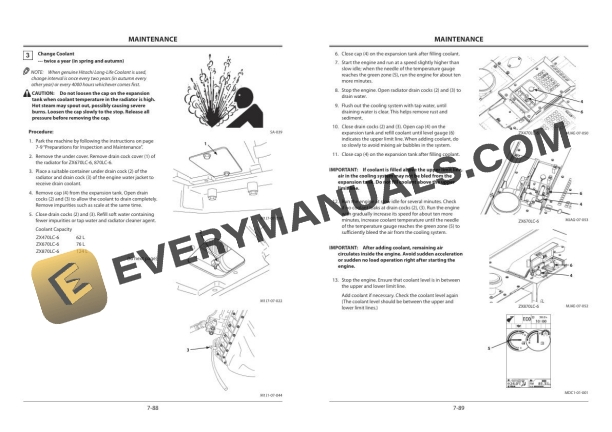
Change Coolant
Clean Radiator/Oil Cooler/Inter Cooler Core
Clean Oil Cooler, Radiator and InterCooler Front Screen
Clean Air Conditioner Condenser
Clean Fuel Oil Cooler
H. Air Conditioner
Clean and Replace Air Conditioner Filter
Check Air Conditioner
Adjust Compressor Belt Tension
Check Looseness at Each of Fastened Areas
Check at Preseason and Off-Season
I. Electrical System
Battery
Replace Battery
Replacing Fuses
J. Miscellaneous
Check and Replace Bucket Teeth
Change Bucket
Adjust Bucket Linkage
Remove Travel Levers
Check and Replace Seat Belt
Check Windshield Fluid Level
Check Track Sag
Clean Cab Floor
Retighten Cylinder Head Bolt
Inspect and Adjust Valve Clearance
Check of Fuel Injection Timing
Measure Engine Compression Pressure
Check Starter and Alternator
Check Water Pump
Check and Replace EGR Device
Check Gas Damper
Check Handrails (ZX470LC-6)
Tightening and RetighteningTorque of Nuts and Bolts
Check O-rings in Bucket
Clean EGR Cooler
Check Turbocharger
Check and Clean Injection Nozzle
K. Aftertreatment Device
Check and Clean Aftertreatment Device
L. Urea SCR System
Check DEF/AdBlue®
Refill DEF/AdBlue®
Extendable Filler Neck
Clean Filler Port Strainer
Change DEF/AdBlue®
Replace DEF/AdBlue® Supply Module Main Filter
Replace DEF/AdBlue® TankWater Supply Inlet Filter
MAINTENANCE UNDER SPECIAL ENVIRONMENTALCONDITIONS
STORAGE
Storing the Machine
Removing the Machine from Storage
TROUBLESHOOTING
SPECIFICATIONS
Specifications ZX470LC-6
Working Ranges ZX470LC-6
Shoe Types and Applications
Bucket Types and Applications
Specifications ZX670LC-6
Working Ranges ZX670LC-6
Shoe Types and Applications
Bucket Types and Applications
Specifications ZX870LC-6
Working Ranges ZX870LC-6
Shoe Types and Applications
Bucket Types and Applications
OPTIONAL ATTACHMENTS AND DEVICES
Counterweight Removal/Install Device
Counterweight Removal/Install Switch
Counterweight Removal/Install Operation Lever
Needle Valve
Counterweight Removal/Install Device Alarm
Counterweight Removal
Counterweight Installation
Greasing Method
Grease Container Replacement
Auto-Lubrication
Manual Lubrication
Fuel Feed Device (with Filter) (Optional
Control Lever (HITACHI Pattern) (Optional)
Attachment Pedal (Hydraulic Breaker) (Optional)
Hydraulic Breaker and Hydraulic Crusher
Hydraulic Breaker and Hydraulic Crusher
Precautions for Breaker Operation
Precautions for Crusher Operation
Attachment
Allowable Weight Limits of Installed Attachment
Attachment
Precaution for Arm Roll-In/Bucket Roll-In CombinedOperation
INDEX