


Case Farmall 100C, 110C, 120C Efficient Power Tractor Operator Manual 51532899 PDF
$20
- Type Of Manual: Operator Manual
- Manual ID: 51532899
- Format: PDF
- Size: 29.3MB
- Number of Pages: 370
Description
-
Model List:
- Farmall 100C Efficient Power Tractor
- Farmall 110C Efficient Power Tractor
- Farmall 120C Efficient Power Tractor
- 1. _Front Flysheet_A4
- 2.1. GENERAL INFORMATION
- 2.1.1. Note to the Owner
- 2.1.2. Intended use
- 2.1.3. ElectroMagnetic Compatibility (EMC)
- 2.1.4. Manual scope and required training level
- 2.1.5. Metric and imperial units abbreviations
- 2.1.6. Identification plates
- 2.1.7. Approval data plate
- 2.1.8. Operators manual storage
- 2.1.9. Machine orientation
- 2.1.10. Health and safety related standards applied to your tractor
- 2.1.11. Selective catalytic reduction (SCR) system
- 2.2. SAFETY INFORMATION
- 2.2.1. Safety rules and signal word definitions
- 2.2.2. Safety rules General information
- 2.2.3. Safety rules Maintenance
- 2.2.4. Safety rules Wheels and tires
- 2.2.5. Safety rules Explosions and fires
- 2.2.6. Safety rules Fire extinguisher
- 2.2.7. Safety rules Battery
- 2.2.8. Safety rules Instructor seat
- 2.2.9. Safety rules Passenger seat
- 2.2.10. Safety rules Operator presence system
- 2.2.11. Safety rules Power TakeOff (PTO)
- 2.2.12. Safety rules Reflectors and warning lights
- 2.2.13. Safety rules Seat belts
- 2.2.14. Safety rules Operator protective structure
- 2.2.15. Safety rules HVAC system
- 2.2.16. Safety rules Personal Protective Equipment (PPE)
- 2.2.17. Safety rules Do not use sign
- 2.2.18. Safety rules Hazardous chemicals
- 2.2.19. Safety rules Near utilities
- 2.2.20. Safety rules In the event of electrical storms
- 2.2.21. Safety rules Mounting and dismounting the machine
- 2.2.22. Safety rules Lifting and overhead loads
- 2.2.23. Safety rules Front end loader
- 2.2.24. Ecology and the environment
- 2.2.25. Airborne noise emission
- 2.2.26. Vibration levels
- 2.2.27. Machine stability
- 2.2.28. Towing the tractor for recovery
- 2.2.29. Tractor jacking points
- 2.2.30. Burn prevention
- 2.2.31. Emergency escape from cab
- 2.2.32. Wheel chocks
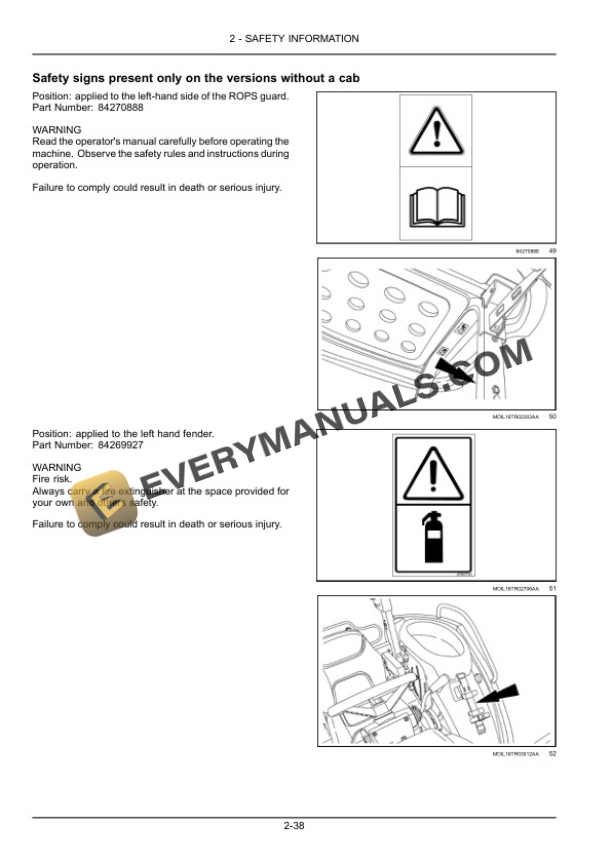
- 2.2.33. Safety signs
- 2.3. CONTROLS AND INSTRUMENTS
- 2.3.1. Access to operators platform
- 2.3.2. Operators seat
- 2.3.3. Instructional seat
- 2.3.4. Forward controls
- 2.3.5. Lefthand side controls
- 2.3.6. Righthand side controls
- 2.3.7. Display
- 2.3.8. Warning and advisory symbols
- 2.4. OPERATING INSTRUCTIONS
- 2.4.1. Commissioning the unit
- 2.4.2. Starting the unit
- 2.4.3. Stopping the unit
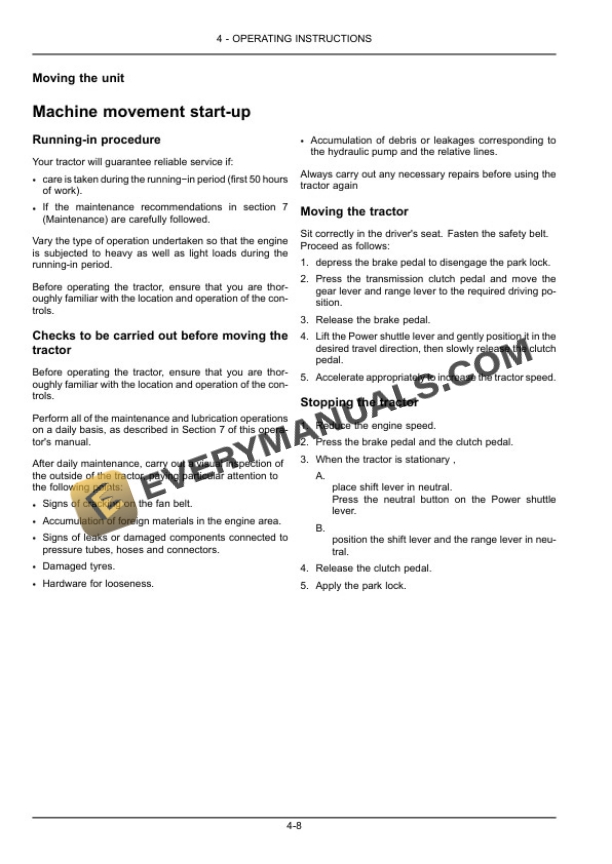
- 2.4.4. Moving the unit
- 2.5. TRANSPORT OPERATIONS
- 2.5.1. Road transport
- 2.5.2. Recovery transport
- 2.6. WORKING OPERATIONS
- 2.6.1. General information
- 2.6.2. Drive
- 2.6.3. Rear remote control valves
- 2.6.4. Rear Power TakeOff (PTO)
- 2.6.5. Rear hydraulic lift
- 2.6.6. Rear threepoint hitch
- 2.6.7. Towbar
- 2.6.8. Towing hook
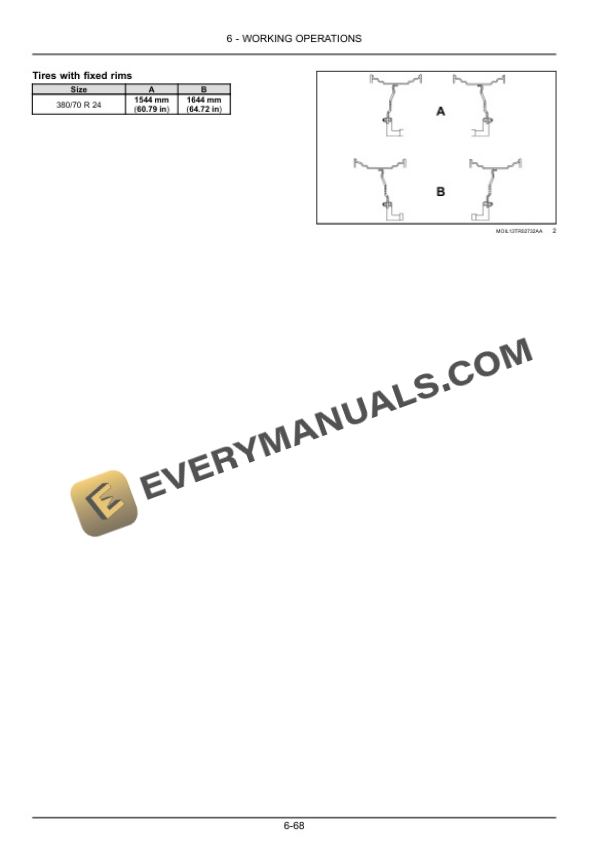
- 2.6.9. Tires and wheels
- 2.6.10. Tread and fender settings
- 2.6.11. General information
- 2.6.12. Maintenance planning
- 2.6.13. As required
- 2.6.14. At warning message display
- 2.6.15. Every 10 hours or daily
- 2.6.16. After the first 50 hours of operation
- 2.6.17. Every 50 hours
- 2.6.18. Every 100 hours
- 2.6.19. Every 300 hours
- 2.6.20. Every 600 hours
- 2.6.21. Every 1200 hours or annually
- 2.6.22. Every 1200 hours or two years
- 2.6.23. Every two years
- 2.6.24. Every 3600 hours or four years
- 2.6.25. Electrical system
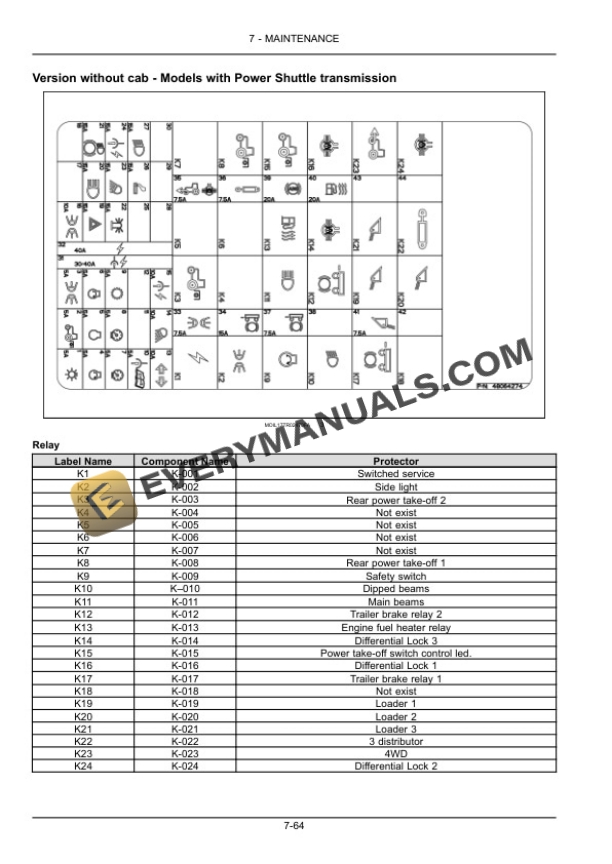
- 2.6.26. Fuse and relay locations
- 2.6.27. Storage
- 2.6.28. CALIBRATION
- 2.7. TROUBLESHOOTING
- 2.7.1. Fault code resolution
- 2.7.2. Symptom(s)
- 2.8. SPECIFICATIONS
- 2.8.1. General dimensions
- 2.8.2. Maximum permitted loads on front and rear axle
- 2.8.3. Maximum permitted loads on towing hitch
- 2.8.4. Speed table for 20 x 20 gearbox
- 2.8.5. Speed table for 24 x 24 gearbox
- 2.8.6. Speed table for 24 x 24 gearbox
- 2.8.7. Speed table for 40 x 40 gearbox
- 2.8.8. Speed table for 40 x 40 gearbox
- 2.8.9. Additional equipment attachment points
- 2.8.10. Consumables
- 2.8.11. Capacities
- 2.8.12. General specification
- 2.9. ACCESSORIES
- 2.9.1. Radio
- 2.9.2. Single piece ballast
- 2.9.3. Coolant immersion heater (where fitted)
- 2.9.4. Frontend loader fixation points
- 3. _Rear Flysheet_A4