


John Deere 3203 Compact Utility Tractors Operator Manual OMLVU17604
$30
- Type Of Manual: Operator Manual
- Manual ID: OMLVU17604
- Format: PDF
- Size: 3.6MB
- Number of Pages: 80
Description
-
Model List:
- 3203 Compact Utility Tractor
- 1. Introduction
- 1.1. Thank You for Purchasing a John Deere Product
- 1.2. Using Your Operators Manual
- 1.3. Special Messages
- 1.4. Attachments for Your Machine
- 2. Product Identification
- 2.1. Record Identification Numbers
- 3. Table of Contents
- 4. Safety Labels
- 4.1. Understanding The Machine Safety Labels
- 4.2. DANGER POISON
- 4.3. CAUTION HOT SURFACE
- 4.4. CAUTION READ OPERATORS MANUAL
- 4.5. WARNING
- 4.6. WARNING ROPS
- 4.7. WARNING
- 4.8. CAUTION IMatch
- 4.9. Emission Control System Certification Label
- 4.10. Operator Training Required
- 4.11. Operating Safely
- 4.12. Using a Spark Arrestor
- 4.13. Parking Safely
- 4.14. Avoid Tipping
- 4.15. Use Seat Belt Properly
- 4.16. Keep ROPS Installed Properly
- 4.17. Keep Riders Off
- 4.18. Towing Loads Safely
- 4.19. Stay Clear of Rotating Drivelines
- 4.20. Checking Wheel Hardware
- 4.21. Wear Appropriate Clothing
- 4.22. Driving Safely on Public Roads
- 4.23. Practice Safe Maintenance
- 4.24. Avoid High Pressure Fluids
- 4.25. Prevent Fires
- 4.26. Tire Safety
- 4.27. Handling Fuel Safely
- 4.28. Handling Waste Product and Chemicals
- 5. Operating Controls
- 5.1. Operator Station Controls
- 5.2. Floor Panel Controls
- 6. Operating
- 6.1. Daily Operating Checklist
- 6.2. Avoid Damage to Plastic and Painted Surfaces
- 6.3. Entering and Exiting Machine
- 6.4. Adjusting Seat Position
- 6.5. Using Seat Belt
- 6.6. Using Light Switch
- 6.7. Using Key Switch
- 6.8. Using the Instrument Panel
- 6.9. Using Turn Signal Switch
- 6.10. Testing Safety Systems
- 6.11. Testing Rear PTO Knob
- 6.12. Testing Rear PTO/Seat Switch Interface
- 6.13. Using Fuel ShutOff Valve
- 6.14. Using Brake Pedal
- 6.15. Using Park Brake
- 6.16. Using Throttle Controls
- 6.17. Starting the Engine
- 6.18. Idling the Engine
- 6.19. Starting a Stalled Engine
- 6.20. Stopping the Machine
- 6.21. Operating Transmission
- 6.22. Driving Machine
- 6.23. Using Differential Lock
- 6.24. Using Mechanical Front Wheel Drive (MFWD)
- 6.25. Using the PowerTakeOff (PTO) Safely
- 6.26. Using Rear PTO
- 6.27. Using Drawbar Hitch
- 6.28. Using 3 Point Hitch
- 6.29. Using Optional iMatch QuickAttach Hitch System
- 6.30. Connecting Implement Hydraulic Hoses
- 6.31. Using Dual Selective Control Valve Lever
- 6.32. Using Dual Selective Control Valve (SCV) Lock Lever
- 6.33. Ballasting Machine
- 6.34. Transporting Machine on Trailer
- 6.35. Transporting Machine
- 6.36. Towing Loads
- 6.37. Using Safety Chain
- 7. Replacement Parts
- 7.1. Service Literature
- 7.2. Part Numbers
- 8. Service Intervals
- 8.1. Servicing Your Machine
- 8.2. As Needed
- 8.3. After First 10 Hours
- 8.4. Every 10 Hours or Daily
- 8.5. Every 50 Hours
- 8.6. Every 200 Hours
- 8.7. Every 400 Hours
- 8.8. Every 600 Hours
- 8.9. Every 1200 Hours
- 8.10. Every Two Years or 2000 Hours
- 9. Service Lubrication
- 9.1. Lubricating Machine Grease Fittings
- 9.2. Lubricating 3 Point Hitch
- 10. Service Engine
- 10.1. Engine Warranty Maintenance Statement
- 10.2. Avoid Fumes
- 10.3. Engine Oil
- 10.4. Checking Engine Oil Level
- 10.5. Changing Engine Oil and Filter
- 10.6. Cleaning Rubber Dust Unloading Valve
- 10.7. Servicing Air Filter Element
- 10.8. Checking Air Filter Hose
- 10.9. Service Cooling System Safely
- 10.10. Checking Coolant Level
- 10.11. Recommended Engine Coolant
- 10.12. Servicing Cooling System
- 10.13. Checking Radiator Hoses
- 10.14. Servicing the Alternator Belt
- 10.15. Servicing Water Separator Sediment Bowl
- 10.16. Cleaning Fuel Filter Sediment Bowl and Replacing Filter
- 10.17. Replacing Fuel Filter
- 10.18. Fuel Injection Pump
- 10.19. Fuel Injection Nozzles
- 10.20. Cleaning Grille and Side Screens
- 10.21. Cleaning Radiator Screen and Fins
- 11. Service Transmission
- 11.1. Transmission and Hydraulic Oil
- 11.2. Checking Front Axle Oil Level
- 11.3. Changing Front Axle Oil
- 11.4. Adjusting Front Axle Thrust Bolt Torque
- 11.5. Checking Transmission Oil Level
- 11.6. Changing Transmission Oil and Hydraulic Suction Oil Filter
- 12. Service Steering Brakes
- 12.1. Adjusting Brake Pedal
- 12.2. Adjusting Parking Brake
- 13. Service Electrical
- 13.1. Service the Battery Safely
- 13.2. Checking Battery Electrolyte Level
- 13.3. Removing and Installing Battery
- 13.4. Cleaning Battery and Terminals
- 13.5. Using Booster Battery
- 13.6. Replacing Headlight Bulb
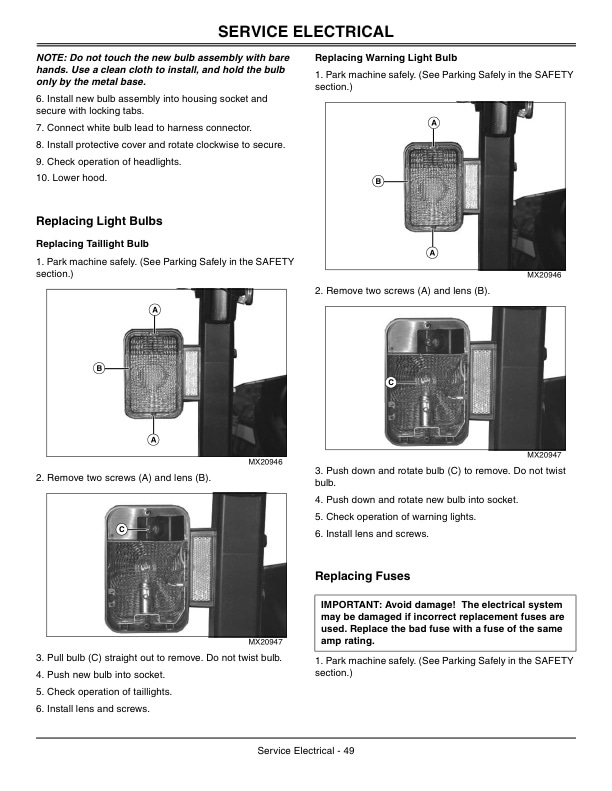
- 13.7. Replacing Light Bulbs
- 13.8. Replacing Fuses
- 14. Service Miscellaneous
- 14.1. Using Proper Fuel (Diesel)
- 14.2. Filling Fuel Tank
- 14.3. Raising and Lowering Hood
- 14.4. Checking Wheel Bolts and Hardware
- 14.5. Removing and Installing Wheels
- 14.6. Checking Tire Pressure
- 14.7. Selecting Front Tire Rolling Direction
- 14.8. Changing Wheel Spacing and Tread Width
- 14.9. Checking and Adjusting ToeIn
- 14.10. Cleaning Plastic Surfaces
- 14.11. Cleaning and Repairing Metal Surfaces
- 15. Troubleshooting
- 15.1. Using Troubleshooting Chart
- 15.2. Electrical System
- 15.3. Machine
- 15.4. Steering
- 16. Storage
- 16.1. Storing Safety
- 16.2. Preparing Machine for Storage
- 16.3. Preparing Fuel and Engine For Storage
- 16.4. Removing Machine From Storage
- 17. Specifications
- 17.1. Electrical System
- 17.2. Fuel System
- 17.3. Drive Train
- 17.4. Hydraulic System
- 17.5. Point Hitch
- 17.6. Fluid Capacities
- 17.7. Ground Speeds
- 17.8. Tire Inflation Pressures
- 17.9. Tire Loads
- 17.10. Dimensions
- 17.11. Recommended Lubricants
- 17.12. Torque Values
- 18. Warranty
- 18.1. Product Warranty
- 18.2. John Deere, Federal And California Emission Control System Warranty (NonRoad Diesel)
- 18.3. Tire Warranty
- 18.4. Limited Battery Warranty
- 19. John Deere Quality Statement
- 19.1. John Deere Quality
- 20. Service Record
- 20.1. Record Service Dates
Related products
-50%

Original price was: $20.$10Current price is: $10.
-50%

Original price was: $20.$10Current price is: $10.
-50%

Original price was: $20.$10Current price is: $10.

-50%

Original price was: $20.$10Current price is: $10.