Description
-
Model List:
- PVG 32 Proportional Valve Group
- 1. MR 52780246 EN 202207
- 1.1. Page de garde / Front page
- 2. AX152886482982en000209
- 2.1. Contents
- 2.2. General information
- 2.2.1. PVG general description
- 2.2.2. Features of PVG 16 and PVG 32
- 2.2.3. PVG modules
- 2.2.3.1. PVP, pump side modules overview
- 2.2.3.2. PVB, basic modules
- 2.2.3.3. Actuation modules
- 2.2.4. PVG 16, PVG 32 and Open Circuit Load Sense Example
- 2.2.5. Load sensing controls
- 2.2.5.1. LS control with bleed orifice (do not use with PVG valves)
- 2.2.5.2. Integral PC function
- 2.2.5.3. Load sensing system characteristics
- 2.2.6. PVBS, main spools with pressure compensated control
- 2.2.6.1. Pressure compensated system characteristics
- 2.2.6.2. Typical applications for pressure compensated systems
- 2.2.7. Remote pressure compensated controls
- 2.2.7.1. Remote pressure compensated system characteristics
- 2.2.7.2. Typical applications for remote pressure compensated systems
- 2.2.8. Open center PVP
- 2.2.9. Closed center PVP
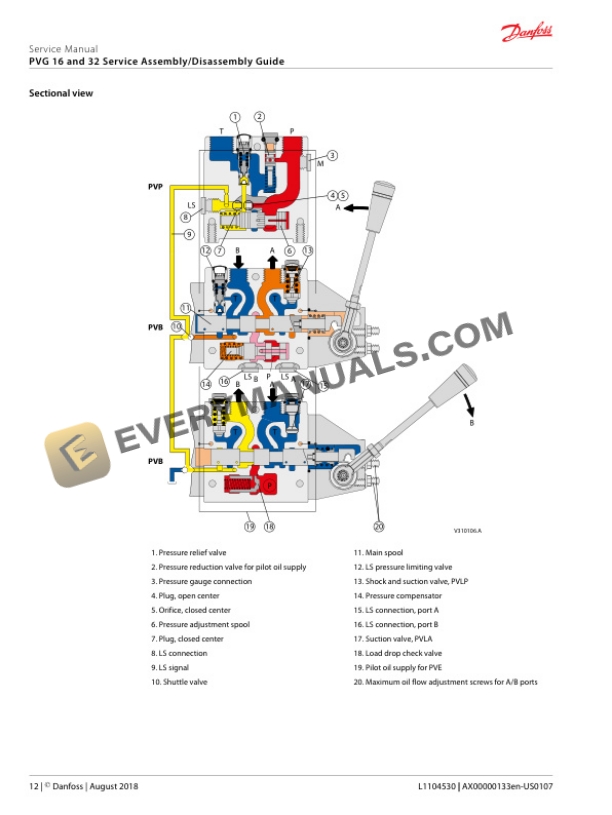
- 2.3. Sectional view
- 2.4. Safety in Application
- 2.4.1. Example of a control system for manlift
- 2.4.1.1. Examples of wiring block diagram
- 2.5. Assembly instructions
- 2.5.1. PVG 16 and 32 general conditions
- 2.5.2. Assembly
- 2.6. Testing
- 2.6.1. PVG 16 and 32 leak test
- 2.6.2. Pressure setting after assembly
- 2.6.3. PVG 16 and 32 function testing
- 2.6.3.1. Recommended equipment and hand tools to assemble PVG 16 and PVG 32
- 2.7. Test report
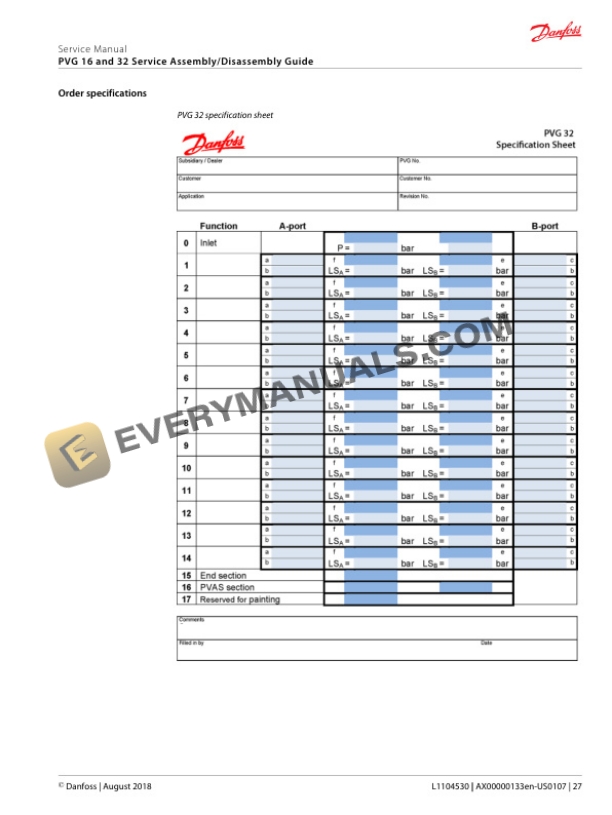
- 2.8. Order specifications
- 3. AX152886481209en000402
- 3.1. Contents
- 3.2. Introduction
- 3.2.1. Overview
- 3.2.2. General instructions
- 3.2.2.1. Remove the unit
- 3.2.2.2. Keep it clean
- 3.2.2.3. Replace all Orings and gaskets
- 3.2.2.4. Secure the unit
- 3.2.3. Safety precautions
- 3.2.3.1. Unintended machine movement
- 3.2.3.2. Flammable cleaning solvents
- 3.2.3.3. Fluid under pressure
- 3.2.3.4. Personal safety
- 3.2.3.5. Hazardous material
- 3.2.4. Acronyms
- 3.3. Operation
- 3.3.1. PVG 32 group with open center PVP (PVB with flow control spool)
- 3.3.2. PVG 32 group with closed center PVP (PVB with flow control spool)
- 3.3.3. PVG 32 sectional drawing
- 3.3.4. PVPC plug for external pilot oil supply
- 3.3.5. Friction detent
- 3.3.6. PVBS, main spools for flow control (standard)
- 3.3.7. PVBS, main spools for flow control (with linear characteristics)
- 3.3.8. PVBS, main spools for pressure control
- 3.3.9. PVPX Electrical LS unloading valve
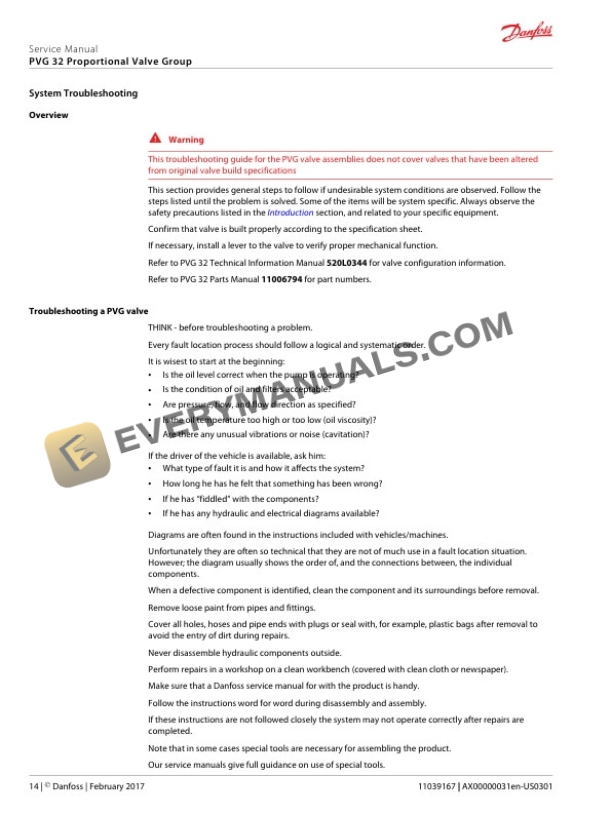
- 3.4. System Troubleshooting
- 3.4.1. Overview
- 3.4.2. Troubleshooting a PVG valve
- 3.4.3. No cylinder/motor response in either direction when remote controller is actuated
- 3.4.4. Cylinder/motor responds in one direction only
- 3.4.5. Main valve spool moves without oil passing to cylinder/motor
- 3.4.6. Cylinder/motor operates without remote controller being operated
- 3.4.7. Cylinder/motor responds slowly to remote electrical or hydraulic controller actuation
- 3.4.8. Erratic cylinder/motor response to electrical or hydraulic controller operation
- 3.4.9. Hydraulic oil supply
- 3.4.10. Electrical supply
- 3.4.11. Hydraulic (remote) pilot control pressure
- 3.5. PVG 32 Component Troubleshooting
- 3.5.1. Pressure relief valve
- 3.5.2. Pressure reducing pilot valve
- 3.5.3. Pressure gauge connection
- 3.5.4. Open center plug
- 3.5.5. Closed center plug and orifice
- 3.5.6. Pressure adjustment spool
- 3.5.7. LS connection
- 3.5.8. LS signal
- 3.5.9. Shuttle valve
- 3.5.10. LS pressure limiting valve
- 3.5.11. LS A, B shuttle
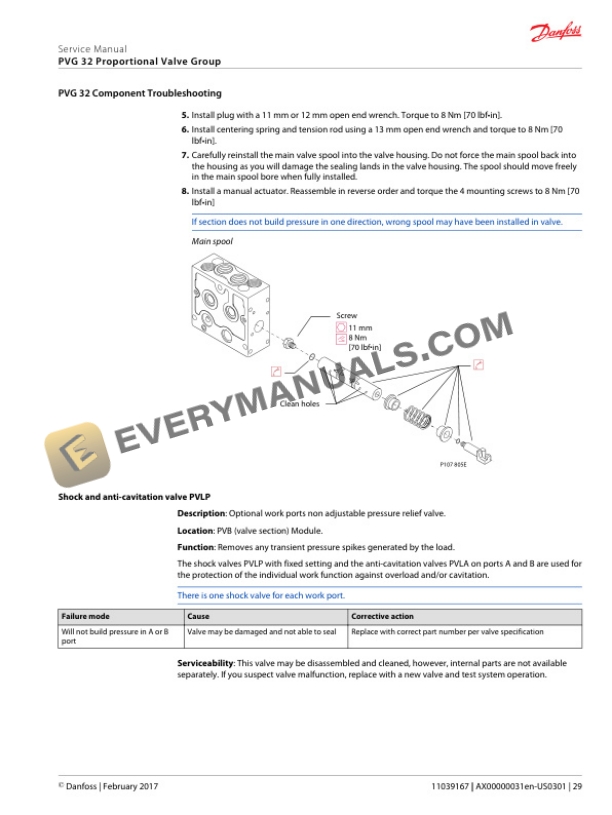
- 3.5.12. Main spool
- 3.5.13. Shock and anticavitation valve PVLP
- 3.5.14. Pressure compensator
- 3.5.15. Load drop check valve
- 3.5.16. Maximum oil flow adjustment screws for ports A and B
- 3.5.17. PVM module
- 3.5.18. PVS module
- 3.5.19. PVPVM module
- 3.5.20. PVAS module
- 3.5.21. PVPX LS unloading valve
- 3.5.22. PVEM, PVEA, PVEH, PVES electrical actuators
- 3.5.23. Troubleshooting Considerations
- 3.5.24. PVEO ON/OFF electrical actuator
- 3.5.25. PVPC plug for external pilot control
- 3.5.26. PVMR Friction Module